Here’s a shameless plug for a presentation I’m doing in Tarrytown at the Shames JCC on Monday, January 22, 2024 @ 10am.

From the Shames JCC website:
Alfred Agate was the illustrator for one of the most ambitious and largest scientific exploratory expeditions that you‘ve never heard of the US South Seas Exploring Expedition from 1838 – 1842 – an epic voyage that sailed to South America, the South Pacific, Australia, New Zealand, Antarctica, the West Coast of North America, the Philippines, and Indonesia. He was born in Sparta, now part of Ossining, and was a very successful portrait and miniature painter before he went to sea. In this image-packed talk, Ossining Town Historian Caroline Curvan presents a fascinating piece of little-known local history.
The Shames JCC is located at 371 S. Broadway, Tarrytown, NY 10591.
Folks, it’s my first video presentation — this one is on Frederick, Alfred and Harriet Agate — artistic siblings who lived in Sparta (now part of Ossining) and were at the forefront of the development of an American style of art and approach to science. Check it out! They are fascinating people.
So, if you know me at all or have attended any of my recent presentations, you’ll know I’ve become obsessed with the Agate family of artists who lived in the hamlet of Sparta in the 1800s. (Today Sparta is part of Ossining, NY.)


Today, I had the privilege of cleaning Harriet Agate Carmichael’s gravestone with the Ossining Historic Cemeteries Conservancy. It was the last cleaning event of the year and an absolutely gorgeous day for it.

Now, who are the Agate family of artists and why should you care?
Well, first, I think it’s all sorts of important to know about people who lived in your very town and contributed to the world in a meaningful and positive way (even if they lived decades, even centuries before you).
So, follow me down a rabbit hole that will take you to the farthest corners of the earth and to the beginnings of an American school of art.
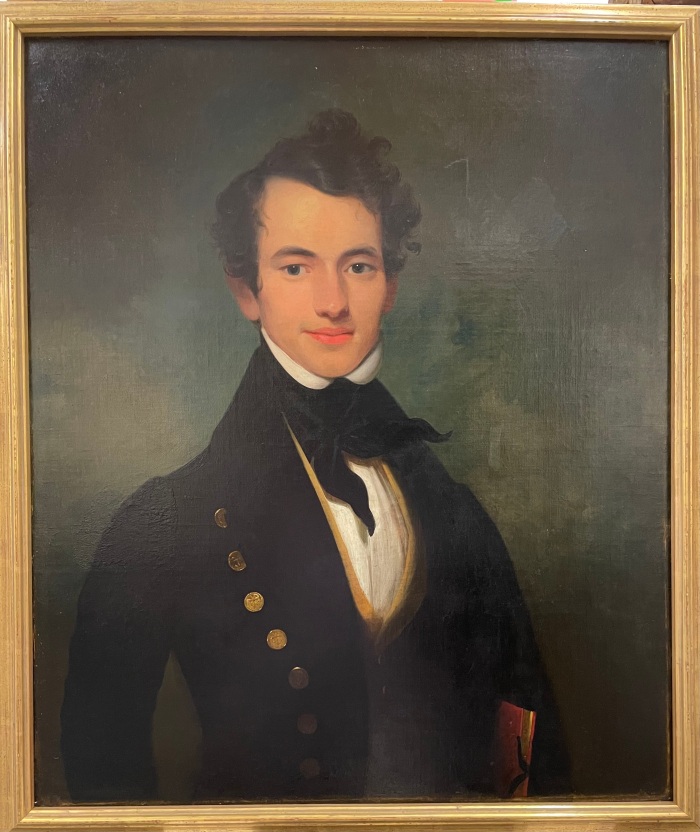
Frederick (1803 – 1844) was a talented oil painter who helped found and run one of America’s first art schools, the National Academy of Design (NAD). He also likely taught his younger siblings Alfred and Harriet to paint. He would die young from tuberculosis and be buried in Sparta cemetery next to his sister Harriet (though his gravestone is currently missing.)

And here’s one of Frederick’s more famous paintings — a portrait of actor Edwin Forrest in the role of Chief Metamora from the John Augustus Stone play “The Last of the Wampanoags”:

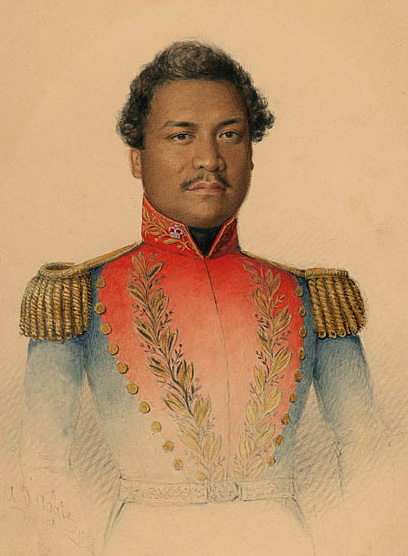
Alfred (1812 – 1846) would go on to study at NAD and exhibit paintings at their annual art show. He became a successful miniaturist and portrait painter before taking on what is arguably his most important role, that of illustrator on the US Exploring Expedition of 1838 – 1842 – one of the most ambitious and largest scientific expeditions of exploration that you‘ve never heard of.

And our Harriet (1817 – 1871) would also study at the National Academy of Design. In 1833, she would be one of the first women to show a painting at the Academy’s annual Art Exhibition. That painting was called “View of Sleepy Hollow,” and Historic Hudson Valley just happens to have a painting of the same name from about the same time, although they note that the painter is unknown.

Could this possibly be by Harriet? Watch this space – I’m going to research this as far as I can!
We have only two other paintings by Harriet – likely from about the same time and likely from her days as a student.


In about 1839 Harriet would marry Thomas J. Carmichael, a contractor for the Ossining portion of the Croton Aqueduct.

They settled in Ossining, in the Agate family house at 2 Liberty Street:

Harriet would have several children then move to Wisconsin with her husband in 1846 to live on a farm. Sadly, Thomas would die there soon after they moved, in 1848, and after settling his estate, Harriet would move back to Sparta where she probably lived with her mother Hannah at 2 Liberty and then with her daughter Melodia Frederica Carmichael Foster in Brooklyn.
Harriet would die in 1871 in Brooklyn (at her daughter’s house) and, as we know, is buried in Sparta cemetery.
Her paintings and many of her brothers’ would be carefully kept in various family attics until 1959 when Harriet’s great grand-daughter, Melodia Carmichael Wood Ferguson, would discover them and donate them to the Ossining Historical Society. Some were in turn donated to the New York Historical Society and the Newark Art Museum. If you reach out to both places very nicely, they might permit you to view the paintings (which are not on display but are safely stored away. I did and they did!)
Here’s what her headstone looked like after the cleaning:

Grateful to the efforts of the Ossining Historic Cemeteries Conservancy for the opportunity to spend some time with Mrs. Harriet Ann Agate Carmichael today.
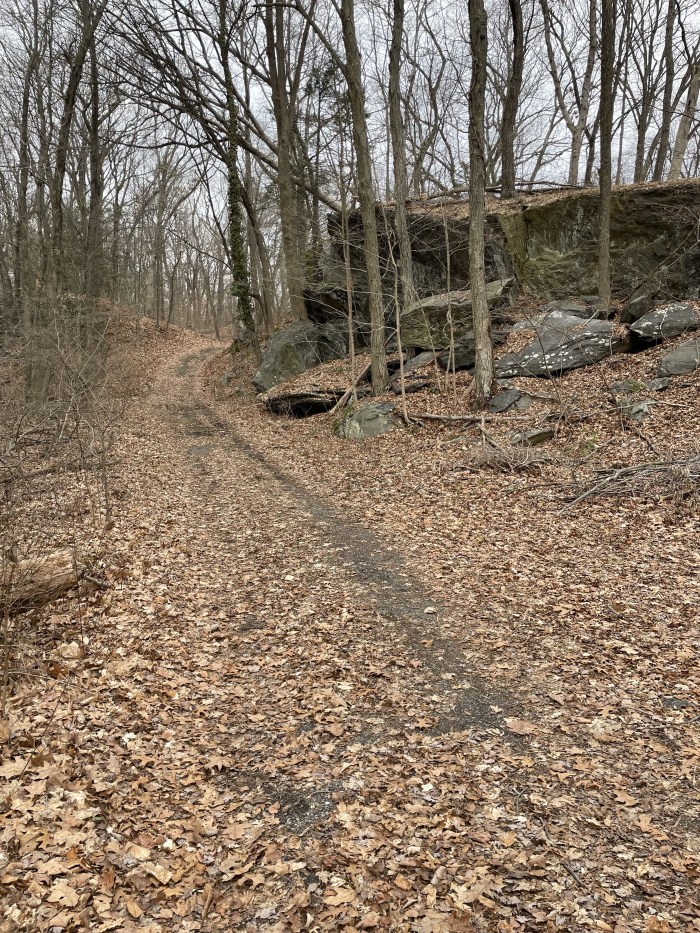
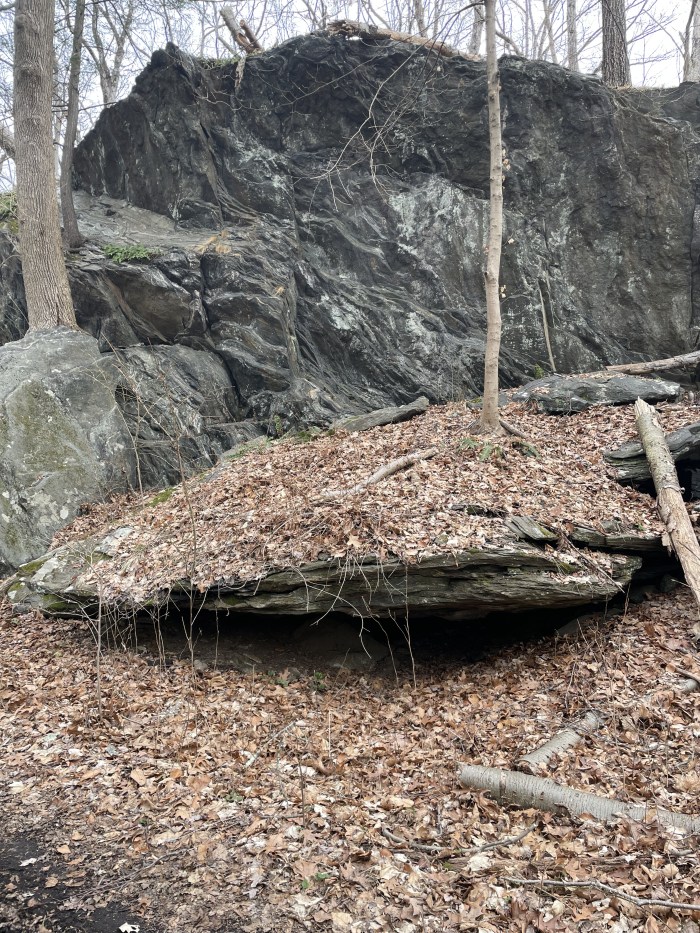
Did you know there’s an indigenous rock shelter accessible to the public just off Route 100??

I stumbled upon it a few months ago while doing some other research (frankly, this seems to be how I discover everything cool!)

This one is from the Late Archaic period (that’s about 3,000 years ago) and has been the subject of at least three archeological excavations.
So, let’s investigate it, shall we?
The first excavation took place in 1929 and was conducted by Leslie Verne Case, at the time the Chairman on the Committee of Indian Remains in Westchester County. (What a title!)
He wrote an article on this dig in the October 1929 Quarterly Bulletin of the Westchester County Historical Society and describes the shelter and its location as follows:
This Algonkian [sic] rock shelter is located two miles from the Hudson River about due east from the village of Ossining. It is one-half mile south of Echo Lake and is near the intersection of the townships of Ossining, Mt. Pleasant and New Castle, but just within the Ossining township. It is about midway between the Saw Mill River Road and the Bronx Parkway Extension now under construction. It is located at about 300 feet elevation above sea level.
The shelter is formed by a great monolith torn by glacial action from the cliff of Fordham gneiss above it. This Archaean ridge extends in nearly a due north and south direction and falls sharply to the east to the Pocantico River a hundred feet below.
Clear as mud right? You can find it from these directions no problem.
Anyway, Mr. Case was clued on to this site by a Mr. Henry M. Schnarr, who reported that he found fragments of pottery and bone chips more or less on the surface. Case went and found that “A brief inspection clearly proved that the work had not been systematically done and a few hours’ work brought to light” many other artifacts, such as projectile points, scrapers, pottery and a paint pot coated on the inside with a red powder.
Case also noted that this shelter was one of three in the area, the other two famously having been used in the late 19th century by the legendary Leatherman (Google him if you don’t know the story). Alas, in the intervening century, the other two shelters have been demolished by “the march of time, real estate developments and private enterprises” as Case put it, but one can imagine that they likely held similar artifacts within.
A few years later, some Scout leaders from Troop 44 did some unofficial digging around and found more artifacts, as reported here in the February 23, 1933 edition of the Citizen Register:

Fast forward to 1982, when an archeologist named Stuart Fiedel spent two seasons excavating the site with his SUNY Purchase students.1 Digging down deeper, and using more modern techniques than Case or the Scout leaders had, Fiedel and his group found an assortment of artifacts from a variety of eras, the oldest being Archaic, but also included were more recent pieces from the Transitional and Woodland periods. Based on the variety of tools he discovered, Fiedel drew the conclusion that the site had been used for many thousands of years. The remnants of fire pits and pottery shards were also found, along with bone fragments from deer, turkey, turtle, snake, fish, as well as shells from hickory nuts.
But the most exciting find was a collection of 17 points stashed in a crack in the back wall of the cave. Some were fully formed, while others were unfinished, but they represented an assortment of styles and uses. Fiedel became convinced that they were the work of a Late Archaic toolmaker who had secreted his cache for some future use. I could go on and describe the differences seen between the Lackawaxen and Taconic points, the parallel blade edges and hafting notches found thereon, but I shall restrain myself. However, I’m sure you’ll agree that the image of this Late Archaic craftsman, sitting in this very cave, patiently working his bits of chert and quartz and slate into elegant tools is pretty heady stuff.
One thing Fiedel notes in his article is that 95% of all artifacts are perishable, being made of bone, antler, wood and natural fibers. So, to be able to find anything after all these thousands of years is quite the accomplishment. It also illustrates how extensive indigenous settlements were in this area, long before Henry Hudson et al showed up. It’s a concept that I have to really work to get my mind around, to unlearn the belief that European explorers “discovered” America. Because while they may not have known of it, the people who had been living here for thousands of years obviously did.
And just because I made the effort, here’s what the view from inside the rock shelter looks like. Thousands of years have caused this cave to fill up with dirt and leaves, but imagine what it could have looked like before all that silt flowed in. As it was, I could almost sit up inside to take this picture:

1 “A Late Archaic Cache from the Ossining Rockshelter” by Stuart J. Fiedel. The Bulletin and Journal of Archeology for New York State, Number 88, Spring 1984
Yesterday I spent an absolutely delightful morning surrounded by Ossining history . . . in Dale Cemetery cleaning headstones.
If you’re reading this blog, I’m assuming you have some interest in the past. Along with that often comes a fascination with cemeteries. (Well, it does for me!)
My family will tell you that I’ve forced them to wander through cemeteries all over the Western world. (Don’t get me started on the summer we drove through the Somme in France.)
But you can learn so much about a culture and about its history from reading gravestones.
One of the things that always shocks me is the number of children and babies one finds in old cemeteries. You’ll see the headstones of the parents and surrounding them, the tiny headstones of 2, 3, 4, 5 children who didn’t make it past infancy. So so many babies. And then there are the 5, 6, 7-year- olds as well. It’s gutting, really, when you think about it.
And I had a lot of time to think about it today as I was working on this gravestone:

But wait, first I should tell you a little about why I was in Dale Cemetery in the first place.
There’s a marvelous local organization called the Ossining Historic Cemeteries Conservancy whose mission is to help preserve Dale and Sparta cemeteries. Active for about a decade, it’s spearheaded by a group of dedicated and capable folks who have done their research, learned the best practices for cleaning old headstones, are super organized, and very, very friendly.
Once a month, from about May through October, they choose a section of either Dale or Sparta cemetery, set up all their equipment and welcome volunteers to help scrub the lichen and dirt off old headstones. They keep excellent records and take the time to look up the people under the stones, sharing their stories on Facebook and in a monthly newsletter.
Today, they were set up in Section 3 of Dale Cemetery and I had the privilege of cleaning the headstone above. The OHCC has it down to a science and they provide all the tools you need, plus instruction.
First, you gently scrape off whatever you can from the dry headstone using a plastic scraper. Then you use a manual pump sprayer filled with water to wet everything down and scrape off more. After that, in comes the plastic dish brush to scrub some more, all the while rinsing with the sprayer.

There are toothbrushes and wooden sticks to get right into the crevices.

Finally a gentle cleaner is sprayed on and after a few minutes, scrubbed off. A few more rinses and voila!
It’s wonderfully meditative and zen – you can indulge your inner obsessive compulsive and just gently scrub and pick and scrape. It’s also oddly restorative, concentrating on just one thing, cleaning away decades, sometimes centuries, of soot and grime and lichen. And there is such a sense of accomplishment at the end, because no matter what, the stone you’re working on looks better than it did when you started.
Plus, you’re engaging with the place in a deeply historic way. Dale Cemetery was founded at a time when cemeteries were more than just places to bury the dead. They were often elegantly landscaped, with an eye towards creating serene and bucolic views. Families would picnic among the graves of their loved ones in the almost parklike atmosphere. According the OHCC website, in the October 8, 1851 speech given at its dedication, Dale Cemetery was described as”one of the most beautiful and appropriate rural cemeteries of the State.”
And so it is. The day I was there, the weather was perfect, the trees were lush and shady, and the company was affable and pleasant. As you work, and the details of the stone become clear, you can’t help wondering about the person beneath.
In my case, I was cleaning the headstone of a three-year -old.

Three. Years. Old.
Oh, Barbara Ann, what happened to you? And where are your parents? Barbara Ann’s stone is solitary, with no obvious relatives of any sort nearby. There are a couple of other tombs within a few feet, but datewise, they don’t seem connected. I’m hoping that a review of the Dale Cemetery files will help clear up this mystery, but in the meantime I’m left with the thought of poor little Barbara Ann, who died at the beginning of the Depression, sleeping anonymous and alone for eternity.
Of course, I can’t help making up a story. What did she die of? Alas, there are so many things to choose from in those days before vaccines and antibiotics: measles, mumps, rubella, rheumatic fever, scarlet fever, chicken pox, polio, whooping cough, diphtheria, pneumonia, tetanus. While we don’t think of these illnesses as death sentences today, they took many children back then and if they didn’t kill them, often left them with lifelong disabilities. Mumps could cause sterility, polio could paralyze, rheumatic fever could leave cardiac issues. The list goes on . . .
Little Barbara Ann suffered the worst fate of all, and has lain alone and obscured for years. Thanks to the OHCC, today her stone is clean and her story will soon be told. (And I’ll be sure to update this post when that happens.)
Next OHCC event is on Saturday, September 9, 2023 at Sparta Cemetery.

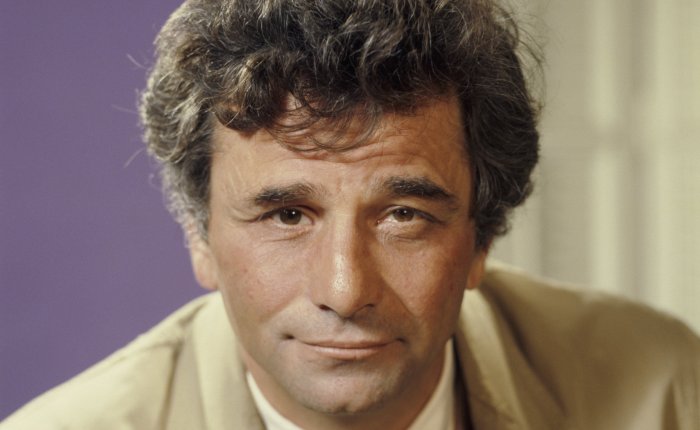
I’m not really quite sure why it’s taken me so long to blog about Peter Falk – I guess it’s mostly because he’s well-known and doesn’t need me to tell his story. But, since he is a true son of Ossining (Ossining High School graduate 1945!) I would be remiss if I didn’t. (Plus, I did a lot of this research for my recent presentation at Sing Sing Kill Brewery, so figured I might as well turn it into a blog post.)
Peter “Pete” Falk was born in the Bronx in 1927 but raised in Ossining on Prospect Avenue. (In 2005, Ossining would officially rename the corner of Eastern and Prospect Avenues “Peter Falk Place.”)

His parents owned a popular local clothing shop, Falk’s, that was located at 159 Main Street. Back in the days before malls and such, this was one of those essential local stores that sold pajamas, kids’ clothes swimsuits, and ladies’ undergarments. (Not the lacy lingerie kind that Victoria’s Secret sells, mind you, but the hardcore 1940s/50s rubbery kind that look just one step more comfortable than a Victorian whalebone corset.)

Falk’s Department Store at 159 Main Street, Ossining.
Photo courtesy of the Ossining Historical Society
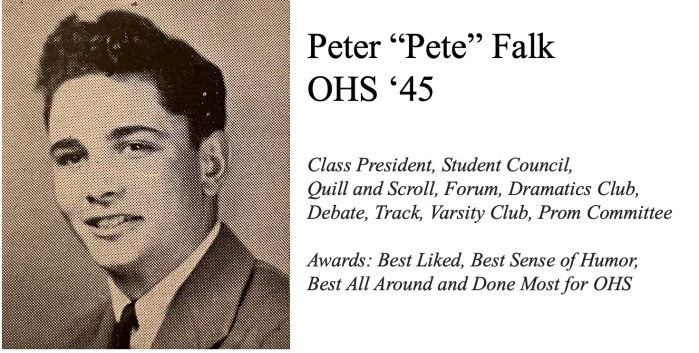
After perusing the 1945 Ossining High School yearbook (“The Wizard”) I get the strong impression that “Pete” Falk was one of those great guys that just everyone loved.

He was Class President for three years of high school (VP the other year) and, as you can see, served on an array of clubs and teams.
Now, if you’ve ever watched “Columbo” (or any of his other films), you might have noticed that he had an unusual squint – you can certainly see that his eyes don’t quite match in this photo. That’s because he had this eye removed at the age of three because of a retinoblastoma – a type of cancerous eye tumor. Ever after he wore a glass eye and would tell various stories regarding said eye.
One took place when he was playing Little League in Ossining. According to his 2006 autobiography, Just One More Thing: Stories from My Life, this happened:
“At Ossining High School, the baseball field was right in back of the school and the grandstand was very close to the playing field, particularly on the 3rd base side. This is significant because on this particular day it was a play at third base where the umpire called me out. It was a bad call. I was clearly safe. I knew it and everyone in the stands knew it. They sat so close to the field that they could see and hear everything. In front of everyone, I whipped out my eye and handed it to the umpire: ‘You’ll do better with this one.’ Talk about getting a laugh.” [2]
Because of his glass eye, he was not eligible for the draft, so he went straight on to Hamilton College but dropped out after three months to join the Merchant Marine. But also because of his glass eye, the only opportunities for him there were in the kitchen. So he sailed off as a third cook. After a year at sea, there were a few more attempts at college until Falk finally graduated from the New School of Social Research with a B.A. in Political Science and Literature. It was here, also, that he got his first taste of professional theater. After a few more false starts that included a master’s degree in Public Administration from Syracuse University (’53) and a job as an efficiency expert, in 1955 he finally followed the siren call of the theater.
When he told his dad, the response was “You’re gonna paint your face and make an ass of yourself for the rest of your life?”
Well, yes Dad, yes I will, said Peter Falk.
After that, things happened pretty fast. Falk began acting in summer stock in Connecticut, directed by theater legend Eva Le Gallienne. The next year, 1956, he made his Broadway debut in G.B. Shaw’s “St. Joan” as an English Soldier. From there, he landed in an off-Broadway production of Eugene O’Neill’s “The Iceman Cometh” directed by Jose Quintero and starring Jason Robards.
Pretty heady stuff for a kid who’d only just decided to make acting his career!
It was around this time that he went to Hollywood for a screen test. And here we get another (possibly apocryphal?) story about his glass eye when the young Peter Falk is introduced to Harry Cohn, the head of Columbia Pictures, as the next John Garfield. (I know, I’m not entirely sure who that is either!)
Cohn mumbled something about Falk’s “deficiency” and when he didn’t seem to be understood, Cohn just took a deep breath and shook his head. “For the same price” he said, “I’ll get an actor with two eyes.” [3]
Ouch!
Disappointed, Falk took himself back to the east coast, where he landed an agent and some bit parts in TV and off-Broadway. Finally, his big break came in 1960 with a movie called “Murder, Inc.” He even scored his first Academy Award nomination (for his supporting role as Abe Reles.)
Another Academy Award nomination came his way two years later, for “Pocketful of Miracles,” a Frank Capra-directed movie with a cast that included Bette Davis, Glenn Ford, Hope Lange and Ann-Margret.
But it was “Columbo” that catapulted him to legendary status. Starting in 1968, with the first pilot, the series ran consecutively from 1971 – 1978. After that, from 1990 – 2003 about ten Columbo specials were made. Falk as Lt. Columbo would get nominated for an Emmy Award almost every year, and he took it home at least four times. (He had already won an Emmy in 1962 for “Dick Powell Theatre.”)

(Fun fact – The Ossining Historical Society has an autographed trench coat on display that was personally given to them by Peter Falk.)
Falk was diagnosed with Alzheimer’s disease in 2008 and played his final film role a year later.
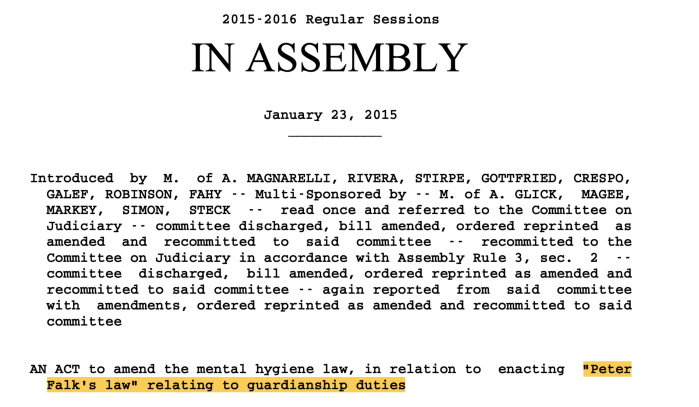
His last years were, it seems, tinged with sadness as his second wife, Shera, reportedly refused to allow his two children (from a previous marriage) to visit him as his dementia progressed. She supposedly didn’t even let them know when he passed away. The situation so troubled Falk’s daughter Catherine that after his death in 2011, she would go on to help pass legislation that would prevent family members from being cut off by the guardians of incapacitated family members. Ossining’s very own Assemblywoman Sandy Galef would introduce “Peter Falk’s Law” in 2015 and see it pass the NYS Senate in 2016.

But I like to think of him as that charming student from Ossining High School who spearheaded all sorts of fun for his class and went on to play one of the most iconic roles on television.

[1] “The Wizard” the Ossining High School Yearbook, 1945
[2] “Peter Falk: Just one more thing – Stories from my Life” by Peter Falk, 2006
[3] Falk, p. 51
During Covid, my friend Dorian and I met almost every Saturday to go to the Farmer’s Market, get a coffee at First Village, and walk along the Sing Sing Kill Greenway. It was a welcome respite from being stuck in our homes teaching via Zoom.
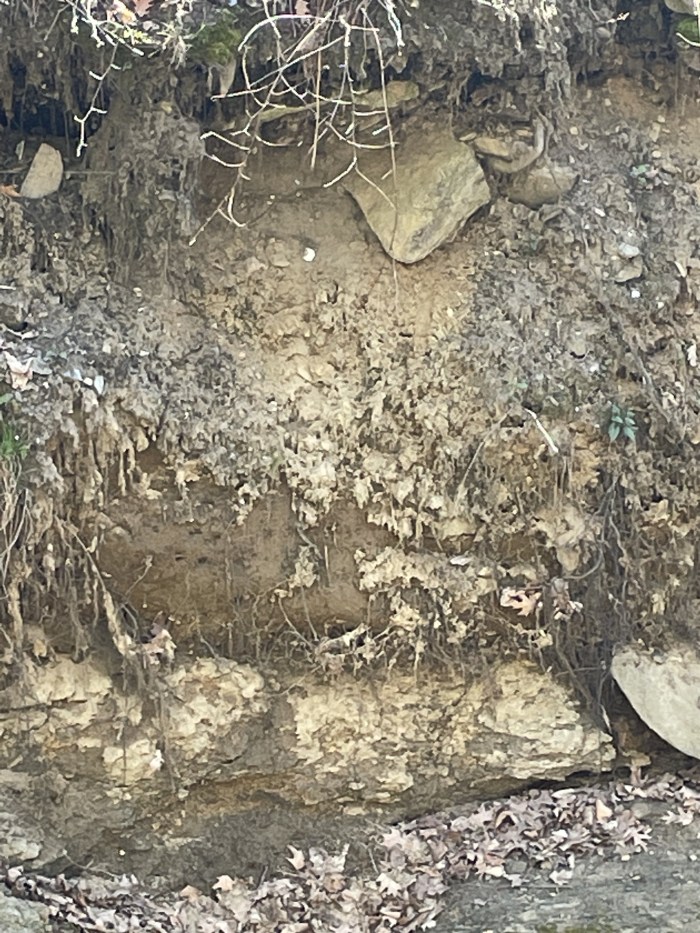
On one of these many excursions, I felt sure I saw a collection of oyster shells poking out from the steep slope across from the pedestrian walkway. Knowing that the indigenous people of this area were known to eat a great many oysters and knowing that there are a number of shell middens along this stretch of the Hudson, and knowing that the sea/river level had been higher here at one point long ago, it wasn’t a completely bonkers assumption.
Here’s what first piqued my interest:

It’s a little hard to tell from this picture, but almost all those white things you see are indeed shells – oyster and clam.
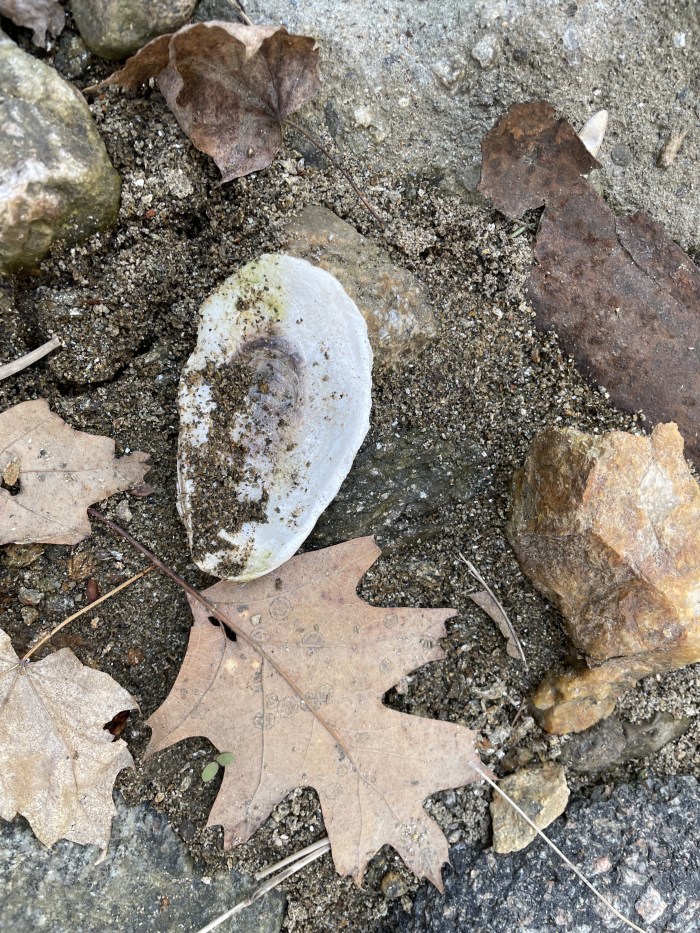
Looking down by the water, I saw several shells just lying about:

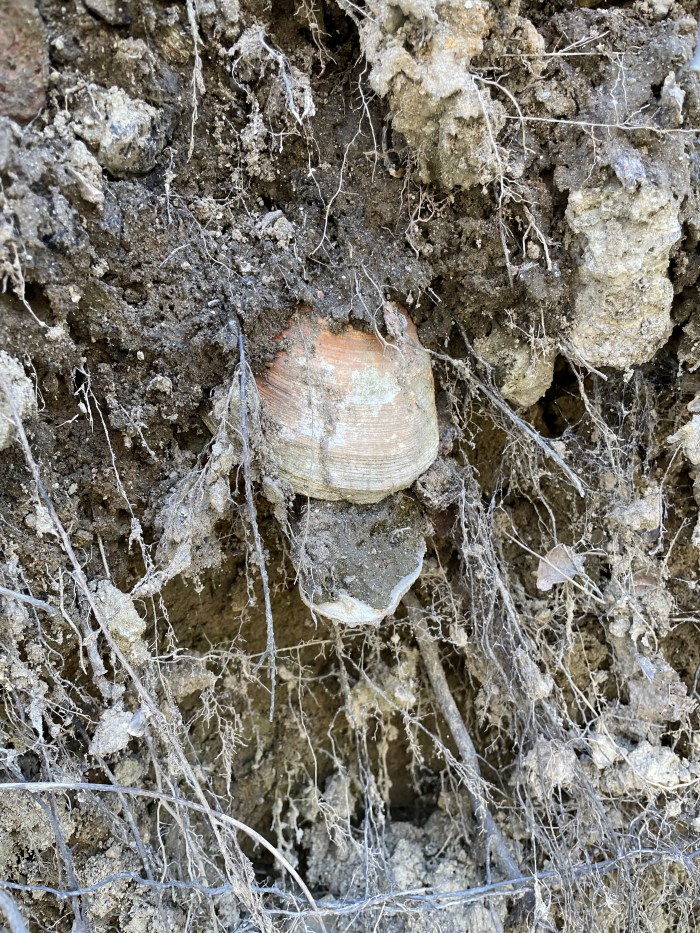
Then, here’s a close-up of the hillside — you can definitely see shells poking out, yes?

Now what, you may ask, precisely IS a shell midden? Well, basically, it’s a pile of discarded shells left there by the indigenous people who visited and inhabited these sites over the centuries. In our area, on the Hudson River, it’s thought the salinity of the river became ideal for oysters around 7,000 years ago. That’s about the age of the oldest oyster that’s been radiocarbon dated around here.
Here’s a picture of one of the middens on Croton Point, not at all far away from Sing Sing Kill:

But somehow it took me until very recently to do my due diligence and really try to figure this out. So, I located the site on a map, took all sorts of pictures of it, and consulted with Dr. Jonathan Lothrop, Curator of Archeology of the NYS Museum in Albany. (And let me take this opportunity to give him and the whole research department there a huge shoutout for their generosity in answering my questions over the years.)
First, I must confess that I’ve always had a fascination with radiocarbon dating – that is, the 1940s-era technology of determining the age of an organic artifact by measuring its radiocarbon levels. Since I learned of this technique in my “Tell Me Why” book when I was 10, I’ve had a burning desire to find an artifact that could be carbon-dated.
Now, I know from writing my book on Croton Point (shameless plug), oyster shells can be carbon dated fairly successfully. In fact, in the 1960s, some shells found in a Croton Point midden were radiocarbon dated by Louis A. Brennan, and that’s how we know for (pretty) sure that there were humans inhabiting the area and eating oysters by the bushel at least 6,000 years ago.
And there were definitely shells to be retrieved and possibly dated from the Kill. I reached out to an archeologist friend and asked her where one could get such an artifact dated. She was skeptical, because context is essential in dating a site, but she gave me the name of Beta Analytics, a Miami-based radiocarbon dating lab. I sent off an email to them, trying to temper my wild enthusiasm and not sound like a nut, and asked how much it would cost to radiocarbon date two shells (because why not, right?) They took me seriously and sent back an official quote of $675 per artifact.
But before I got too crazy, I sent a carefully composed email with photos to Dr. Lothrop and asked his opinion. Was it possible I had found something significant? And if I retrieved samples, would they be worth spending this kind of money on?
His response was swift and measured. And while I was pretty sure my zeal to accomplish this childhood dream of mine was clouding the skepticism required for any reasonable investigation, he let me down gently and gave me some excellent advice for the future.
First, he confirmed that
“In terms of location, sure it’s entirely possible to encounter a Native American shell midden of some antiquity in this stretch of the Hudson Valley; you are not far from a number of recorded shell midden sites, primarily dating to the Archaic.”
So, yay, it wasn’t totally illogical to think this is an ancient midden.
But then he went on to explain why context is so important in an archeological site and what exactly that means. You see, so much of how artifacts can be identified and dated (even without the radiocarbon technology) is based on association – what artifacts are found near other artifacts, and how deep one has to dig to find them. Artifacts include things like cracked rocks (indicating a fire pit), points (or arrowheads), fishing net sinkers and other tools carved from rocks. Obviously rocks can’t be used to tell us the date of anything because they are as old as time. (Okay, I exaggerate, but they are far older than any of the humans who chipped them into shapes.) So the only way we can make sense of such things is to meticulously note what is found where and make educated guesses as to how and when they got there. The types and shapes of points is a science unto itself, and context is so important there in identifying them with any accuracy. Then and only then, if we’re lucky enough to find some organic artifacts like shells or bones, does it make sense to radiocarbon date them.
And while we might be able to date the oyster shells I found, the place I found them is on an almost perpendicular hillside that has been greatly disturbed by erosion and industry over the centuries. So, who knows where these shells were located originally.
Dr. Lothrop emphasized this in his response:
“Perhaps the biggest issue is, given this very steep slope, there is virtually no chance that what you are observing is “in-situ.” By that I mean that such a steep slope has likely been continually eroding over time since the Ice Age, and anything discarded there by humans would no longer be in its original position (a scenario consistent with the exposed bedrock). From that standpoint, any archaeological material (whether historic or pre-contact) that has not yet been eroded, is not found in a stratigraphically stable environment and therefore lacks stratigraphic integrity and association – a key feature of any archaeological site that might have reasonable research potential.”
Finally, he went on to say
“However equally and perhaps more probable – given the urban setting – is that what you’re seeing is historic food refuse that was discarded on this steep slope, some of which is being exposed by active erosion at the base.”
So, alas, there is no point is spending $675 to date a shell found at this location.
But, I still want to believe I’ve found the remains of an Archaic or Sint Sink midden, and not the garbage from a 19thcentury oyster house!
Have you ever seen unexplained piles of oysters in our area?

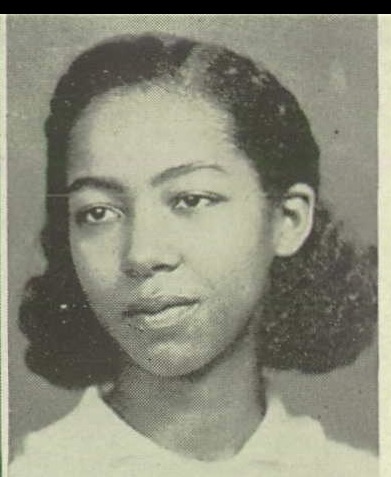
Edith Cheatham Smith
1917 – 2007
OHS 1936
WWII Red Cross Volunteer, Italy
Aviator
President, Warhawk Aviation
***Local Connection: Hunter Street***
Edith Cheatham was born on March 8, 1917, in Lunenberg, Virginia to John Floyd Cheatham and Susie Fowlkes Cheatham. Her father came up to Ossining in about 1911 and is said to have helped build Maryknoll.
In about 1924, her parents were both living in Ossining, and in the 1930 census we find the family living at 59 Durston (now Hunter) Street. Her father was a carpenter who had his own business, and her mother was busy raising Edith and her six siblings.
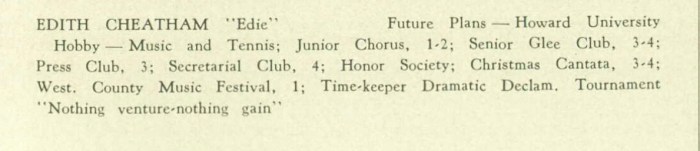
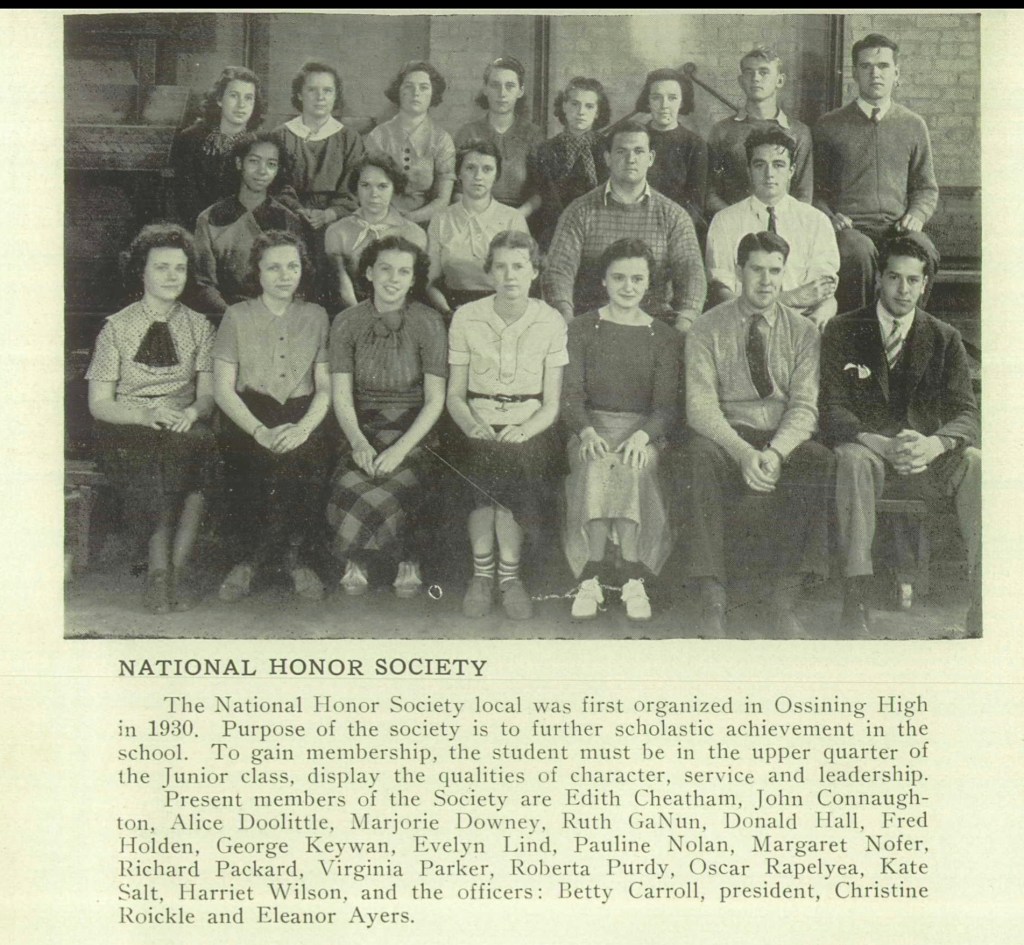
Edith attended Ossining High School, graduating in 1936. A member of the National Honor Society and numerous music clubs, she had hoped to go on to Howard University.


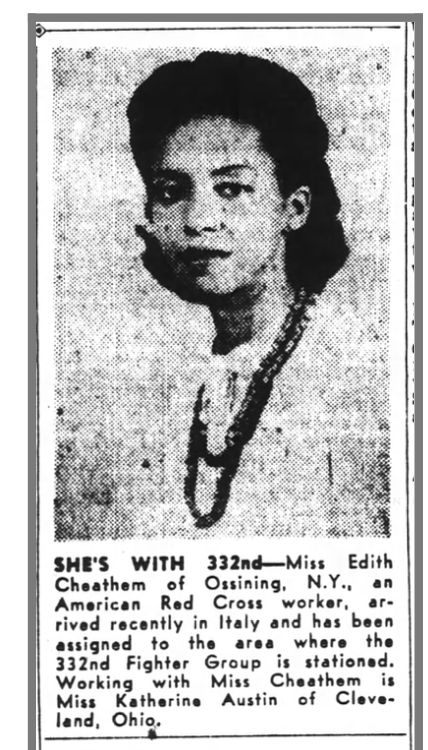
According to the 1940 US census, Edith was still living at home and working as a clerk. She also was apparently taking business classes at NYU. Then, in 1943, she accompanied a friend who wanted to volunteer for the Red Cross into the city and ended up volunteering herself. She was first assigned to the Aberdeen Proving Grounds in Maryland and then sent overseas in 1944 to support the men of the 332nd Fighter Group, aka the Tuskegee Airmen, a pioneering group of Black aviators who fought in WWII.


Thanks to the Baltimore Afro-American newspaper, we know that Edith was one of the first “Colored women to operate Clubmobile Service in the Mediterranean Theater of Operations,” delivering coffee and donuts to fighter pilots at Ramitelli Airfield as they returned from their bomber escort missions. She also may have assisted in the base hospital in the nearby town of Campomarino. Perhaps she was occasionally stationed at the Officers Club at the 332nd base. Maybe she even snuck onto a plane on a covert mission to photograph future bombing sites. (Things like this ARE documented!)
But whatever her specific activities were, they involved courage and resourcefulness. (Read this thesis by Julia Ramsey on Red Cross Volunteers during WWII, which offers great information about what the Red Cross volunteers did.)
In January 1946, she left Naples on the USS General W.P. Richardson, a troopship with about 4,000 on board, and arrived in New York City two weeks later.
She would return to Ossining and then take flying lessons at Zahn’s Flying Service in Amityville, Long Island, where her instructor was Archie Smith. They married in October 1946. (Smith was a graduate of Tuskegee University in Alabama and had been a Flight Instructor and Commander at the Tuskegee Institute during World War II. After his stint at Zahn’s, he would go on to found Warhawk Aviation Service, based at the Westchester Airport, in the 1950s.)
Archie and Edith settled on Batton Road in Croton-on-Hudson, and raised their three children, David, Tim, and Dolores.
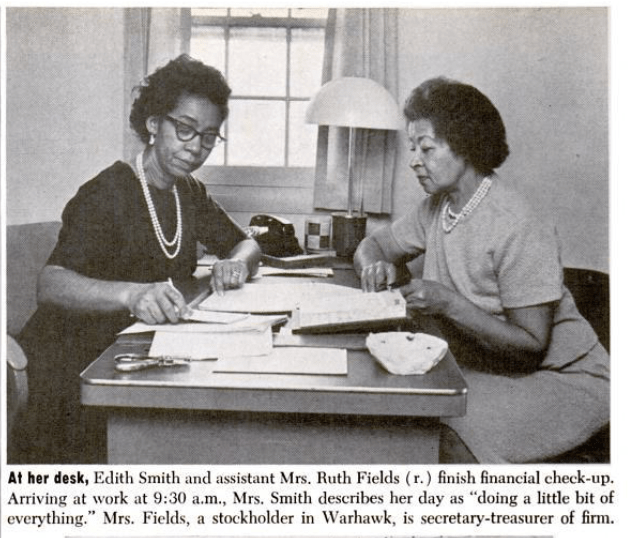
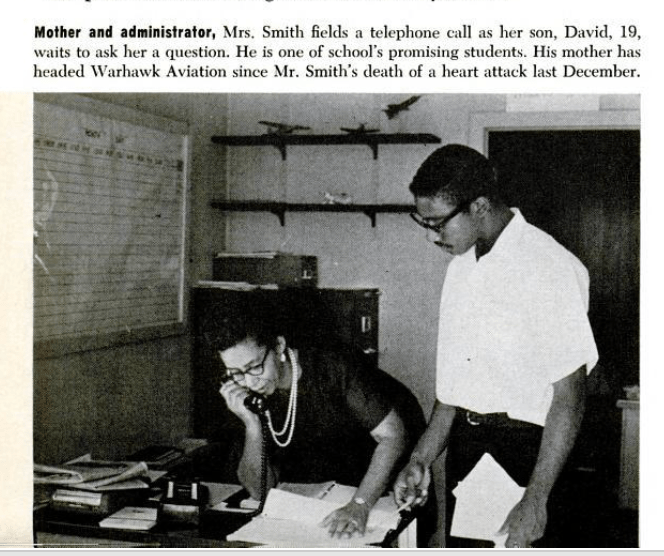
Archie passed away suddenly in 1966 and Edith took over Warhawk Aviation, running it until 1969. Below are two images from an October 1967 article in Ebony Magazine, titled “Spunky Widow Runs Modern Pilot School”:


She would then work at IBM for nearly 20 years, before moving to Mesa, Arizona to be near her daughter Dolores. Edith lived there until her death in 2007.
Her relatives remember her as independent, strong-willed and kind. She loved to do New York Times crosswords and could usually fill them out in one pass. Not surprising for a former member of the National Honor Society.
If she could do what she did in the 1940s – volunteer overseas on the battlefield, learn to fly, run a business – what’s stopping the rest of us?

Today I am highlighting the life and work of Sally Ziegler, the Executive Director of the Ossining Children’s Center in the 1970s. In addition to helping run the Center, she also saw the need to engage in the political arena to further advocate for childcare and founded the Child Care Council, an organization she helped lead into the 1990s.

Now, the Ossining Children’s Center is another one of those resilient organizations that was founded years ago by a group of community-minded, compassionate and powerful women in Ossining.
In 1895, seeing a need to offer childcare to immigrant women, the Women’s Association of St. Paul’s Episcopal Church started what was then called the Christ Child Day Nursery and Bethany Home. According to the website of Grace Episcopal Church (the current iteration of St. Paul’s), at the end of the 19thcentury there were many widows in Ossining, women whose husbands had been killed working on the railroad or building the Croton Dam. Women who then needed to go to work to support their families but had no one to look after their children.
Let’s stop here for a moment and unpack that bit of history. In that time before OSHA, before any sort of Worker’s Compensation, before any worker protection really at all, enough local workers were dying on their jobs that the good women of Ossining saw the need to organize one of the first childcare centers in the United States. It’s hard not to have strong feelings about the plight of working people in the United States at the turn of the 20th century, where a fatal accident could leave a family indigent and the business owner unscathed.
But back to the Ossining Children’s Center and Sally Ziegler.
Sally McIntosh Ziegler was born in 1936 in Savannah, Georgia. Attending Duke University, in 1956 she became the first female editor-in-chief of the Duke Chronicle, the university newspaper.

She married and moved to Ossining in the early 1960s, where she and husband Ted started their family. Sally began volunteering at the Children’s Center when her children were toddlers.
What was a volunteer position soon morphed into something paid, then permanent, until Sally was appointed Executive Director, a role she held for over a decade.
From what I’ve read about her (see her Duke University obituary here), and conversations I’ve had with her son Andrew, Sally was one of those quietly determined women who got things done. I’m sure her soft southern manners helped mask her grit and fierce desire to help those less fortunate.
Stories of her taking night classes in Spanish to better communicate with the parents at the Children’s Center, tirelessly lobbying the legislature for more funding for childcare, and becoming an Episcopal deacon in retirement, all speak to a woman who was dedicated to the service of others.

I see her as one of a parade of women who have done great good in our community, and perhaps got a testimonial dinner and a plaque upon retirement (a la Fanny Kane), but the remembrance of their good works has melted away as the years march on. Unlike the Carnegies and the Rockefellers whom we can’t help continuing to honor thanks to their largesse and the fact that their names are on things, the stories of the people who do the work, who show up day after day, who minister to the needy are so often forgotten. Perhaps that’s the way they wanted it, but I think we need more stories of good people who think of others. Just imagine the number of families whose lives have been lifted up by Sally Ziegler and all the others who have made (and continue to make) the Ossining Children’s Center a success.
Sally Ziegler is just one of many of the unsung heroes who have bolstered and improved our community. And though I rail against the necessity of “theme months,” I have to admit I likely would never have heard of her if I hadn’t been writing these Women’s History blog posts. Her story is inspiring and should be told. I’m grateful to have had the opportunity to learn about and highlight her, even if only in blog form.