The Bark Europa (Post #2)

The Bark Europa (Post #2)

This is the 2nd post detailing my 2024 voyage to the South Pacific.  (Thanks to all of you who responded to my last post asking for more info!)

Herewith I shall answer the essential questions.  To wit:

  1. What is it that I’m doing?

My primary impetus for this expedition is to follow in the wake of the artist Alfred Agate, born in Sparta village (today’s Ossining) in 1812.  

I am constantly amazed by how the local can connect us to the world.  I mean, local history is the bridge that gets you from your neighborhood in Ossining to Tahiti, to Fiji, to Antarctica and beyond.  Plus, let’s face it, history is often taught in a rather remote way, dealing with Great Men, dates, wars and empires – things that are grand and far removed from our everyday experience.  I think the more we can weave these threads of local connection into the global fabric, the more interesting history becomes, and the tighter our understanding and bonds become with people and cultures around the world.

It’s my hope that I can make the life of Alfred Agate and his experience on the US Exploring Expedition of 1838 – 1842 not only more immediate, but also relevant to our understanding of the world today. Because understanding the past can help us learn from it and move this knowledge forward to do things better in the future.  

2. Where am I going?

On July 3, 2024, I’ll be embarking on the Bark Europa from the port of Papeete, Tahiti (French Polynesia) for a 35-day journey to the Fiji Islands, by way of Tonga and whatever other islands the wind leads us to.  Our precise route will be determined by the Captain, the weather, and the permits of the local authorities.

Beauty Shot of the Bark Europa

3. How am I getting there?

What exactly is this Bark Europa of which I speak?  Well, she’s a square-rigged, steel-hulled barque that sails under the flag of the Netherlands and is owned and operated by a Dutch company.  

Sailing a variety of routes, the Europa often spends her summers in the Antarctic and the Southern Ocean. (As I write this, she just left Pitcairn Island, home to the HMS Bounty mutineers c. 1780s, and South Georgia Island, where Ernest Shackleton landed in 1916 after an 800-mile journey from Elephant Island to arrange the rescue of his crew.  Yeah, I might be a little obsessed with the Southern Ocean . . .)

This past fall, the opportunity arose for me to sign on as voyage crew on the Bark Europa on this Tahiti-Tonga-Fiji route.  Deep into my obsession with Alfred Agate and the USXX, it seemed like a sign.  And sometimes, you just have to say yes to the universe.

Now, for my sailing experts (and to avoid sounding like the neophyte I am regarding all things sail), here is some text lifted in its entirety from the Bark Europa website giving the nitty gritty details on the ship:

Rigged as a bark, the Europa carries twelve square sails in total: six on both the fore and the main mast. The mizzen mast carries the spanker and the gaff topsail. Moreover, she carries ten staysails, to be found between the masts and between the jibboom and the foremast. Sailing broad reach in seas with winds up to 5 Beaufort, Europa can carry six studding sails. In total, a huge area of canvas that has to be set and manned by a lot of hands. 

When not under sail, Europa has two Caterpillar 380 HP diesels driving two propellers. For manoeuvring, the ship also has a DAF 180 HP engine that drives a bow thruster and the anchor winch. Both are used in shallow waters, when hoisting anchor and when finding a way through the ice. Bunker capacity for diesel fuel is limited and diesel is also needed to drive the generators for electricity. 

This, my friends, is not a Carnival Cruise with unlimited umbrella drinks, a Guy Fieri 24-hour burger buffet and luxury Platinum cabins:

My shared berth

No, as a member of the voyage crew, I’ll be standing watch, acting as helmsman/lookout, climbing the rigging, and practicing all those knots I learned when the boys were in Scouts. (I’ll also learn what the spanker and jibboom are!)

It’s also going to be an experience of slow travel and a return to the pre-internet, pre-smartphone world.  There’s satellite communication onboard, but that’s it, and I’m told one pays about $1 per KB for email messages, so don’t expect any Instagram or blog posts from me for the duration (unless we should happen upon an internet café!) 

Finally, there will be about 65 people aboard, consisting of crew and passengers.

Feel free to leave a comment if there’s something else you want to know!

For my next post I’ll be giving a little history of the US Exploring Expedition and after that, stories and images of Tahiti, Alfred Agate-style.

If you haven’t already subscribed and are interested in following this journey, you can do so here:

You can also follow the route of the Bark Europa here updated in real time.

Ossining and the US Exploring Expedition of 1838 – 1842 (Post #1)

Ossining and the US Exploring Expedition of 1838 – 1842 (Post #1)
The Bark Europa

Soon I shall be heading to sea on the above Dutch-registered, steel-hulled barque as voyage crew to follow in the footsteps of Ossining’s own Alfred Agate, best known as one of two illustrators for the US Exploring Expedition of 1838 – 1842 (USXX).

Wait, what?

“To sea”?  

“Voyage crew”?

“Alfred Agate”??

“US Exploring Expedition of 1838 – 1842”???

Oh yes, I hear all your questions.  So consider this the first of several blog posts detailing the life of  Alfred Agate, the US XX (aka the Largest All-Sail Exploring Expedition You’ve Never Heard Of), and my 21st century pilgrimage on a tall ship.

Today’s post will focus on Alfred Agate, Ossining artist and International Man of Illustration.

Now, truth to tell, I knew nothing about Alfred or his family until I stumbled into the bottom drawer of a filing cabinet at the Ossining Historical Society and learned about this surprisingly influential family of artists.

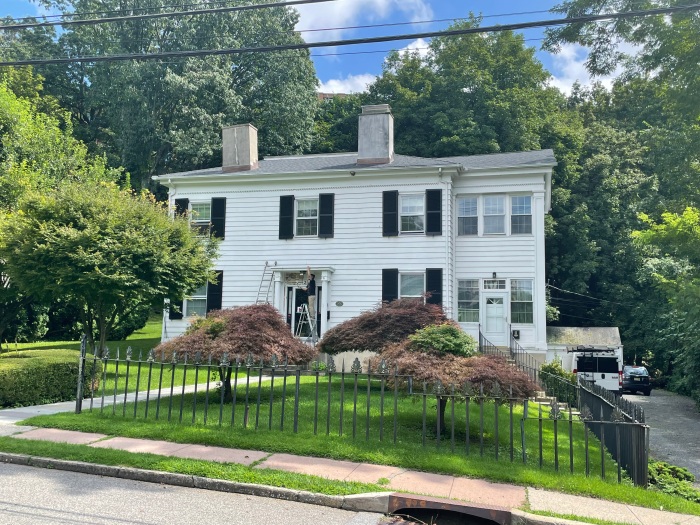
First, perhaps you’re familiar with this house that still stands at the corner of Hudson and Liberty Streets in the Sparta area of Ossining?

2 Liberty Street, Ossining
c. 2023

Built over 200 years ago by Thomas Agate, it is the grand home of one of the first English settlers in Sparta.   

[NOTE: much of the following information comes from a 1968 article written by Ossining historian Greta Cornell, Ancestry.com, and Phillip Field Horne’s A Land of Peace.]

Here’s some background: Alfred’s father, Thomas Agate, was born in Sussex, England c. 1775.  He came to Sparta in the 1790s with his siblings John, William, Ann & Mary.  In about 1795, the Agates purchased two lots of Sparta land from James Drowley’s estate via a Richard Hillier.   They were Baptist/Republicans who didn’t believe in the monarchy, so settling in the recently independent colonies must have been a no-brainer for these motivated Brits.  

Thomas seems to have been scrappy and ambitious, and according to Philip Horne, kept a “House of Entertainment” in Sparta until about 1811.  (Excellent term, no? Sounds like a strip club to me, although it was likely just a tavern.)  

In 1795, he married Hannah Stiles and would continue living and prospering in Sparta.  After leaving the “entertainment” business, he would run a store in Sparta, manage the Sparta dock, and buy and sell numerous parcels of land in the neighborhood.   When copper was discovered practically right under his house in 1820, Thomas Agate was one of the first to invest in the Westchester Copper Mine Company. Unsurprisingly, nearby Agate Street is named after the family, and the house pictured below was still in the family as late as 1960!

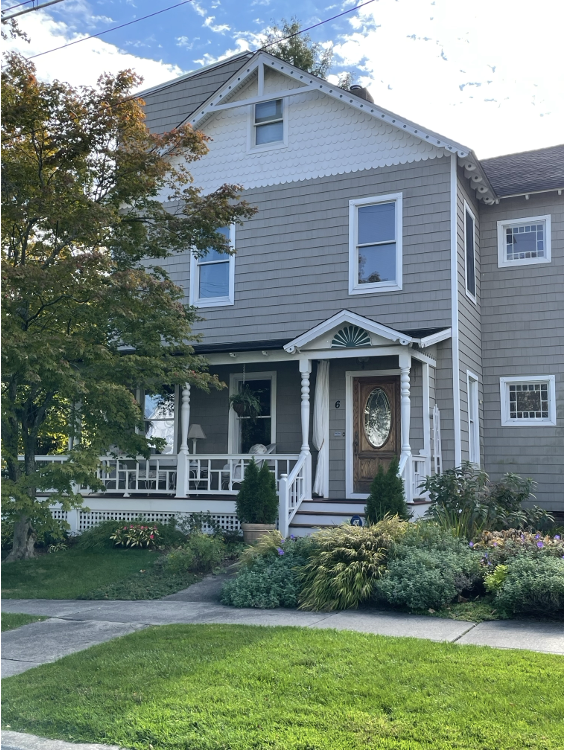
6 Agate Avenue
In 1959, home of descendant Melodia Agate Foster Wood

Thomas and Hannah would have at least 4 children:

Edward Priestley Agate: 

b. August 29, 1798

m. Mary Williams (7 children “all died young”), 

d. November 22, 1872

Frederick Stiles Agate: 

b. January 29, 1803

Never married

d. May 1, 1844 (buried in Sparta Cemetery)

Harriet Ann Agate Carmichael 

b. March 29, 1817

m. Thomas J. Carmichael c. 1835

d. January 12, 1871 (buried in Sparta Cemetery, though his headstone is currently missing)

Alfred Thomas Agate 

b. Feb. 14, 1812

m. Elizabeth Hill Kennedy, 1844

d. Jan. 5, 1845 (buried Mt. Olivet Cemetery, Washington DC)

But Frederick, Harriet and of course Alfred are the ones we are most interested in here.

Older brother Frederick was a precocious and artistic child who, at the age of 15 or so, was sent to study art in New York City with John Rubens Smith.  Frederick would then teach his siblings Alfred and Harriet the rudiments of oil painting and find them teachers at the National Academy of Design (which Frederick would help found in 1825 with his bosom friend Thomas Seir Cummings, and painter/telegraph inventor Samuel F.B. Morse.)

At the time, historical and portrait painting was a lucrative career – photographs of course did not yet exist, so painted portraits were the only way to capture a person’s likeness.

Alfred studied with Thomas Seir Cummings at the National Academy of Design (NAD), and by the age of 20 he was exhibiting his paintings at their annual exhibition.  By 25, he had his own studio at 25 Walker Street and churned out portraits – both oil paintings as well as miniatures.

Now, during this time, it’s entirely likely (though I have so far found no concrete evidence of it) that Frederick and Alfred met and socialized with Charles Wilkes, the man who would become the leader of the USXX.  Wilkes was a Navy man, a talented artist himself, and, most importantly, a skilled navigator, cartographer and surveyor.  It does seem that he took some drawing classes at the NAD during the late 1820s/early 1830s.  

This connection will become important when the US XX, an expedition that was about a decade in the making, starts to come together in the late 1830s. 

In late 1836 our Alfred is offered a position as illustrator for what was then called the “South Seas Surveying and Exploring Expedition.” Here’s his acceptance letter written to Secretary of the Navy Mahlon Dickerson:

Isn’t his handwriting gorgeous???
Courtesy of the National Archives

Now, as promised, I will expound on the development and purpose of said Expedition in a future post.  For now, let us concentrate on young Alfred.

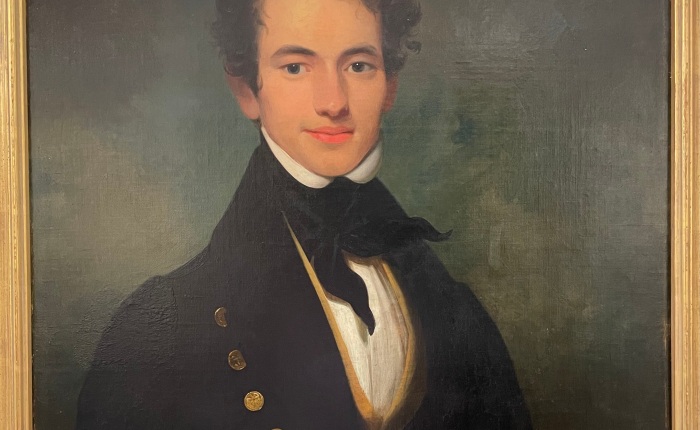
Alfred Agate, c. 1838
Courtesy of the New-York Historical Society

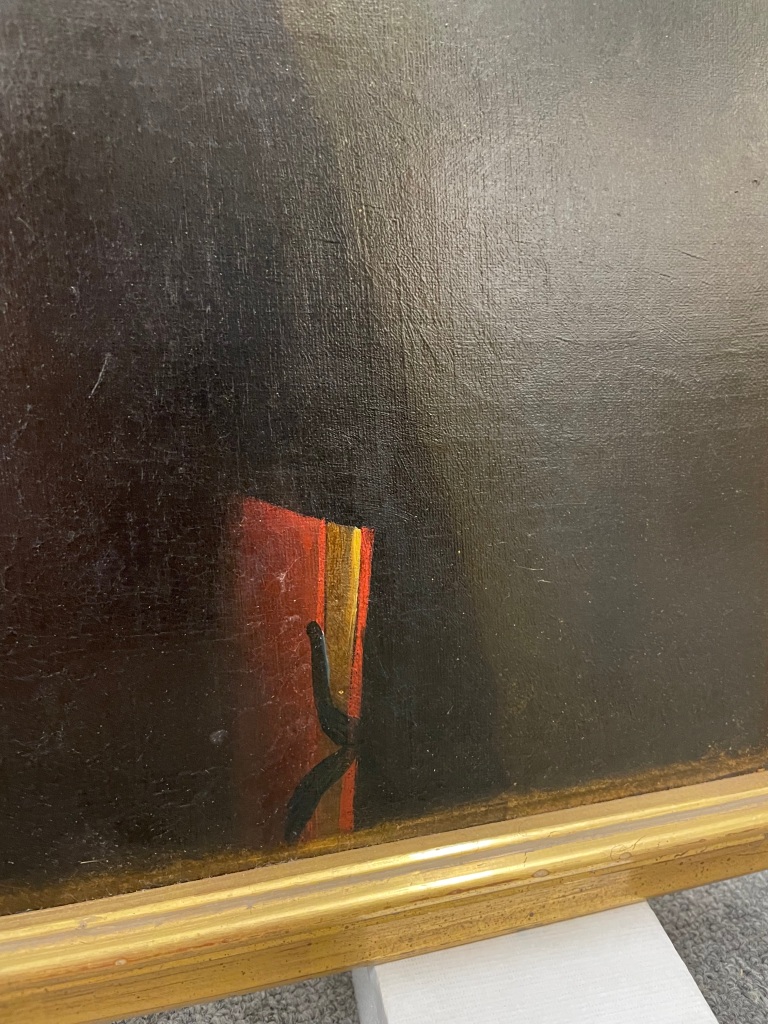
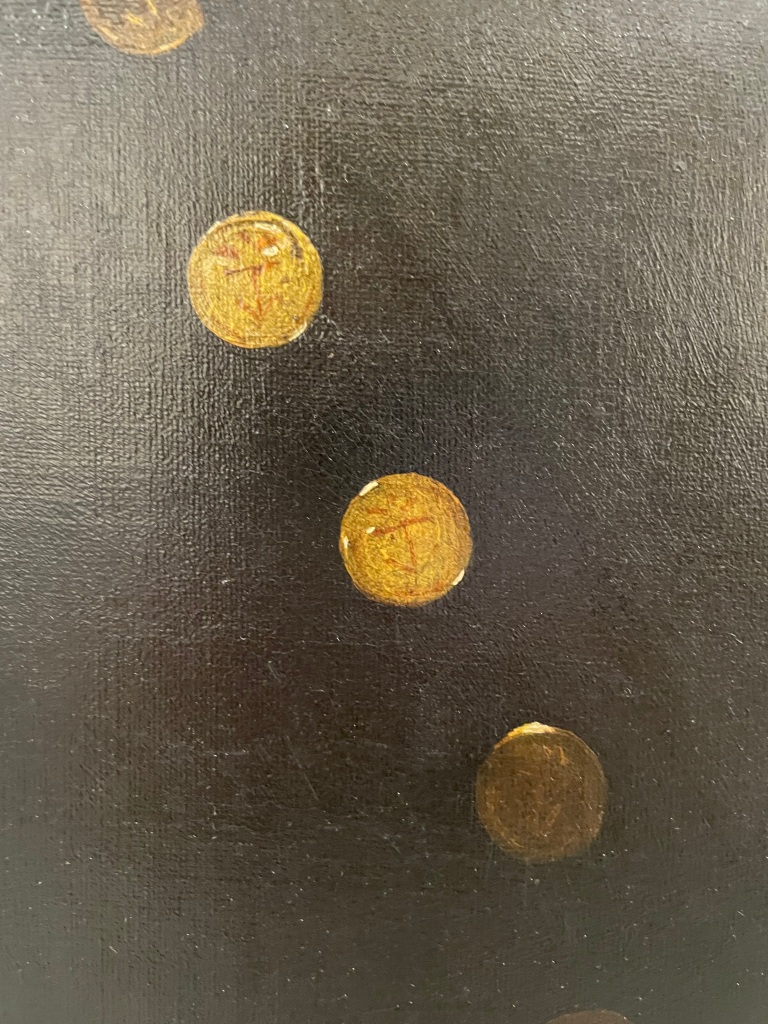
It is believed that brother Frederick painted this portrait just before Alfred left for his voyage to points south.  And if you look closely, you can see some subtle iconography in the form of the red sketchbook under Alfred’s left arm and the boat anchors on his fetching gold buttons. Here they are in close up for your amusement:

On August 18, 1838 six ships set off from Norfolk, Virginia on what is often described as the world’s last all-sail exploration expedition:

Approximately 440 men served – 82 officers, 345 sailors, 7 naturalists/scientists and 2 illustrators.

Alfred shared the load with fellow illustrator Joseph Drayton and their importance to the expedition cannot be underestimated.  With no ability to photograph anything, it was up to these two artists to document as many plants, animals, landscapes, and people as possible.  (Knowing that the US XX sent back about 40 TONS of artifacts, it would have been an Herculean task to document it all.) To that end, to save time, the illustrators often used the Camera Lucida, an optical projection device that some say was developed in the 1600s, though it wasn’t patented until the early 1800s.

Alfred tended to do landscapes and portraits, while Drayton focused on botanical and animal illustrations

Sometimes they worked from sketches of others – many of the officers were passable artists themselves and would give sketches to the illustrators to work from.

During the course of the expedition, hundreds of sketches, watercolors, oils, and later, engravings were made.  Just a small number of these were published in the multi-volumed post-expedition Narrative of the USXX.

Sadly, some of Agate’s work was lost in the wreck of the Peacock in 1841, and in a later fire at the Philadelphia publisher’s plant, but there still are a large number extant.

Today, the Naval History and Heritage Command website has digitized and interpreted its significant collection of Alfred’s USXX illustrations.  Check it out here.

The route of the USXX is mind-boggling:

And our Alfred sketched wonderful portraits throughout — here are just two of many:

Alfred returned to New York on June 10, 1842, landing at the Brooklyn Navy Yard. After spending a week in quarantine, he likely came back to Ossining to recuperate at his parents’ home on Liberty Street. He was apparently unusually sickly on the expedition (at least, according to Charles Wilkes’ memorial to him). He regained enough strength to relocate to Washington, DC to finalize illustrations for the first volume or two of the Narrative of the US Exploring Expedition written by Charles Wilkes. He also married Elizabeth Hill Kennedy in October 1844. But, tragically, his life was cut short by tuberculosis, that scourge of the 19th century, and he died just a few months after his wedding.

He was fondly remembered by all who knew him, and Senator James A. Pearce of Maryland would honor him with the following words:

The delicacy and sensibility of the man seemed to characterize the produc­tions of his pencil. His drawings, which have been published, and those which remain to be published, show a truthfulness and harmony which stamp him as an artist of the highest order of talent.

RIP Alfred Agate.

Type your email address below to subscribe and make sure you don’t miss the next exciting posts about the USXX and the upcoming voyage I’ll be taking to Tahiti, Tonga & Fiji in July/August 2024 to see the actual sights our Alfred memorialized!

Or click here for the next post in the series on the Bark Europa.

The Agates – The Second in An Occasional Series of Ossining Historic Cemeteries Conservancy cleanings

So, if you know me at all or have attended any of my recent presentations, you’ll know I’ve become obsessed with the Agate family of artists who lived in the hamlet of Sparta in the 1800s.  (Today Sparta is part of Ossining, NY.)

Today, I had the privilege of cleaning Harriet Agate Carmichael’s gravestone with the Ossining Historic Cemeteries Conservancy.  It was the last cleaning event of the year and an absolutely gorgeous day for it.

Now, who are the Agate family of artists and why should you care?

Well, first, I think it’s all sorts of important to know about people who lived in your very town and contributed to the world in a meaningful and positive way (even if they lived decades, even centuries before you).  

So, follow me down a rabbit hole that will take you to the farthest corners of the earth and to the beginnings of an American school of art.

Frederick (1803 – 1844) was a talented oil painter who helped found and run one of America’s first art schools, the National Academy of Design (NAD).  He also likely taught his younger siblings Alfred and Harriet to paint.  He would die young from tuberculosis and be buried in Sparta cemetery next to his sister Harriet (though his gravestone is currently missing.)

And here’s one of Frederick’s more famous paintings — a portrait of actor Edwin Forrest in the role of Chief Metamora from the John Augustus Stone play “The Last of the Wampanoags”:

Edwin Forrest in the Role of Metamora, c. 1832
Courtesy of the Smithsonian National Portrait Gallery

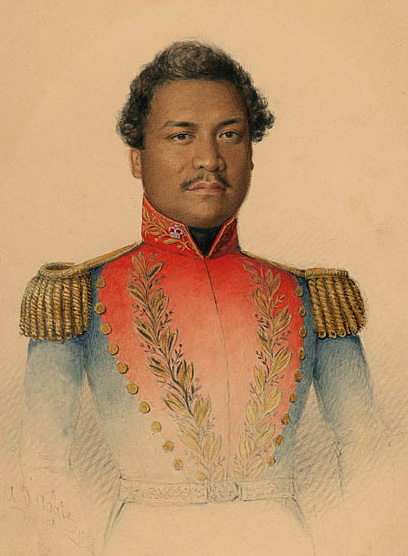
Alfred (1812 – 1846) would go on to study at NAD and exhibit paintings at their annual art show.  He became a successful miniaturist and portrait painter before taking on what is arguably his most important role, that of illustrator on the US Exploring Expedition of 1838 – 1842 – one of the most ambitious and largest scientific expeditions of exploration that you‘ve never heard of.

King Kamehameha III of Hawaii by Alfred Agate c. 1840
Courtesy of the Naval History and Heritage Command

And our Harriet (1817 – 1871) would also study at the National Academy of Design.  In 1833, she would be one of the first women to show a painting at the Academy’s annual Art Exhibition. That painting was called “View of Sleepy Hollow,” and Historic Hudson Valley just happens to have a painting of the same name from about the same time, although they note that the painter is unknown.  

View of Sleepy Hollow
Courtesy of Historic Hudson Valley

Could this possibly be by Harriet? Watch this space – I’m going to research this as far as I can!

We have only two other paintings by Harriet – likely from about the same time and likely from her days as a student.

Still Life by Harriet Agate
Courtesy of the Ossining Historical Society and Museum
Greek Scene at the Monument of Lysicrates by Harriet Agate
Courtesy of the Newark Art Museum

In about 1839 Harriet would marry Thomas J. Carmichael, a contractor for the Ossining portion of the Croton Aqueduct.  

You’ve probably seen this aqueduct ventilator on Spring Street, near Park School. That’s Harriet’s husband!

They settled in Ossining, in the Agate family house at 2 Liberty Street:

2 Liberty Street, still standing in 2023!

Harriet would have several children then move to Wisconsin with her husband in 1846 to live on a farm. Sadly, Thomas would die there soon after they moved, in 1848, and after settling his estate, Harriet would move back to Sparta where she probably lived with her mother Hannah at 2 Liberty and then with her daughter Melodia Frederica Carmichael Foster in Brooklyn.

Harriet would die in 1871 in Brooklyn (at her daughter’s house) and, as we know, is buried in Sparta cemetery.

Her paintings and many of her brothers’ would be carefully kept in various family attics until 1959 when Harriet’s great grand-daughter, Melodia Carmichael Wood Ferguson, would discover them and donate them to the Ossining Historical Society.  Some were in turn donated to the New York Historical Society and the Newark Art Museum.  If you reach out to both places very nicely, they might permit you to view the paintings (which are not on display but are safely stored away.  I did and they did!)

Here’s what her headstone looked like after the cleaning:

Grateful to the efforts of the Ossining Historic Cemeteries Conservancy for the opportunity to spend some time with Mrs. Harriet Ann Agate Carmichael today.

Jeanne Eagels – Star of stage and film.

Jeanne Eagels – Star of stage and film.
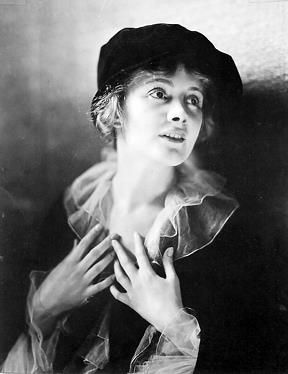
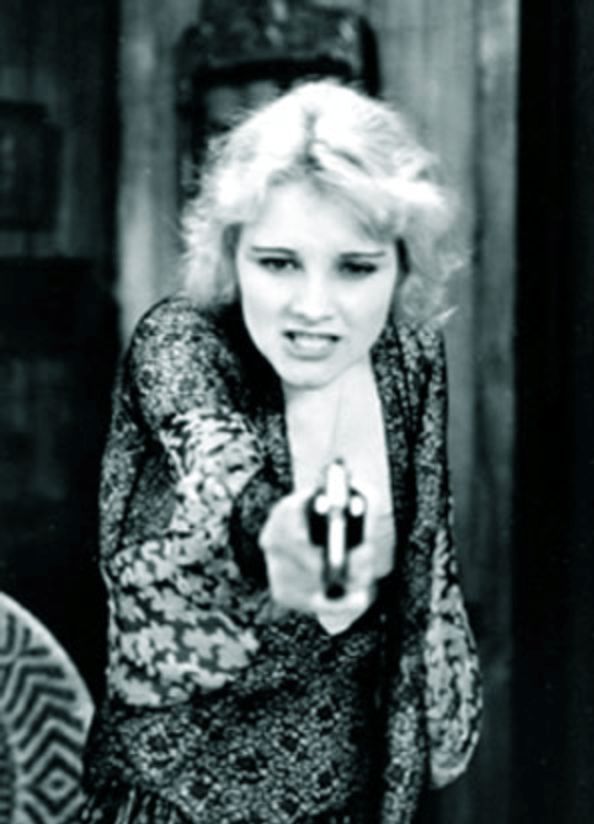
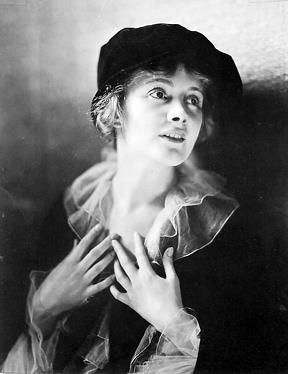
Jeanne Eagels, as a war orphan in the 1918 play “Daddies,” produced by David Belasco

Jeanne Eagels
1890 – 1929

Broadway and early film star
***Local Connection: Homes on Kitchawan Road (Rt. 134) and Cedar Lane***

Okay, first, if you are under the age of 95, you might ask, who is Jeanne Eagels?

Well, she was a big Broadway and film star in the 1910s and ‘20s — in fact, one of the biggest.

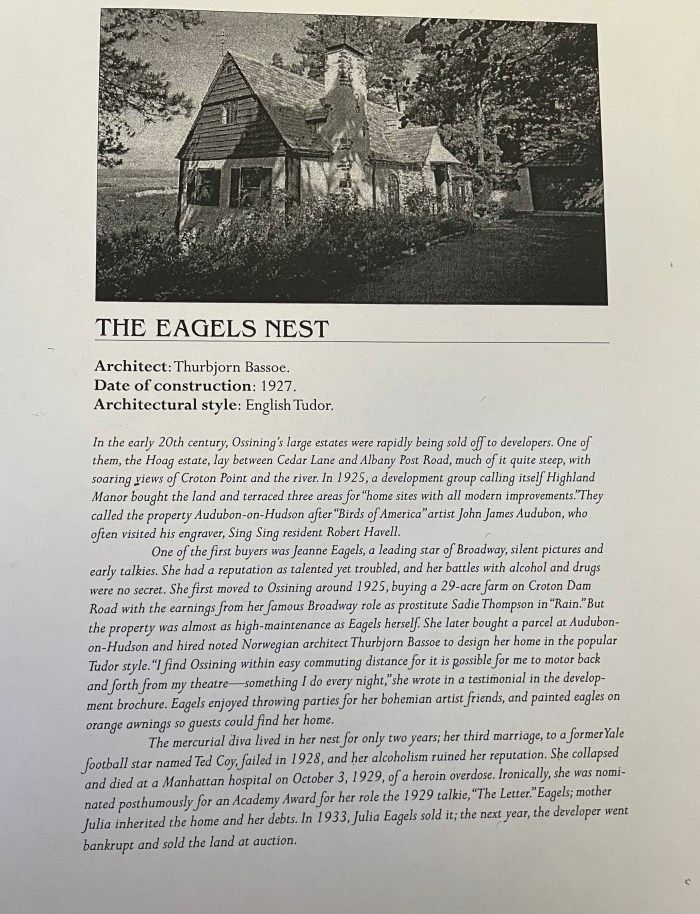
And her Ossining connection is that she owned not one, but two estates here:  a 30-acre estate called “Kringejan” at 1395 Kitchawan Road, and 22-acres of land and a house on Cedar Lane Road.

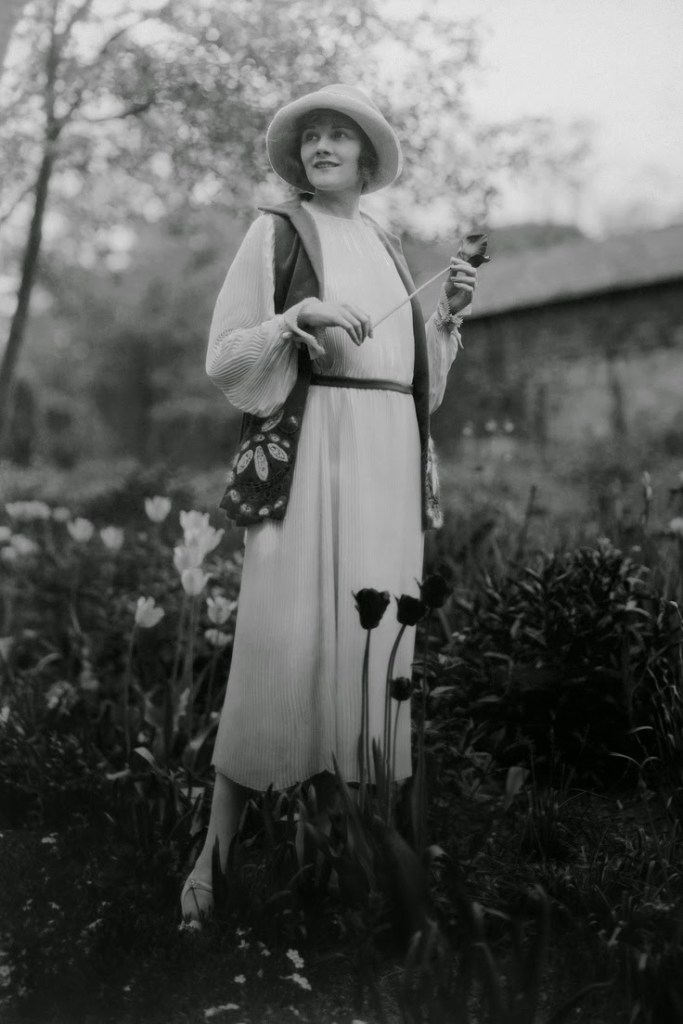
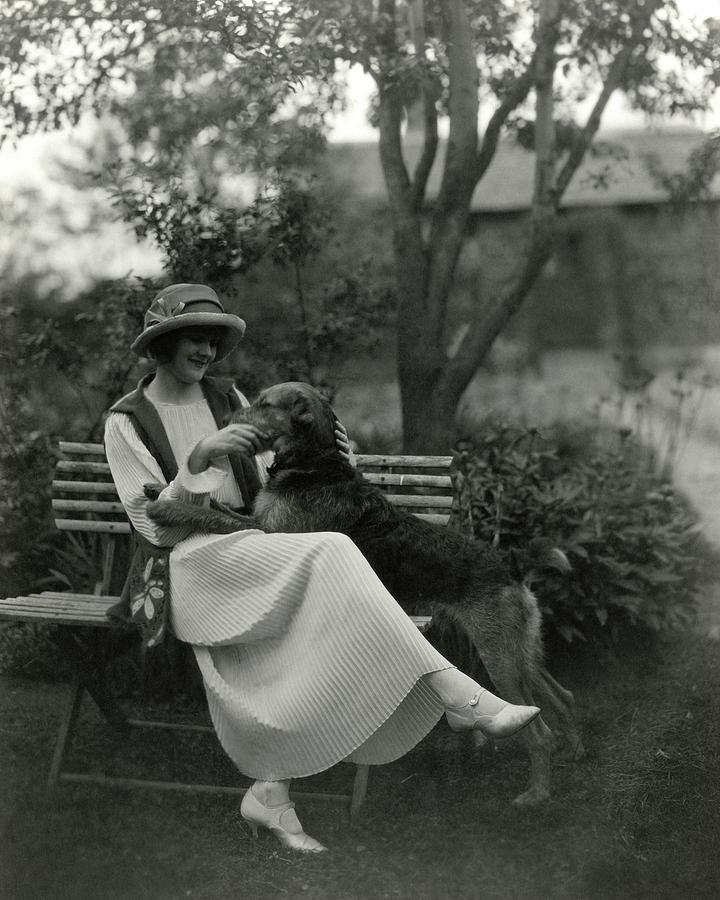
In fact, I’m convinced that these two photos below were taken in the gardens of Kringejan:

Photographs by Maurice Goldberg for Vanity Fair, c. 1925
Public Domain

And here’s a description of her 2nd home in Ossining, on Cedar Lane Road:

Courtesy of the Ossining Historical Society

In those days, Ossining was quite the place for the gentry to land – businessmen, bankers, writers and actors were snapping up farms and transforming them into elegant country estates.  According to Eric Woodard and Tara Hanks in their biography Jeanne Eagels: A Life Revealed, Eagels fell in love with the Ossining area when she was making silent films at Thanhouser Studios in New Rochelle.

Hers was the classic “lift yourself up by your bootstraps” story that America loves: the small-town girl who comes to the big city and makes good.  She started by nabbing bit parts in around 1908, and by dint of hard work, talent and luck, reached the top of her profession before her untimely death at the age of 39.

1924 found her on a list with Rockefellers, Roosevelts, Guggenheims and Harrimans when the income tax payments of Manhattan’s wealthiest were made public.  

But somehow, that’s not at all how she’s remembered.

She lived most of her life on that tricky front line where she was applauded for her success while at the same time condemned for it.  She was raised up and then torn down time and time again.  The insatiable curiosity of the press and the public transformed almost every detail of her life into something salacious.  

So, let’s try to separate the fact from fiction and give this accomplished woman her due.

Jeanne Eagels was born Amelia Eugenia Eagles in Kansas City, Missouri in 1890.

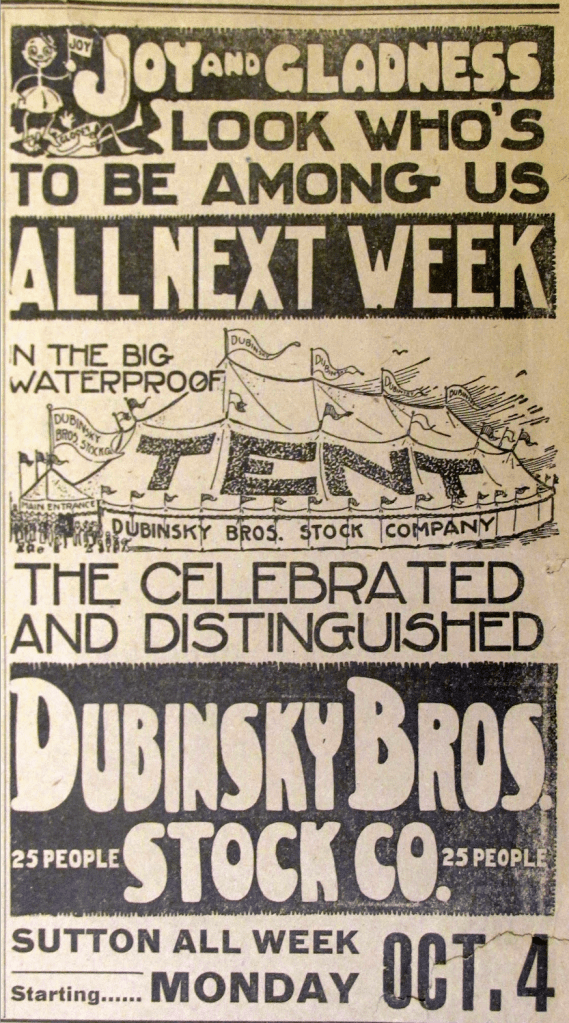
The story goes that Jean Eagles [sic] ran off with the Dubinsky Brothers Stock Company at the age of 15 (though she was really 18.)   Starting off with a few small parts (and possibly by marrying one of the Dubinsky brothers) she clawed her way to the top there.  At the time, stock companies were how most people living outside cities got their entertainment in the years before film and radio.  And also how many actors got their starts.

These companies were constantly touring, often doing one night stands, after which the company would sleep sitting upright on chilly trains as they overnighted to the next stop.  They played all sorts of venues, from legitimate theaters to church basements to tents in the nicer weather.  On the rare occasion they played more than one night in a particular town, there were limitations about where they could stay because many hotels wouldn’t rent rooms to actors due to their supposedly loose morals.  (And maybe because more than one had skipped out without paying.)

Sometimes they played in theaters, sometimes in tents . . .

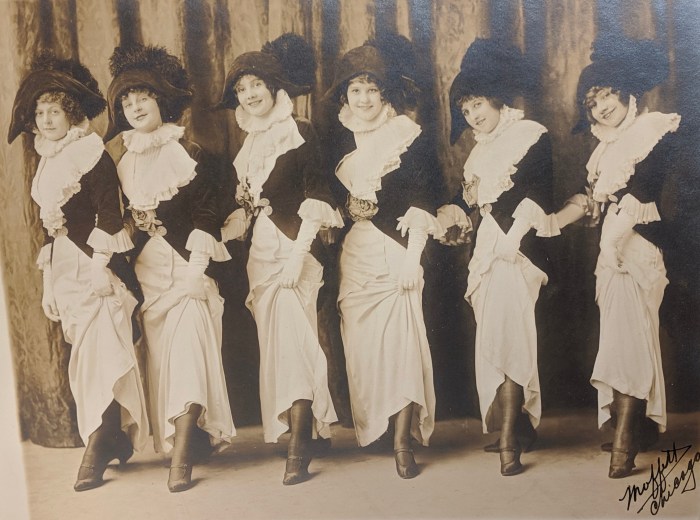
She left the Dubinsky Brothers in 1910 (and changed her name to Jeanne Eagels) to join a tour of Jumpin’ Jupiter, landing on Broadway for three weeks in March of 1911.  While the show was savaged by critics, Eagels managed to land on her feet and score a job in the chorus of The Pink Lady, a Klaw & Erlanger production.  

Jeanne Eagels is third from the left in this c. 1910 photograph.
Courtesy of the New York Public Library – Billy Rose Theater Division

From here on, she’d continue to work steadily and for the most influential producers on Broadway, such as Charles Frohman, David Belasco, and the Shubert brothers.

Arguably, her most famous role was as Sadie Thompson in the play Rain. Whether you know it or not, I can guarantee you’ve heard of it somehow, or at least of the character of Sadie.  Based on what was at the time considered a wicked and immoral story by Somerset Maugham (written in 1921), it’s about a prostitute named Sadie Thompson and the married missionary who falls in love with her as he tries to save her soul.  It was provocative, controversial and just downright shocking.  

Audiences couldn’t get enough of it.

Rain first premiered on Broadway in 1923. Lee Strasberg, the father of Method Acting, called her Sadie “One of the great performances of my theater-going experience . . .  An inner, almost mystic flame engulfed Eagels and it seemed as if she had been brought up to some new dimension of being.”  

(Fun fact:  Gloria Swanson sold her Croton-on-Hudson estate to finance the 1928 silent picture version of Rain called Sadie Thompson, which she produced and starred inOther actors connected to Rain in later films include Joan Crawford and Rita Hayworth.  And, in 2016, the Old Globe Theater in San Diego premiered a musical version also called Rain. It’s a story that continues to fascinate.)

Jeanne Eagels quickly became as big a star as you could be back then.  She appeared on Broadway and took her shows on the road, often selling out when she was the star.  The Cleveland News ran a story about her which noted her “Lightning energy . . . Eyes snap.  Voice trills.  She seizes the attention.” It goes on to praise her realism and emotionalism – attributes it seems that most actresses of the time lacked.

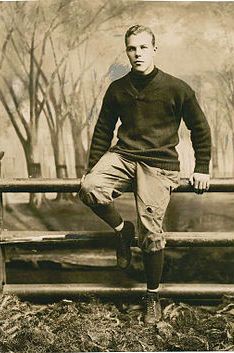
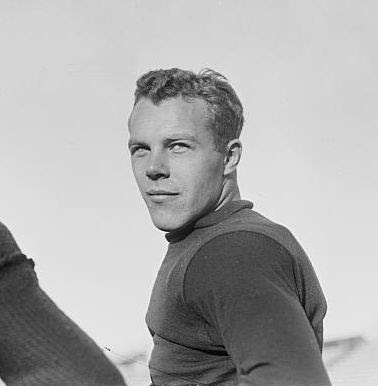
In 1925, Eagels secretly married Ted Coy, a famed Yale football player and supposedly the inspiration for F. Scott Fitzgerald’s character of Tom Buchanan in The Great Gatsby.

Ted Coy, legendary Yale football star.

But Eagels didn’t allow marriage to slow down her career.  She stayed on tour with Rain until 1926, when she left to take on the role of Roxie Hart in the Maurine Dallas Watkins-penned play Chicago (in 1975, John Kander, Fred Ebb and Bob Fosse would turn it into a hit musical.) But as her star continued to ascend, her marriage with Coy became more and more volatile.

It’s at this point of her career that the legend of her temperamental nature becomes the story. Soon, the papers were running article after article about her failing marriage, health problems, mental instability and whispers of drug addictions. Ultimately, they got the better of her, and she quit Chicago.

After spending a few months in Ossining recuperating and trying to repair her marriage, she signed on to star in the play Her Cardboard Lover opposite a young Leslie Howard.  Directed by an early-in-his-career George Cukor, and with a script doctored by P.G. Wodehouse, it seemed destined for success.  Alas, Eagels’ reviews paled next to Leslie Howard’s.  

Thus began a series of missed performances and general incidences of unprofessional behavior.  

Here’s an excerpt from an article in the Milwaukee Sentinel from May 6, 1928, during the tour of Her Cardboard Lover:

Miss Eagel’s eccentricities are of long standing.  Before each performance, the company and management wait anxiously to see if she will appear at all.  When she does, nobody knows what she will do on the stage, and the stage manager stands ready to ring down the curtain in case of trouble.  

The article goes on to describe how she simply disappeared when the show moved from Chicago to Milwaukee:

Days passed, the theatre remained dark, the company idle, the management began to tear its hair, already made gray by the erratic star. Towards the end of the week, the lady of mystery turned up with the simple explanation that “She hadn’t been feeling well.” It was too late to do anything in Milwaukee, but there was a fine advance in St. Louis. So the manager bought flowers for the star and the company took turns petting and pitying her and asking no questions.

But the newly formed Actors’ Equity Association (of which Eagels, along with her New Castle neighbor Holbrook Blinn, had been unsupportive and initially refused to join) brought her up on charges for her behavior, levied a $3,600 fine equal to two weeks’ salary (or $48,000 in 2025 dollars) and banned her from appearing on the Broadway stage for a year. 

In response, Eagels just went off and made films because she could. She had made some silent movies before her stage career took off, and film producers had never stopped clamoring for her.

However, her personal demons were taking over, and after missing two weeks of shooting, she was fired from MGM’s Man, Woman and Sin, a silent film in which she was co-starring with John Gilbert. (Since she’s in the final cut, it seems like most of her scenes had been shot.)  It’s also around this time the gossip columns start calling her “Gin Eagels” because she was known to drink hot gin “prescribed by her doctor to relieve persistent neuralgia.” (Let’s not forget, this is all during Prohibition.)

For the last year of her life, most of her press mentions concern her health (many hospitalizations), her divorce (in lurid detail), and her films.  And, of course her tragic death.

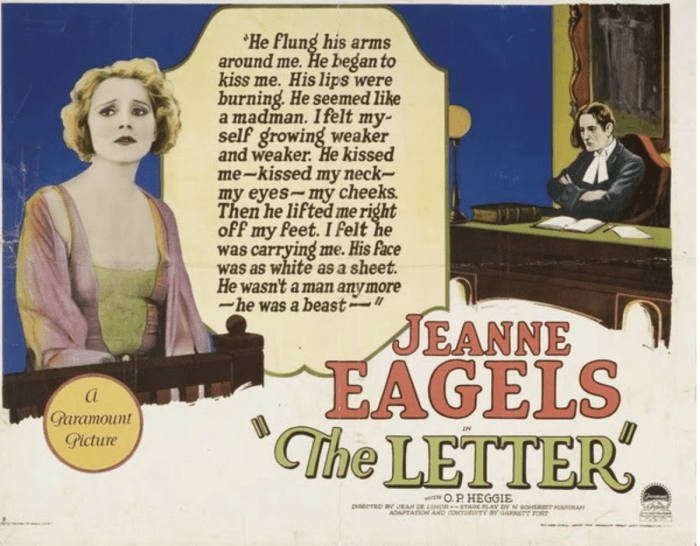
Her last project was a 1928 film called The Letter. It’s her only talkie, and she was posthumously nominated for a Best Actress Oscar Award for her performance (it went to Mary Pickford instead.)

Here’s a link to a scene.  She does not look like she is at her best here.

Sadly, the story that’s mostly remembered is the tragedy of her early death, and her erratic behavior.  This was helped along by a titillating biography written in 1930 by a muckraking Chicago reporter, Edward Doherty.   Called The Rain Girl: The Tragic Story of Jeanne Eagels, her death was attributed to heroin addiction and alcoholism.

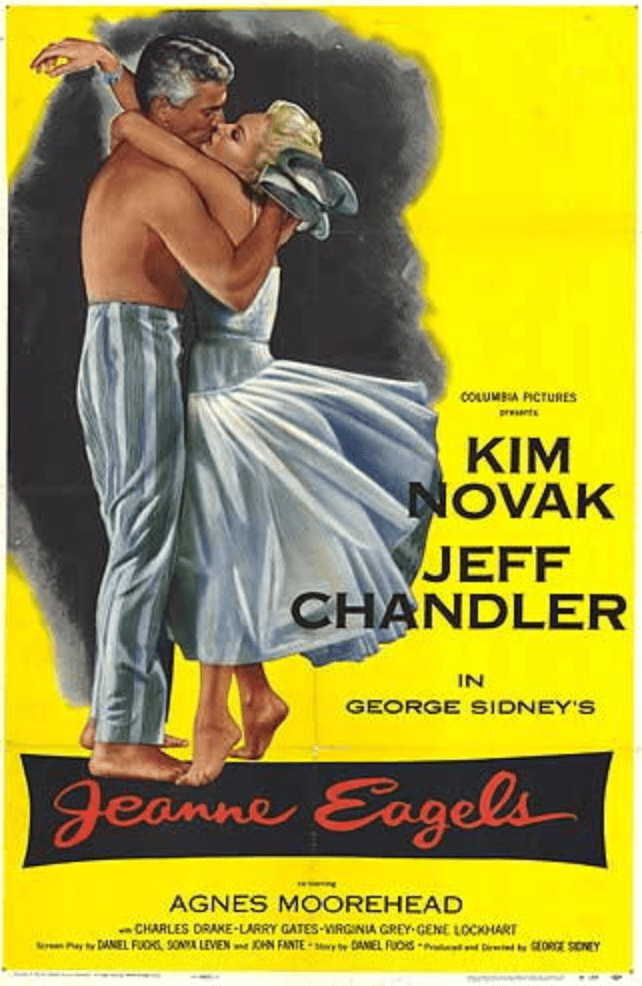
Eagels’ story was still bankable in 1957 when Columbia Pictures produced a highly fabricated biopic based on the Doherty book, starring Kim Novak:

Even the New York Times was not immune to capitalizing on her death.  Her 1929 obituary made sure to remind everyone of her volatility and instability.  It even took the time to follow up on her cause of death, publishing an article several days later that quoted the City Toxicologist’s finding that she “died from an overdose of chloral hydrate, a nerve sedative and soporific.”

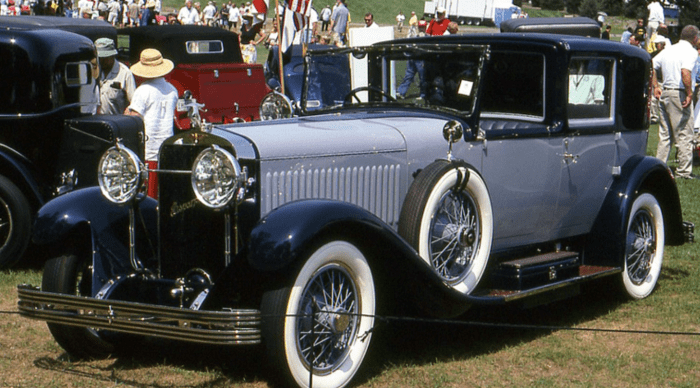
The Times would go on to cover her funeral, burial and the settlement of her estate, noting that it totaled over $88,000 (that’s $1.1 million today) and consisted of her Ossining home, nearly $12,000 in jewelry and furs, and a rare Hispano-Suiza autocar.

 A 1927 Hispano-Suiza motorcar. Imagine living in Ossining when cars like that were on the road! Today such cars can sell for up to $450,000

Clearly she was troubled and likely an addict of some kind, and I’m not trying to be an apologist here for the unprofessional behavior reported by the press at the time.  The fact of the matter is that she was a remarkably successful actress, and producers kept hiring her because she sold tickets and made money for them.  Looking at her films today, it might be hard to see the appeal, but back then, she was the cat’s meow.

A still from her last picture, The Letter

Vera Neumann — Textile Designer

Vera Neumann — Textile Designer

Vera Neumann
1907 – 1993

Textile designer
***Local Connection: Smith-Robinson House/Printex Factory, 34 State Street***

Do you know who Vera Neumann was?  Perhaps your mother or grandmother owned a Vera scarf? Or maybe you bought some Vera dish towels from Crate & Barrel, or a Vera dress from Target not too long ago?  She’s an absolute legend in the world of textile design and her Printex printing plant was located right here in Ossining, at 34 State Street.

So settle in, tie a brightly hued scarf around your neck, and read on . . .

Born in 1907 in Stamford, CT, Vera was creative from the time she could hold a pencil.  The story goes that her father nurtured her talent by taking her to the Metropolitan Museum of Art every Sunday, as well as hiring a sign painter to give her private drawing lessons.  Vera went on to study at the Cooper Union and started out as a fashion illustrator and freelance painter of murals for children’s rooms.  (Wouldn’t THAT have been a thing to grow up with on your wall!)

She married her husband George Neumann in the 1940s and they became the power couple of textile design.  With her limitless imagination and his business acumen, they built a wildly successful and long-lived company.  Their first commission was placements for the B. Altman department store, with Vera screenprinting the entire run on her dining room table.  After that, it was a race to keep up with demand.  

The post-World War II world complicated matters, as it was difficult to source fabrics.  An oft-repeated story is that Vera came across a stash of silk parachutes in an army surplus store and began screen printing her whimsical, colorful, ever-changing designs on silk and so created her iconic line of scarves.

Outgrowing one studio after another, Vera and George settled in Ossining, buying the former Smith-Robinson House at 34 State Street and fitting it out for their Printex plant.  (An 1810 Georgian mansion, it’s still standing today, barely, and is one of the few remaining buildings in Ossining built with prisoner-quarried Sing Sing marble.)

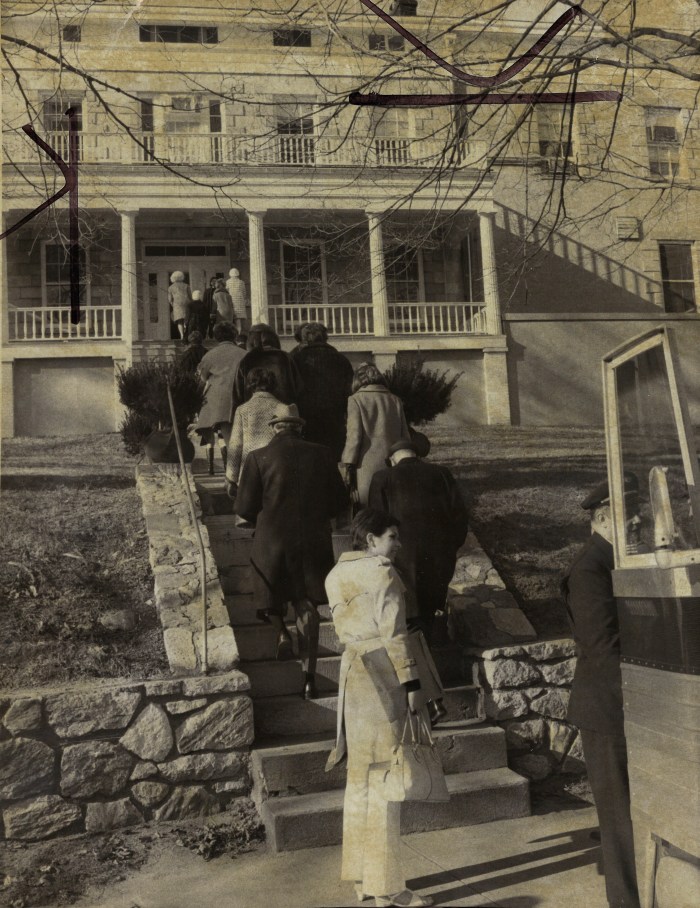
Department Store buyers visiting the Printex Plant, c. 1960s
Courtesy of the Ossining Historical Society and Museum

With their living space and office right next to the plant, Vera’s reputation and creativity thrived.  

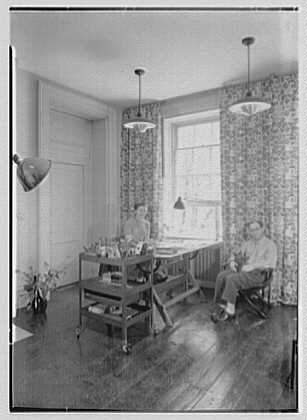
Vera and George Neumann in the design studio of Printex.
Photo by Gottscho-Schleisner, Inc. (1951),
Courtesy of the Library of Congress
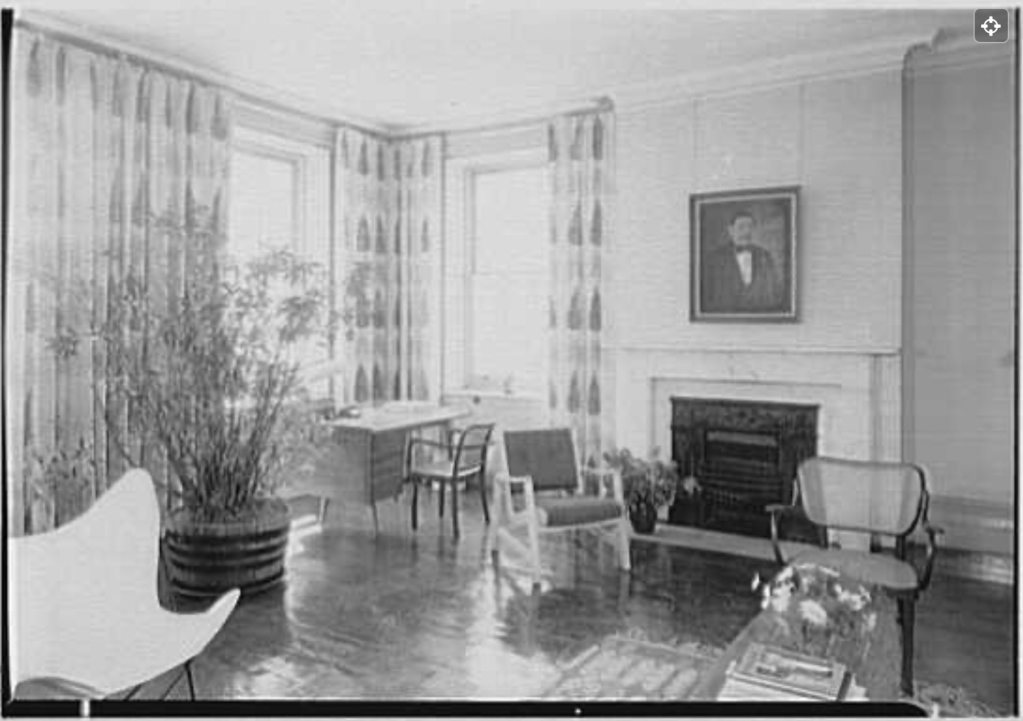
The Living Room
Look at that shiny wood floor! And that fireplace!
Photo by Gottscho-Schleisner, Inc. (1951)
Courtesy of the Library of Congress

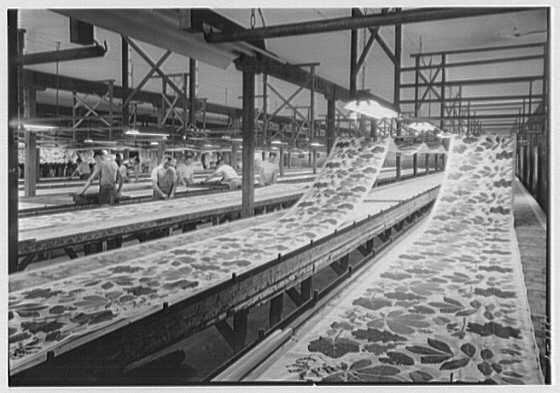
The printing plant
Photo by Gottscho-Schleisner, Inc. (1951)
Courtesy of the Library of Congress
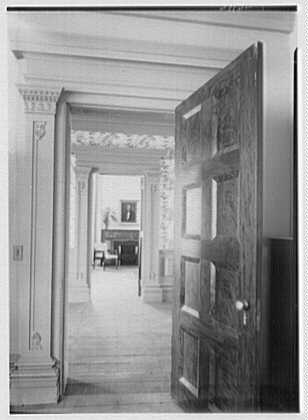
The office suite of Printex
Photo by Gottscho-Schleisner, Inc. (1951)
Courtesy of the Library of Congress

How fabulous was this?  River views and no commute? Wood floors and fireplaces? And just look at the Georgian decoration around those doorways! I wonder if any of it survives today?

The Printex company employed many Ossiningtonians.  Dr. George Hill, their neighbor at 30 State Street, provided medical services to Printex employees.  He also helped connect young people with jobs there.  Local artist Donna Chambers was one of them, and the training and inspiration she received no doubt helped inspire her to become a professional artist who creates remarkable quilts and jewelry today. 

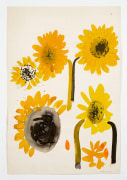
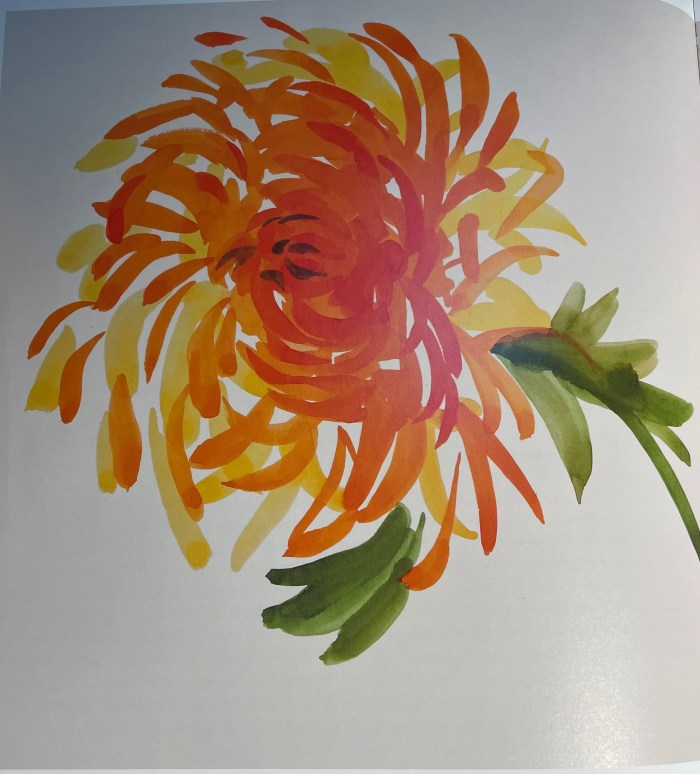
And here’s just a tiny selection of Vera designs, from a 2015 exhibit at the Alexander Gray Gallery in New York:

If we were going to play six degrees of Vera Neumann, we can connect in one turn to President Harry S Truman and First Lady Bess Truman, who chose Vera’s Jack-in-the-Pulpit design (below) for the upholstery in the White House solarium. 

Jack-in-the-Pulpit design – note, the shadows are part of the design. It is one of Vera’s most popular, in active use from 1952 to the mid-1980s

We can also connect to Marilyn Monroe. who famously wore nothing but a Vera scarf in her last photo shoot (with photographer Bert Stern.) Some might find the photos a bit raunchy, so be warned before you click here.

But one of the most admirable things about Vera Neumann is that she kept her price point low enough so anyone could own a Vera. While other designers charged upwards of $25 a scarf, Vera’s averaged from $2 – 10. (Remember inflation! $25 in the 1960s is about $250 today.)  “I don’t believe only the wealthy deserve good design,” she said and meant it.  And her inexhaustible creativity meant that the market was never saturated with the same thing, so even these “cheaper” scarves were always unique and special.

In the 1950s, as their family grew, George and Vera decided to build their dream house, reaching out to the leading architect of the day, Marcel Breuer.  On their plot of land at the top of Finney Farm Road in Croton, with magnificent views of the Hudson and beyond, Breuer’s modernist design is a triumph.  Still standing, and recently restored, it was on the market in 2020 for $4.2 million. Take a look here and here.

Vera and George travelled widely and collected art – Alexander Calder (who briefly lived in Croton as a child) was a close friend, and the Neumann lawn was decorated with a large Calder sculpture, a gift from the artist.

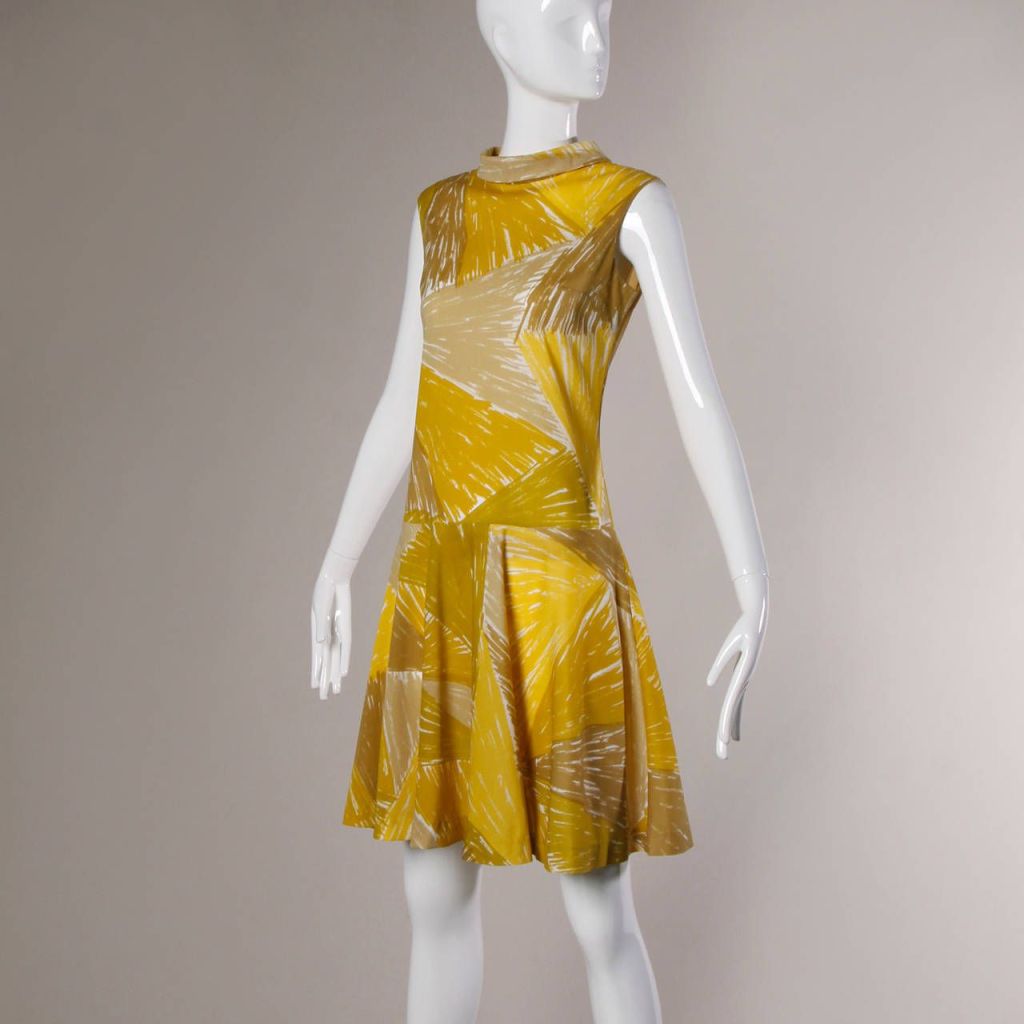
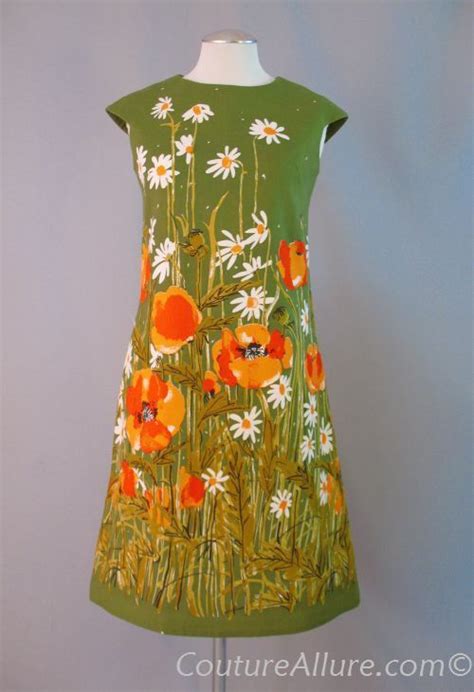
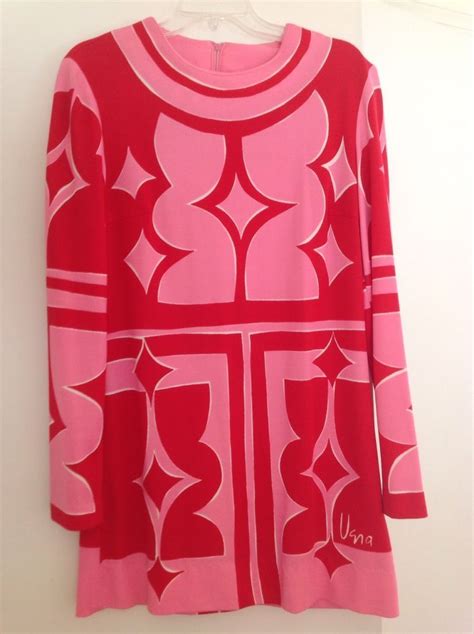
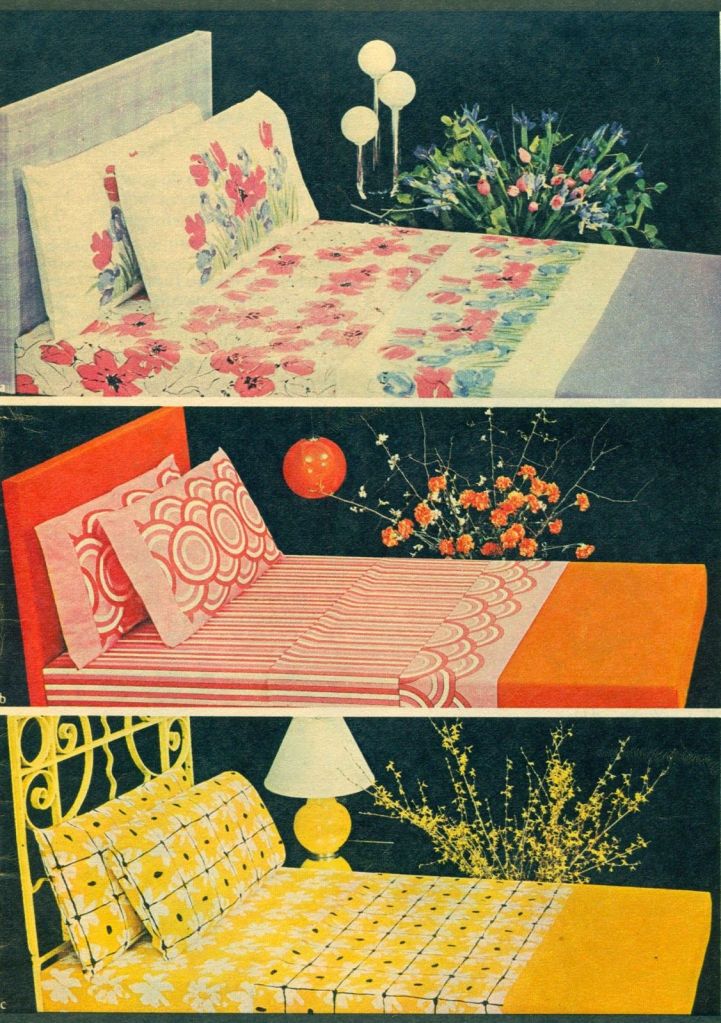
In the 1960s, the company branched out into clothing and home textiles, and sales skyrocketed. Here are a few outfits I plucked off Ebay/Pinterest:

And here are some homegoods items:

George died in 1960 and Vera sold Printex in 1967, though she remained active as a designer and board member for decades.

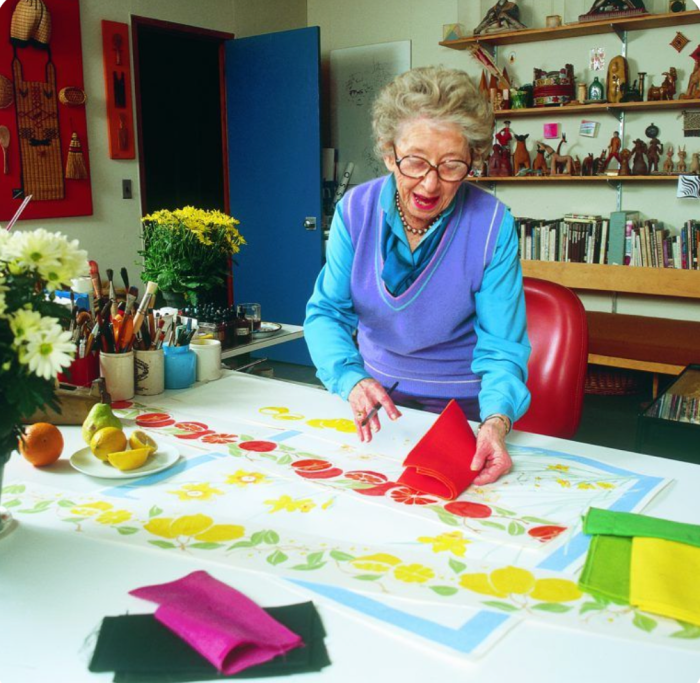
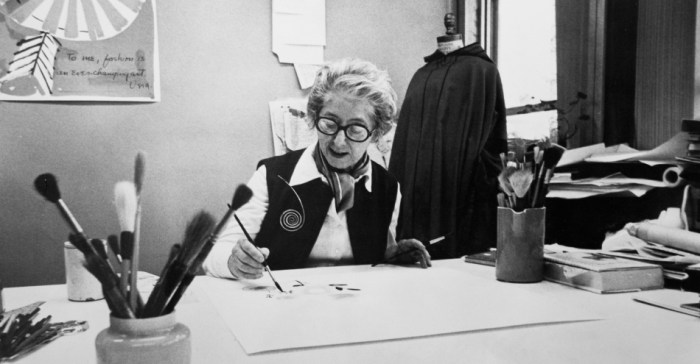
Vera Neumann in her Ossining studio, c. 1974

She lived in her beautiful home with her dachsunds and cats, swimming daily in her indoor pool until 1981, when she moved in with her daughter in Ossining.  

Vera Neumann died in 1993, designing to the end.  An artist, a trendsetter, a savvy businesswoman, hers was certainly a life well-lived who brought joy to everyone who saw her designs. Check out more of her work here.

Edward Kemeys – Ossining Artist

Sometimes I think one could easily play Six Degrees of Ossining – mention any person or any place in the entire world and you could connect it back to Ossining (or Scarborough or Briarcliff) in less than six degrees.  

First, for you runners out there, does this statue look familiar?

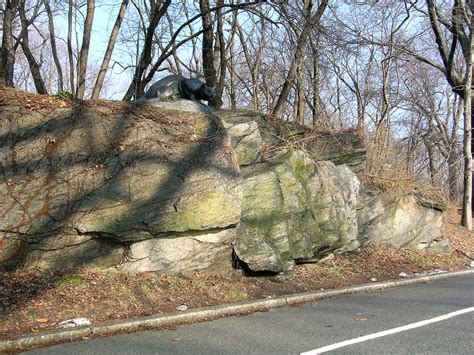
“Still Hunt” by Edward Kemeys
Central Park, NYC

If you’ve ever run a race in Central Park, you’ll be familiar with the steep hill, sometimes called “Cat Hill,” right after the Boathouse at about East 76thStreet.  It’s there, almost at the top, that you see this remarkably life-like panther crouched in the shadows on top of a rock to your left.  

The story I’m about to share delighted me and I hope you’ll find it just as interesting.

But let’s set the stage first — those of you who are familiar with Ossining might know of Kemeys’ Cove.  Today it’s a condo complex near the Jug Tavern and the Arcadian shopping mall.  But back in the day, it was homestead of one of the first European settlers in the area. (Watch this space for a post about the pre-European people who lived here.)

Just after the Revolutionary War, William Kemeys, a wealthy shipowner from Scarborough, England left the mother country due to his lack of enthusiasm for the Church of England and the social constraints he suffered from because of that.  He came to America looking for tolerance, acceptance and opportunity.  Taking a brief foray up the North River (as the Hudson was called in those days), he found a delightful spot in which to settle: “There he built a long low ceilinged English House of red brick facing south on the cove and called the place Scarborough after the English town from whence he came. The house was still standing about 1870 until the property passed out of the hands of Edward Kemeys, the great grandson of William Kemeys and was demolished.”[1]

Now, it’s this Edward Kemeys that concerns us here.  Born in 1844 in Milledgeville, Georgia (“during a sojourn of his parents to the South”[2]) to Abby Brenton Greene and William Kemeys.  Abby sadly died soon after Edward’s birth, and he spent much of his childhood on the Kemeys homestead in Scarborough, with his grandparents Judge Edward Kemey and Gertrude Bleeker.  

At the outbreak of the Civil War, our young Edward enlisted in the 65th New York Volunteer Regiment, eventually attaining the rank of Captain of Artillery.  Edward and the 65th served nobly at many battles,[3] Antietam and Gettysburg being perhaps the most well-known today.  

After the war, Edward studied civil engineering and helped survey Central Park.  But his heart wasn’t in it — he soon became interested in animal sculpture and went west to study animals (so the story goes) and then to London and Paris to learn how to sculpt.

Here’s a slightly more in-depth history on Kemeys and his work written by the NYC Parks Department[4]

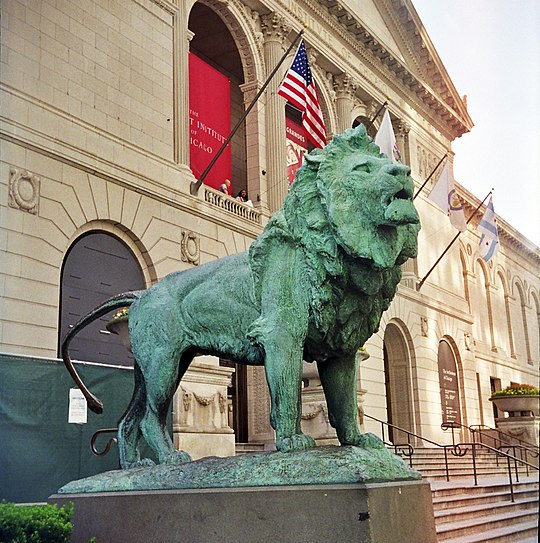
“Still Hunt” was by no means his only famous sculpture – if you’ve ever been to the Art Institute of Chicago, you’ve seen his handiwork —  the two bronze lions at the entrance were sculpted by Kemeys.

One of a pair of lions at the entrance of the Arts Institute of Chicago
sculpted by Edward Kemeys

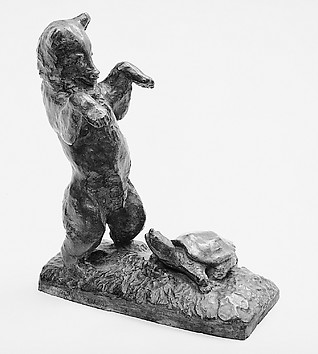
The Metropolitan Museum of Art in New York also has a number of his works on display – this one, called “Mutual Surprise” is one of my favorites:

“Mutual Surprise” by Edward Kemeys
The Metropolitan Museum of Art

Here’s a link to his New York Times obituary just because I like obituaries.  

I still do wonder why Edward let the Kemey’s homestead go.  Seems like it would be an idyllic spot for an artist.

But there you have it, from Ossining to Central Park to famous sculptor.  


[1] From a xeroxed history with no author information found at the Ossining Historical Society

[2] From the same xeroxed history with no author information found at the Ossining Historical Society

[3] See here for more:  https://civilwarintheeast.com/us-regiments-batteries/new-york-infantry/65th-new-york/
[4] https://www.nycgovparks.org/parks/central-park/monuments/1506

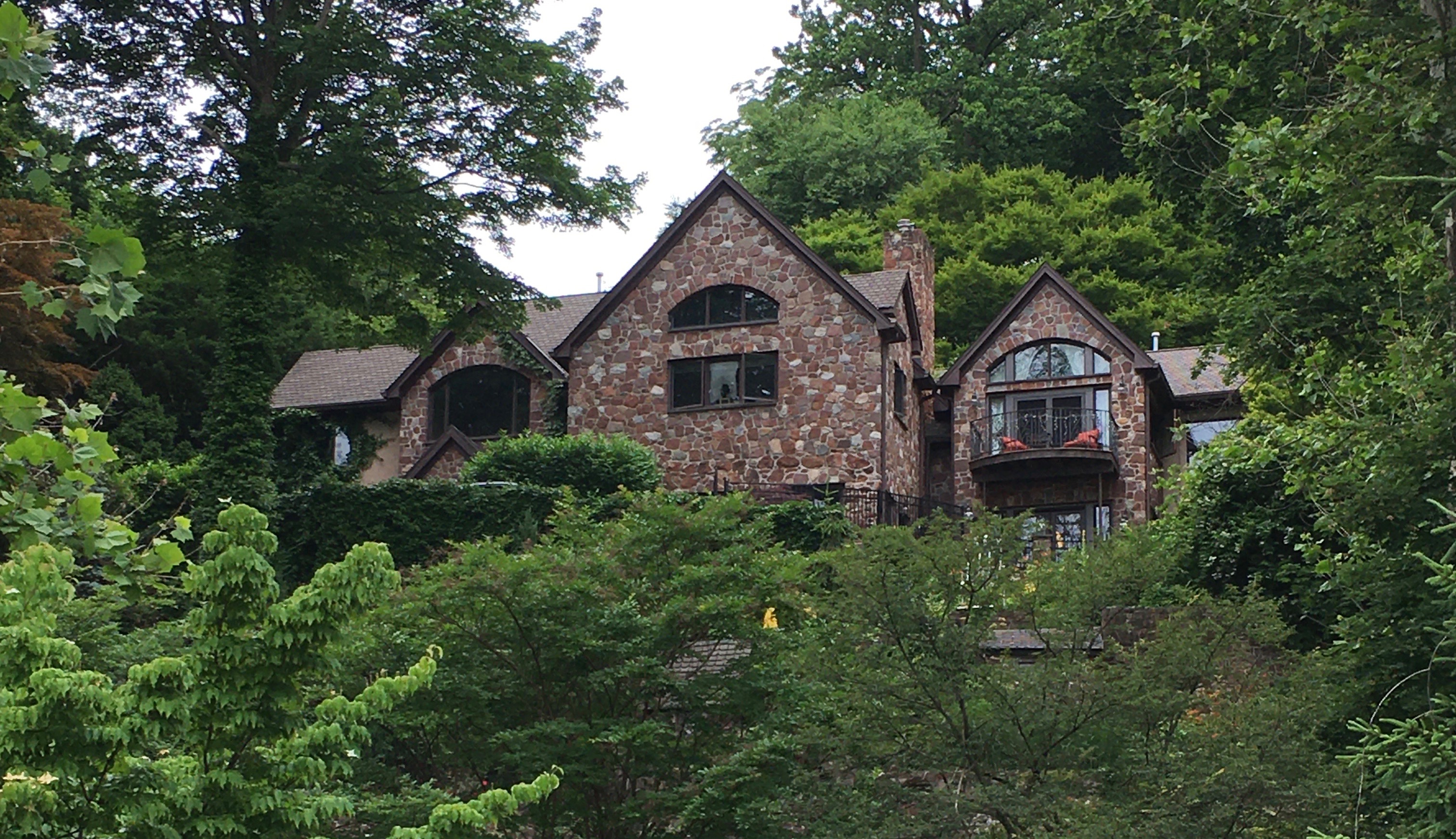
The Home of Berta and Elmer Hader, Nyack, New York

The Home of Berta and Elmer Hader, Nyack, New York

Hader house with car

Nyack, New York — Okay, so I didn’t run by here, but I DID bike by here, so that still seems in keeping with the theme of this blog.

I had the good fortune to be one of the first riders across the new Gov. Mario M. Cuomo Bridge Bike/Walk path.  (The path had officially opened the day before.)

Here’s a shot of it:
Cuomo

I rode from the Tarrytown side all the way over to the other side, and as I was biking through the picturesque town of Nyack, I remembered that Berta and Elmer Hader had lived here, so I needed to go find their house.

Who, I hear you asking, are Berta and Elmer Hader, and why should I care?

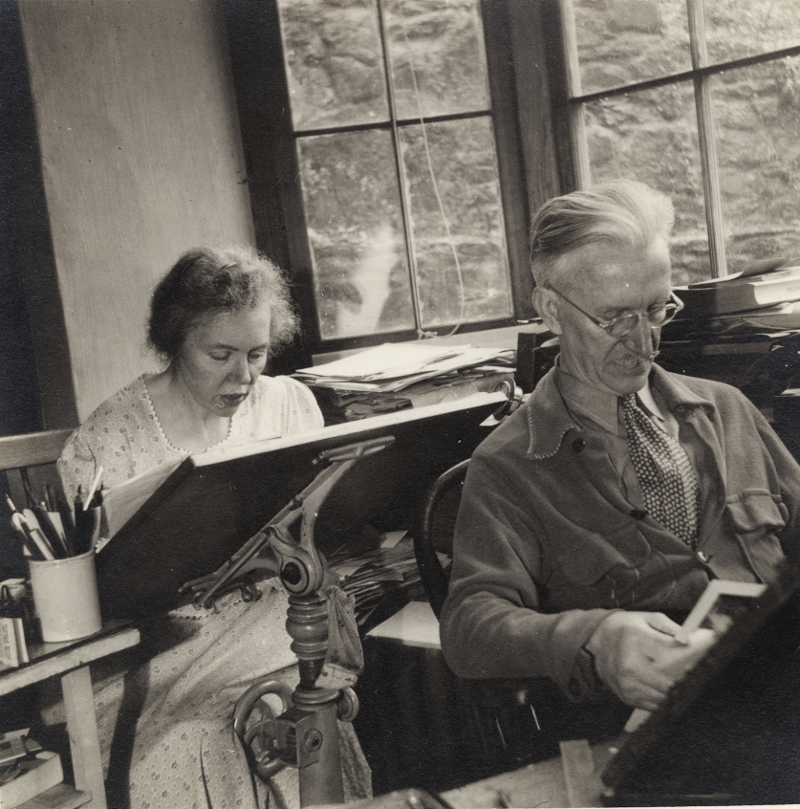
Well, they were popular and prolific children’s book writers and illustrators.  A husband and wife team, they met in San Francisco in the teens, married, and moved to Nyack, New York, because they thought that to really make it they had to be near New York City. Over a period of some years, they built this glorious stone house perched high on the hill overlooking the Hudson.  Big enough to accommodate many guests and their studio, they lived, worked and entertained here up until they died (Elmer in 1973, Berta in 1976)

Hader_studioBerta and Elmer Hader in their studio in Nyack, NY (Courtesy of Concordia University)


Here are some images of their work:

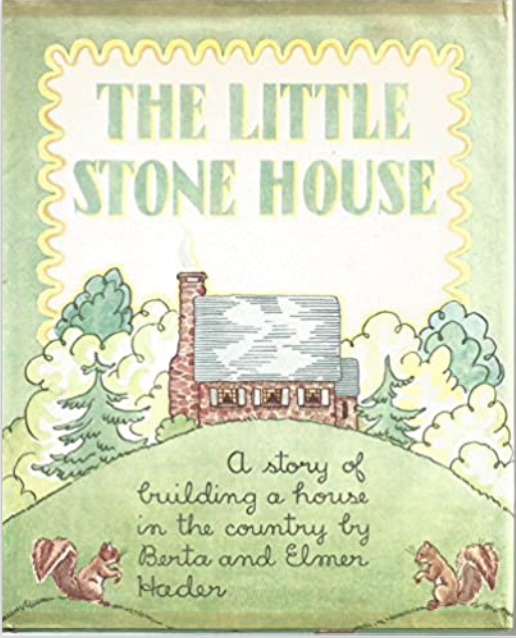
Here’s the cover of a book they wrote in 1944 about building their lovely stone house.  (It even got a review in the New York Times):

Screen Shot 2020-06-18 at 10.38.31 AM

Elmer also illustrated John Steinbeck’s first four novels – the story goes that Steinbeck saw the drawings for the book “Billy Butter” and was so impressed with it that he asked him to do the cover art for “The Grapes of Wrath.”

One of the things that strikes me about them, their work, and their house, is that it seems like they would have been magical parents.  However, tragically, their only child, Hamilton, died at the age of two from meningitis.  But Berta and Elmer soldiered on and brought joy to hundreds of thousands of children.

According to the research guide at the Concordia University Library, which houses an archive of their illustrations, the Haders once wrote this about their artistic philosophy:

“We write for children, not to preach, nor moralize, but to suggest that the world about them is a beautiful and pleasant place to live in, if they but take time out, to look. And perhaps in doing so, our young readers will develop an interest to save what is good of their world for others to enjoy.”

What a delightful and joyful way to approach the world, eh?

The Haders were active in their community, early supporters of the environmental movement, and committed pacifists (Elmer had served in WWI, though it’s unlikely he ever saw any action, leaving on a troopship for France as he did on November 10, 1918, the day before the Armistice.)

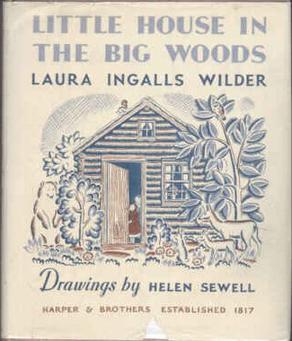
But I’m not going to lie – my interest in the Haders did not stem from books of theirs I read as a child.  No, my interest in them comes by way of Laura Ingalls Wilder and “Little House in the Big Woods.”

Little_House_in_the_Big_woods_easyshare

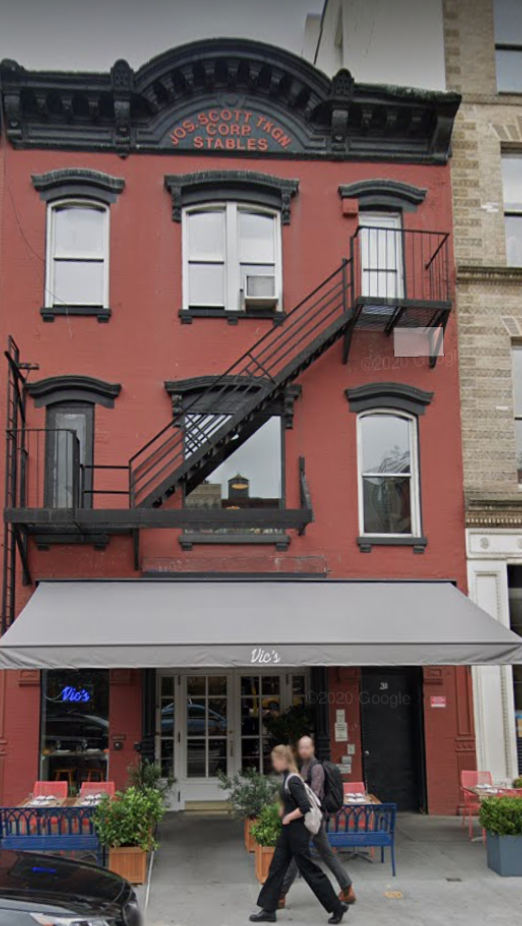
That’s a whole other post unto itself, which I will take up at the proper time, but let’s just say that Berta flatted with Laura Ingalls Wilder’s daughter Rose in San Francisco in the late teens.  It’s during this time that Berta met Elmer, a fellow artiste and a former vaudeville performer, and they all moved to New York to live in that epicenter of artistic poverty, Greenwich Village, in a converted stable at 31 Great Jones Street. (Well, I’m not sure Elmer lived with them there, but he was certainly in the picture by then.)

31 Great Jones Street

(Courtesy Google Maps Street View)

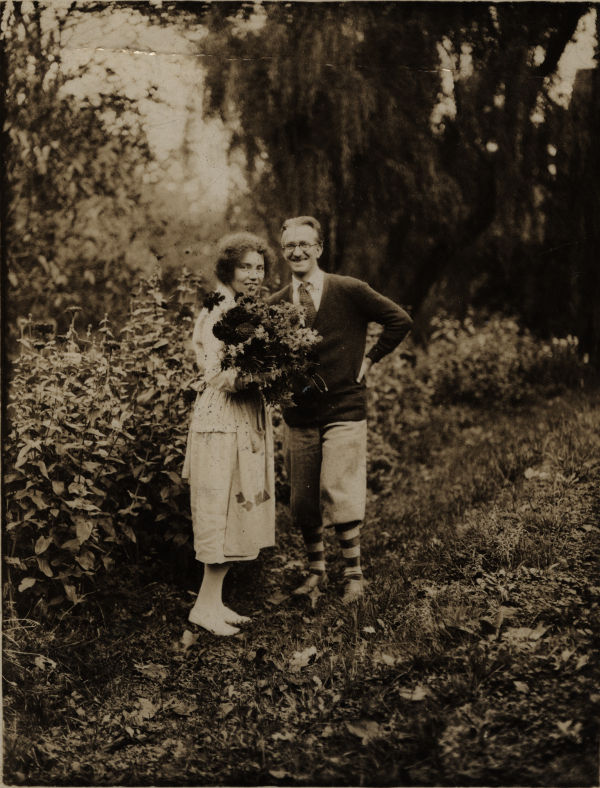
Berta married Elmer in 1919, and they moved to Nyack, New York.  This is their wedding photo:

Hader_wedding_-_MAIN_PAGE

(Courtesy of Concordia University)

Berta and Elmer would spend the rest of their lives in their eyrie at 55 River Road, watching the sun rise over the Hudson, and happily writing and illustrating books together.