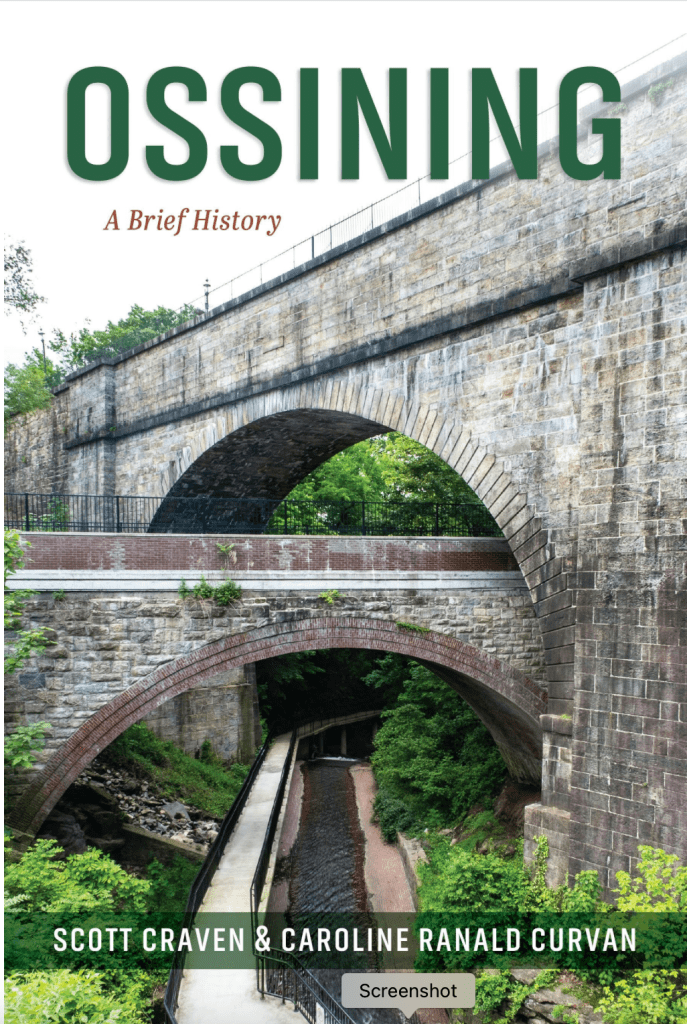
It’s almost here! Our new book, Ossining: A Brief History, will be released on February 10, 2026. Here’s a sneak peek at the cover — what do you think?
Check out the publisher’s website here to pre-order, or visit your favorite brick and mortar bookshop after its release.
We’ll be doing an official book launch at the Ossining Public Library on Saturday, February 21, 2026 at 2pm — watch this space for more info on that and other events coming your way soon!
Welcome to the virtual exhibit page for Ossining Women’s History Month 2025!
While the installation at the Ossining Public Library (53 Croton Avenue) is no longer on display, the entire exhibit will live on this blog in perpetuity.
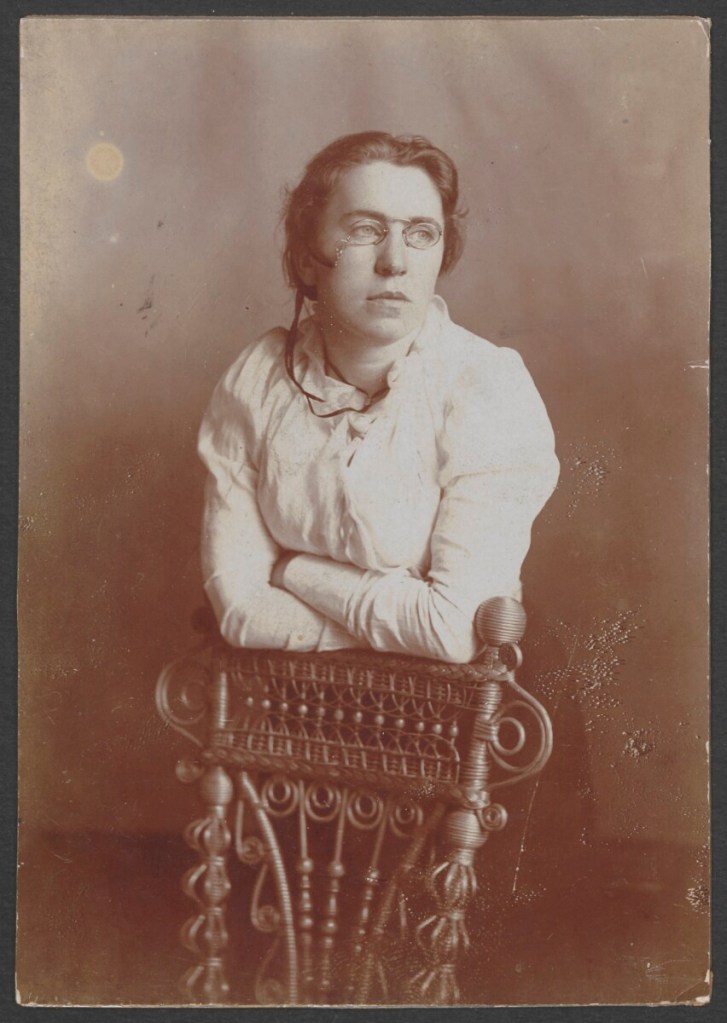
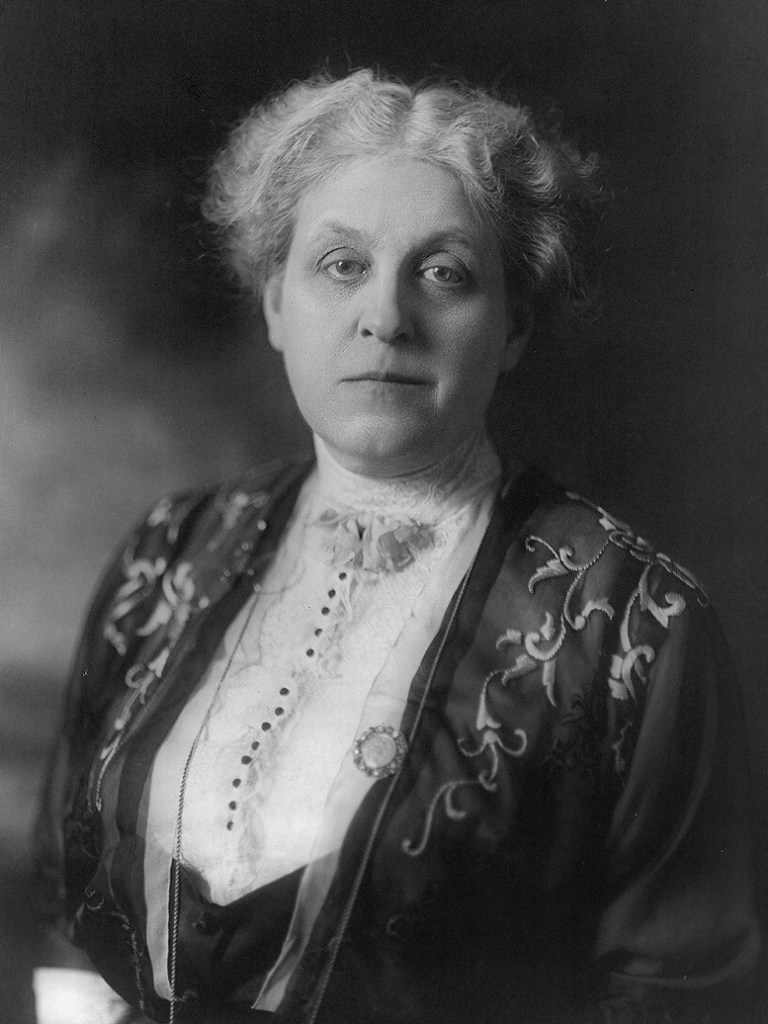
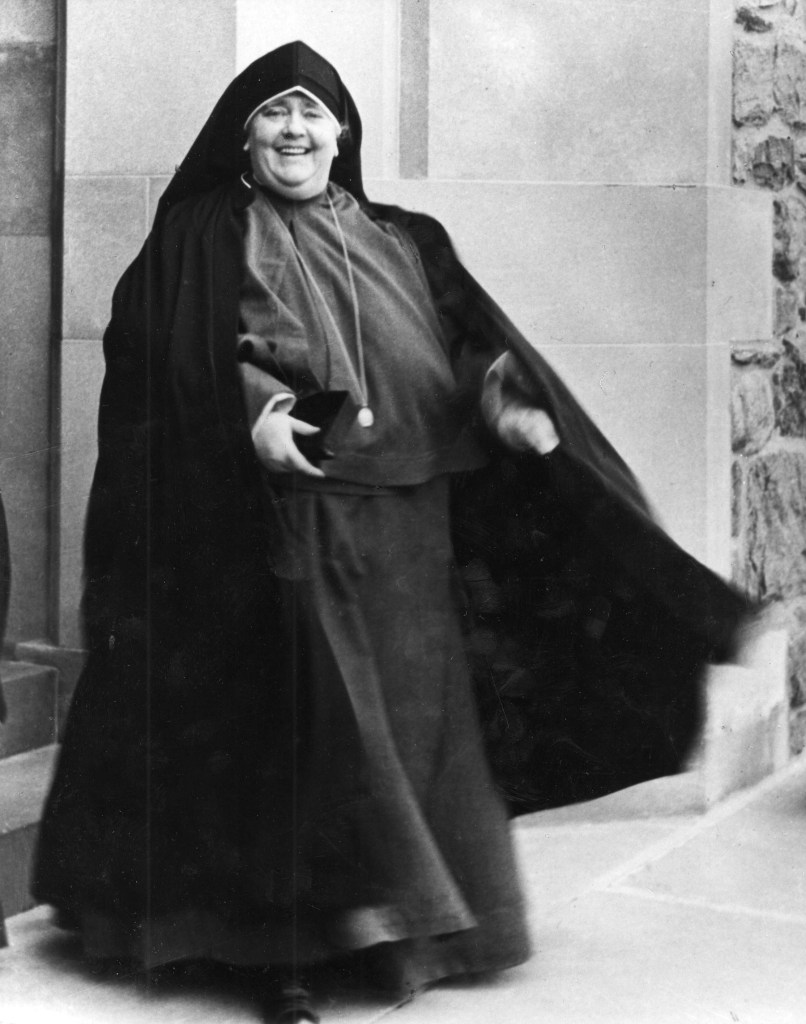
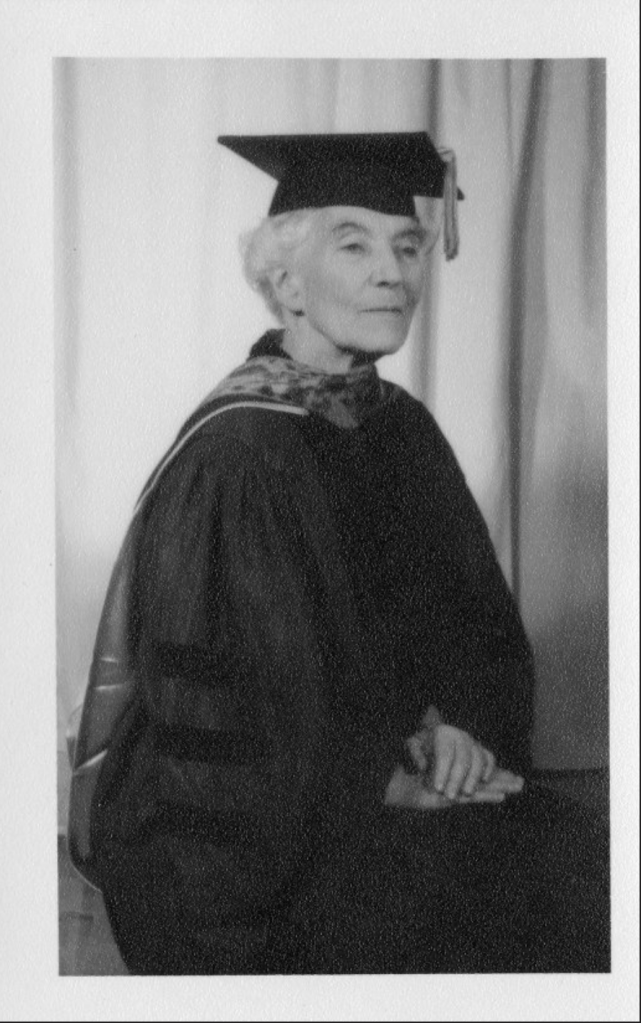
Who are these women?
These are all remarkable women local to Ossining who made a big impact in shaping our community and our world. Some are national figures. Some have local streets, schools or parks named after them. And some just did their work quietly. But all have accomplishments that deserve to be recognized and shared.
What will you see?
This is a retooling and enlargement of last year’s exhibit presented at the Bethany Arts Community, with expanded biographies and four more fascinating women included.
These women represent all facets of American life – art, religion, science, politics, military service, activism, and philanthropy. Those with a higher profile in life offer more images and material. Others avoided the limelight (either on purpose or through circumstance) and less is known about them, but this exhibit will help uncover and celebrate all of their remarkable stories.
To learn more about each woman featured, simply click on their names below and you’ll be quickly directed to a page with their detailed biography, including photos and links to further enrich their extraordinary stories.
Enjoy!
Caroline Ranald Curvan Ossining Town Historian & Exhibit Curator
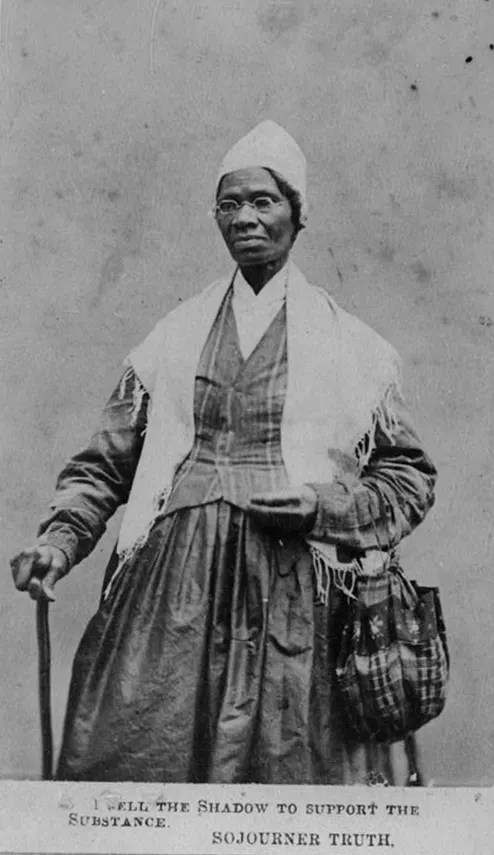
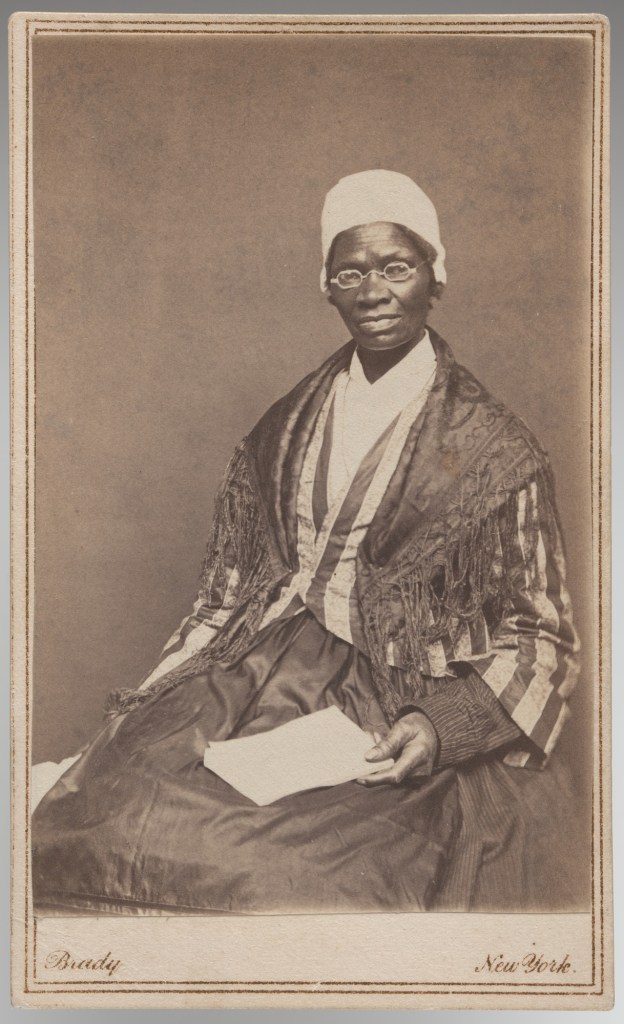
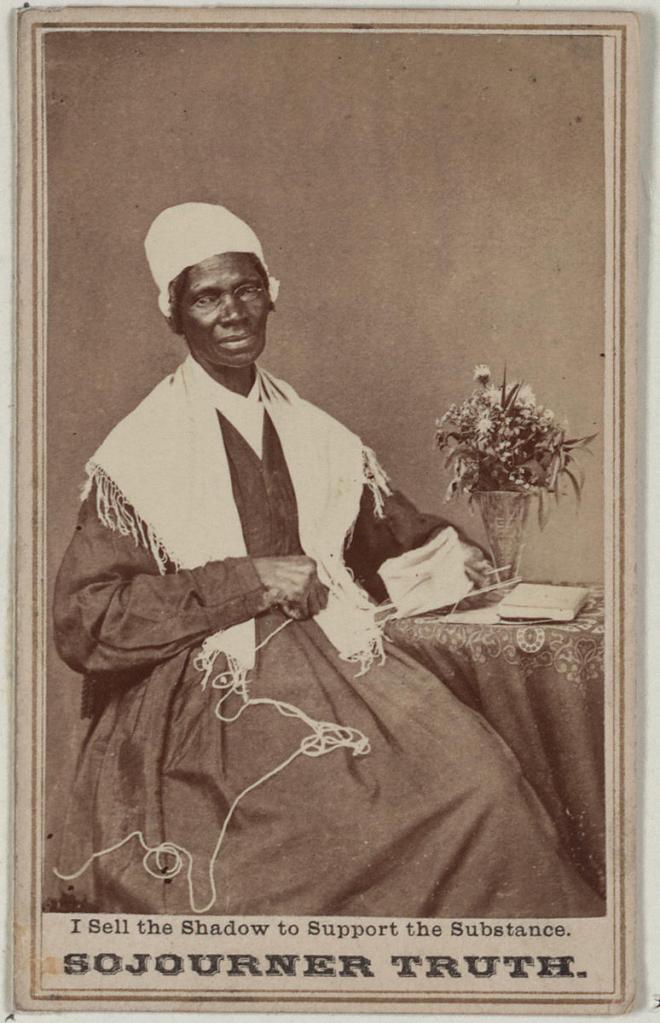
Sojourner Truth, c. 1864 Photographer: Mathew Brady Credit: National Portrait Gallery, Smithsonian Institution
Sojourner Truth (aka Isabella Baumfree Van Wagenen) c.1797 – 1883
Abolitionist Activist Speaker ***Local Connection: Zion Hill, Sparta*** (today the site of the Beechwood Condominium Complex off Route 9)
Sojourner Truth was born Isabella Baumfree in about 1797, to James and Elizabeth Baumfree. One of about ten children, the family was enslaved by a Col. Hardenburgh who owned a large farm in Ulster County, New York.
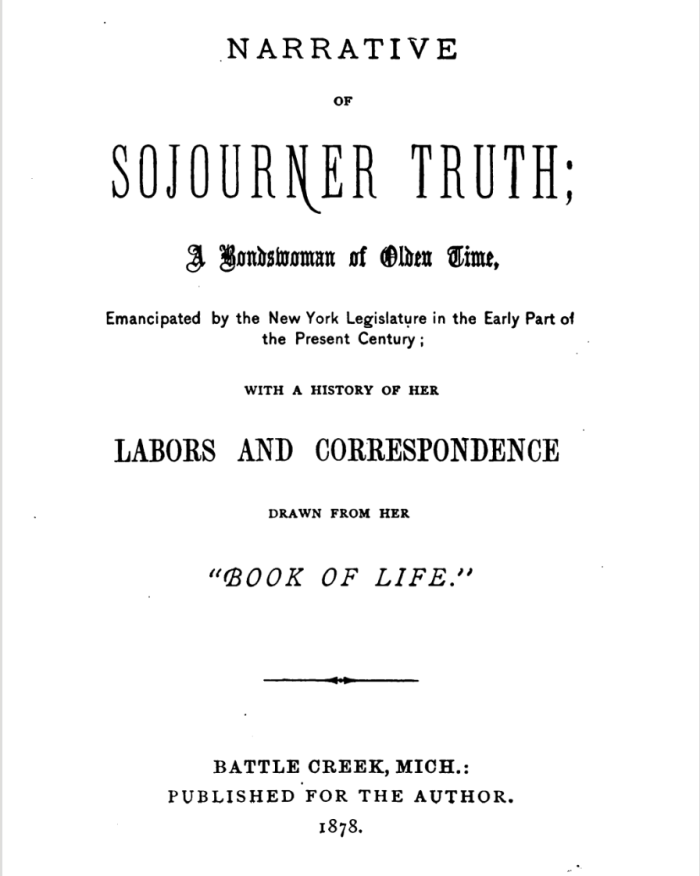
First, we’re able to know so much about her because in 1850 she dictated her memoirs to friend Olive Gilbert and they were published. This Book of Life would be added to and republished in 1878:
You can read it in its entirety here if you’re interested.
At the age of 9 (or so), Isabella was sold away from her family “for the sum of one hundred dollars, to one John Nealy, of Ulster County, New York; and she has an impression that in this sale she was connected with a lot of sheep.”
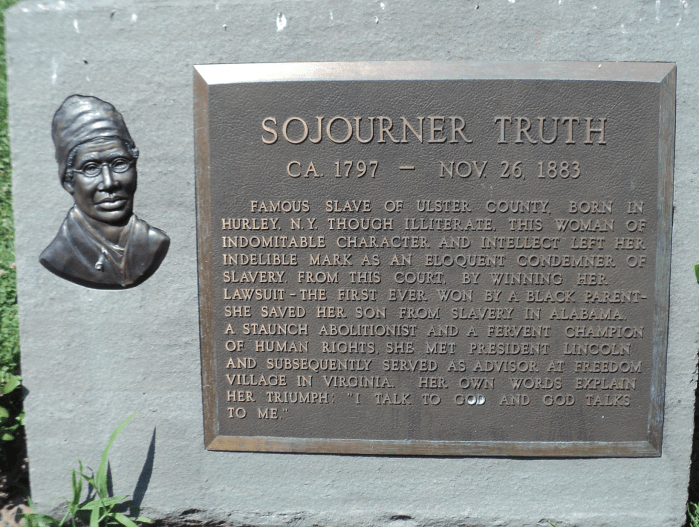
Sojourner Truth plaque in Ulster County
Her first language was Dutch, and she was said to speak with a Dutch accent when speaking English (which then brings into question the stylized “dees, dems and doze” accent she is often quoted as having in her famous “Ain’t I a Woman” speech. But more on that anon.)
Because at this point (she was NINE!) Isabella could only speak Dutch and the Nealys could only speak English, she was frequently whipped for her misunderstanding and confusion. Within a few years, she was again sold, this time to a tavern owner named Martinus Schryver who lived nearby in Port Ewen. She would later describe this as “a wild, out-of-door kind of life. She was expected to carry fish, to hoe corn, to bring roots and herbs from the wood for beers, go to the Strand for a gallon of molasses or liquor as the case might require . . . morally, she retrograded, as their example taught her to curse; and it was here that she took her first oath.”[3]
Within two years, Schryver sold her to a John Dumont in New Paltz, New York.
So, before she was 15, she had been taken from her family and sold as chattel to three other men.
Around the age of 18, she was “married to a fellow-slave, named Thomas, who had previously had two wives, one of whom, if not both, had been torn from him and sold far away.”[4] She would have about five children with Thomas.
Now, beginning in 1799, New York State began slowly abolishing slavery – so slowly, that it would take until 1827 for it to be completely outlawed. As described in her Narrative:
“After emancipation had been decreed by the State, some years before the time fixed for its consummation, Isabella’s master told her if she would do well, and be faithful, he would give her ‘ free papers,’ one year before she was legally free by statute. In the year 1826, she had a badly diseased hand, which greatly diminished her usefulness; but on the arrival of July 4, 1827, the time specified for her receiving her free papers, she claimed the fulfilment of her master’s promise; but he refused granting it, on account (as he alleged) of the loss he had sustained by her hand.”[5]
Furious, Isabella would sit down and spin about 100 pounds of wool before taking her infant daughter and walking away from the Dumonts early one morning (walked away, not run away. The distinction was important to Isabella.) She would eventually find herself in the home of the Van Wageners, an abolitionist, Quaker couple. When John Dumont tracked her to the Van Wageners, they offered $25 for Isabella and her infant. Dumont acquiesced, and Isabella lived with the Van Wageners (and took their name) until she was legally freed by the State of New York a year later.
Once free, Isabella Van Wagener wanted to find her young son, Peter who, at the age of five, had been sold away from Isabella by John Dumont. Now, human enslavement in New York State operated in a bit of a gray area. Post-1799, several laws were passed that would free all enslaved minors once they reached the age of 21, and specifically outlawed selling enslaved minors out of state. However, these laws were enforced only occasionally. But Isabella Baumfree was not to be trifled with and she marched down to the courthouse to file a lawsuit. Long story short, she got her son back from Alabama where he’d been sold – a remarkable feat for a woman of that era.
A page from court documents pertaining to Isabella (Baumfree) Van Wagener’s suit to regain her son, Peter, recently discovered in the NYS Archives Courtesy of the New York State Archives
It’s at this point in her life that Isabella Baumfree Van Wagener’s Ossining connection arises. It’s a very complicated story and even the Narrative doesn’t get into the particulars, but let’s just say that in 1833 she was hired to be a housekeeper for what can really be only called a cult, led by one Prophet Matthias. They all ended up in a house in Sing Sing/Scarborough called Zion Hill (still standing today as part of the Beechwood condominium complex,) living with Benjamin and Ann Folger.
We can be quite certain that she really did live here, because Benjamin Folger implicated her in the murder of one Elijah Pierson, a follower of Matthias and resident of Zion Hill, who mysteriously died after eating blackberries. But though accused of murder, Isabella went to court, sued Benjamin Folger for libel and, amazingly, won. See (former Ossining Village Historian) Miguel Hernandez’s article here for a deeper dive.
Isabella would continue working as a servant for about ten more years, before she heard the Lord call on her to preach. She changed her name to Sojourner Truth on Pentecost Sunday, 1843 and began preaching against slavery. By all accounts she was a very charismatic speaker and an inspiring singer. She would go on to dictate her memoirs, and with the proceeds, buy a house in Massachusetts.
In 1851, Sojourner Truth gave her famous “Ain’t I a Woman” speech at the Ohio Women’s Rights Convention.
Today it’s believed that this is probably not at all an accurate representation of the speech Truth gave. A transcription was published at the time and is very unlike the version that has become associated with Truth. In fact, it wasn’t until 1863, at the height of the Civil War, that the version linked to above became the accepted version. (For more on this, check out the Sojourner Truth Project here.) But let’s just say the popular speech sounds pretty racially stereotyped linguistically and not at all like it came from someone who spoke with a Dutch accent.
Regardless, I think we can agree that Truth’s speech enlightened many who heard it, as did her life story.
Truth was a savvy marketer. She would sell Cartes de Visites (postcards) like the one below to support herself and fund her lecture tours. Often carrying the caption “I sell the shadow to support the substance,” these cards symbolized Truth’s struggle between self-promotion and her desire to be seen as a sophisticated and respectable free woman. Distributed at anti-slavery conventions and through mail orders, these postcards became wildly popular, enabling Truth to fully pay off her first home within three years and then purchase a second home.
In this image, the seemingly random coils of yarn on her skirt are believed to have been placed quite deliberately – if you look closely, they seem to form the shape of the east coast of the United States. This symbol reiterates Truth’s message of freedom and equality that applied to all states, both North and South. Courtesy of the Library of Congress
Truth would move to Michigan, join a Seventh Day Adventist sect there, all the while preaching about equality.
She would die in Battle Creek, MI in 1883, in the home she owned, bought with money she had earned from her writing and speeches, surrounded by her children.
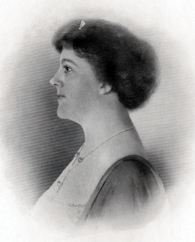
Today’s Women’s History Month post is celebrating Edith Carpenter Macy (1869 – 1925).
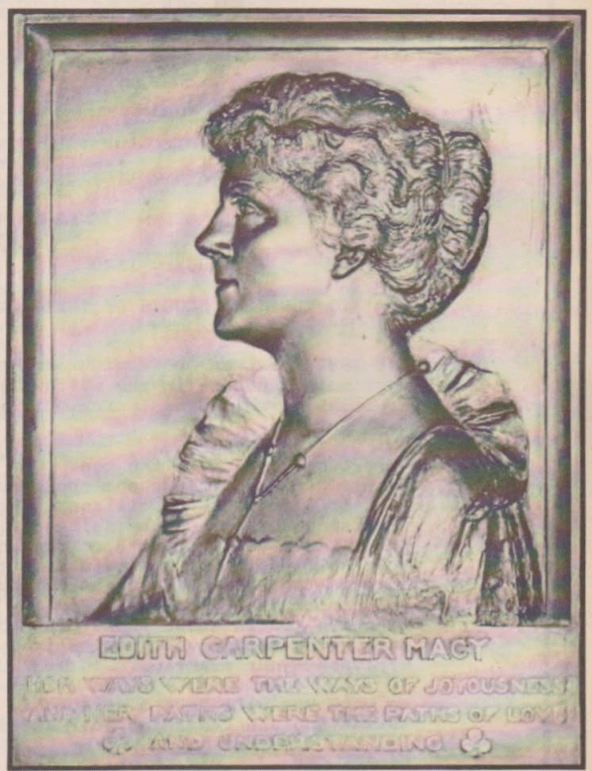
Edith Carpenter Macy, plaque located at the Edith Macy Center. Photo from the Girl Scouts Archives
If you’ve ever shopped at the Chilmark Center on the border of Ossining and Briarcliff Manor, you’ve been wandering through what was part of V. Everitt and Edith Carpenter Macy’s eponymous farm and estate.
Also, if you’ve ever bought a box of Girl Scout cookies, you were enjoying a fundraiser popularized by Edith Macy in the 1920s, in her position as Chair of the Girl Scout Board of Directors.
Edith Macy lived amidst great privilege. Marrying Valentine Everit Macy in 1896, she would benefit from his prodigious wealth (he inherited $20 million at the age of 5 thanks to his father’s canny merger with Standard Oil – but more on that in another post).
The 1900 Census notes that she and Everit had a butler, a 2nd butler, a cook, 3 maids (kitchen, chamber and ladies’), a laundress, and a nurse living with them on Underhill Road.
But though it might sound like she lived the American version of Downton Abbey (sorry, it’s that 2nd butler listed above!) Edith Macy spent much of her time working for the good of others.
Like many of her neighbors (Narcissa Cox Vanderlip, Carrie Chapman Catt and Elizabeth Underhill, just to name a few) Macy participated wholeheartedly in the fight for women’s suffrage. And once the 19th amendment was passed in 1920, (though let’s not forget that New York State passed a women’s suffrage act in 1917), Macy became the Director of the Westchester League of Women Voters.
But Edith Macy wasn’t content with only being associated with suffrage – she was also active in charities that directly helped poor women and children.
Now, one of the things I enjoy about writing these posts is that not only do I learn about the individuals I write about, but I gain granular insights into what the world was like “back then.” In writing up Mrs. Macy’s story, I’m reminded about all the things we take for granted today, such as the right for women to vote, pure food, and not seeing the majority of your children die before they reach adulthood.
One of the many organizations Mrs. Macy was involved in was the Henry Street Settlement. According to the Scarsdale Inquirier, “Long before the milk situation in New York city was satisfactory, [she] took an active part in the work of the Henry Street Settlement and furnished pure milk for the babies to that settlement from [her] farm at Chilmark.”[1]
I think it’s worth unpacking that snippet a bit, because we so take for granted that the milk we get in our supermarkets is safe for human consumption. But back at the turn of the 20th century, that was decidedly not the case. In 1901, in response to rising infant mortality rates, especially in the poorer sections of Manhattan, the Rockefeller Institute commissioned a report on the sanitary conditions in New York’s milk industry. They documented the generally filthy conditions found in local dairies, such as open vats of milk stored in stables and near manure piles that resulted in skyhigh bacterial content that sickened and killed thousands of infants.
So this “pure milk” the Macys supplied to the Henry Street Settlement was more than just a small PR stunt – they were actually responding to a serious need until routine pasteurization of milk was adopted in New York City in 1912.
In 1914, she helped found the Westchester County Children’s Association – an organization that still thrives today and, true to its original mission, provides direct support for children’s programs while also lobbying on behalf of policies that will benefit Westchester’s children.
Macy’s interest in women’s suffrage rather naturally steered her to the Girl Scouts, an organization she would help lead from 1919 – 1925. She thought it was never too early to educate girls about citizenship and how they could be effective, useful members of society. Indeed, one of her first initiatives was to involve the Girl Scouts in the final campaign that helped pass the 19thAmendment.
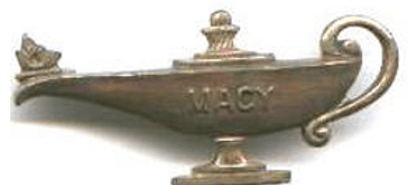
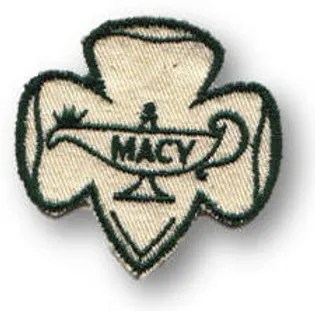
Vintage pin and patch celebrating Edith Macy. Photo credit Vintagegirlscout.com
Sadly, Edith Macy died suddenly at the age of 55. In her honor, her husband purchased 200 acres of land and established the Edith Macy Center, a permanent place for Girl Scout leaders to receive training. The Edith Macy Center at 550 Chappaqua Road is still active today and still named after her.
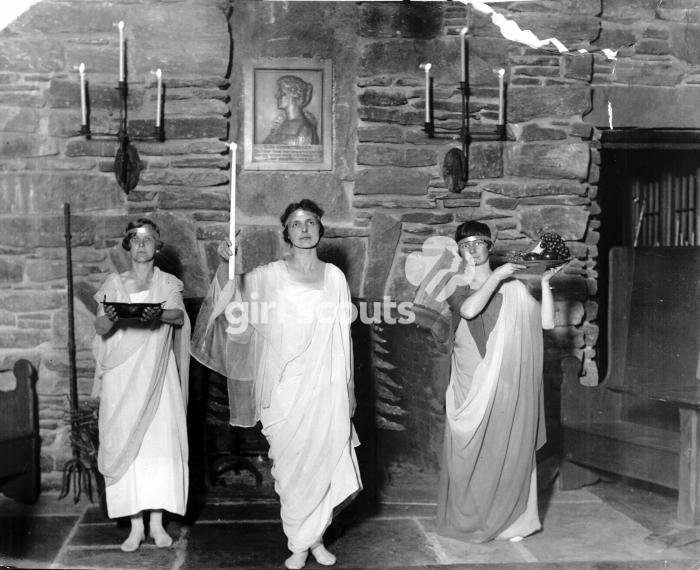
Dedication of Camp Edith Macy in Great Hall, 1926. Left to to Right: “Warmth”, Ruth Mitchell; “Light”, Oleda Schrottky; “Food”, Elsa G. Beeker. Plaque of Edith Macy on the wall behind them Photo credit the Girl Scouts Archives
[1] Scarsdale Inquirer, Volume VI, Number 12, 14 February 1925





 Ossining History on the Run