Margaret (“Margie”) Griesmer – Founder, Open Door Family Medical Center

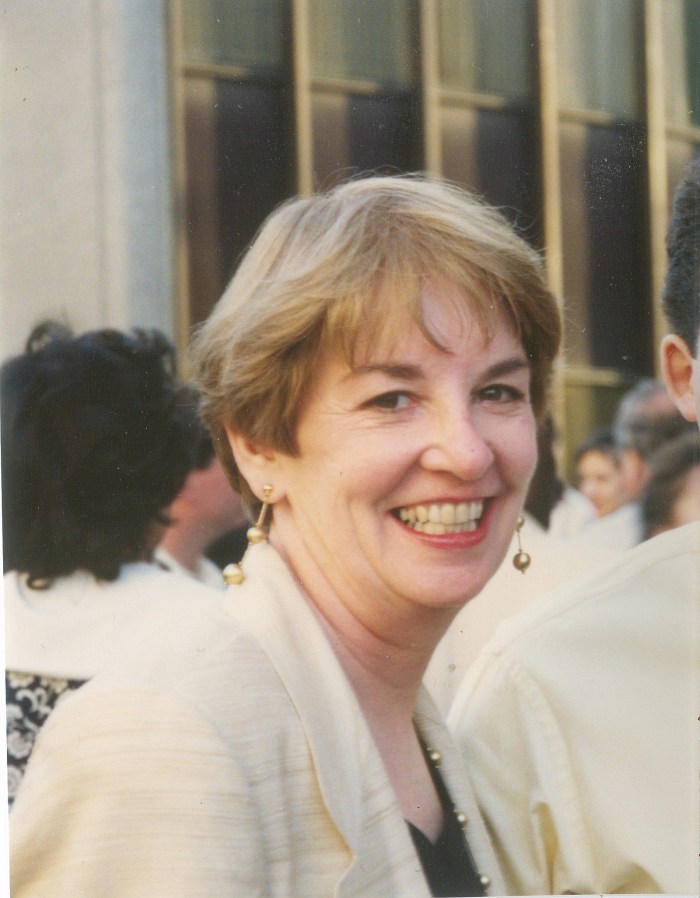
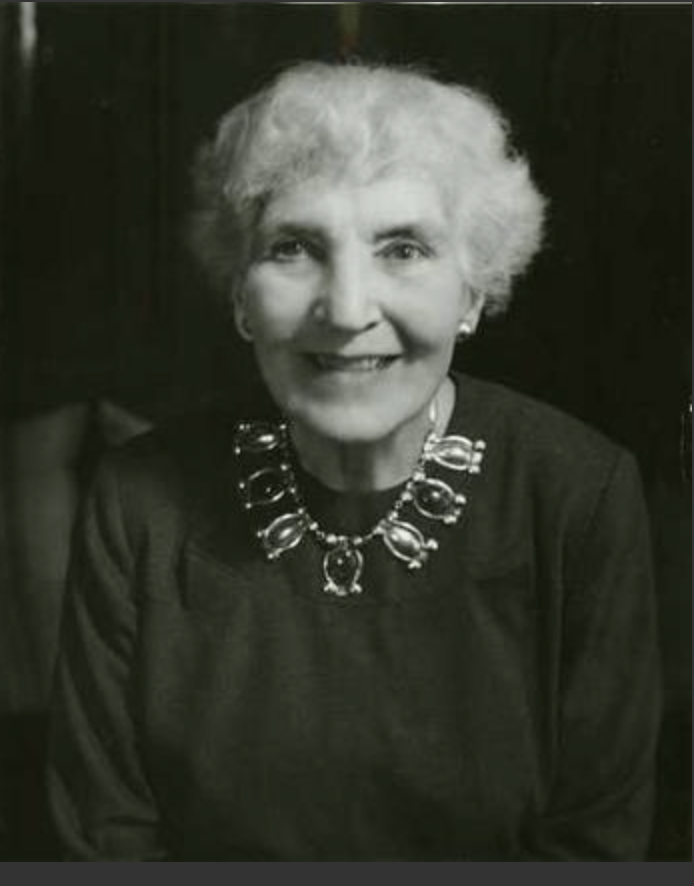
Margaret “Margie” Griesmer 
Courtesy of Open Door Family Medical Center

Margaret “Margie” Griesmer
1934 – 2008

Founder and First Executive Director of the Open Door Family Medical Center
***Local Connection: 165 Main Street

Margaret “Margie” Griesmer made a tremendous difference to thousands, maybe even hundreds of thousands of people in and around Ossining.   

And her legacy continues.

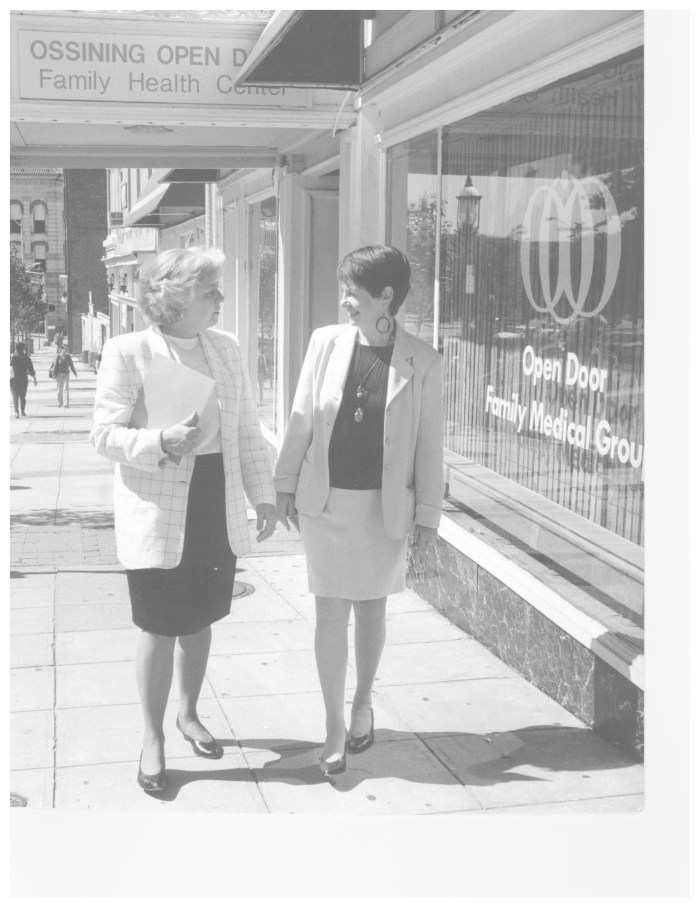
Those of you who live in Ossining are no doubt familiar with the Open Door Family Medical Center.  Located at 165 Main Street, it was the first location of what has become a chain of accredited health centers that serve the un- and underinsured throughout Westchester, Putnam, Dutchess and Ulster counties.

In 1972, Griesmer was the driving force behind its founding and development, quietly and methodically laboring to bring excellent, low- to no-cost health care to marginalized community members and the working poor.

Born in 1934, Griesmer graduated from the Mercy School of Nursing in Detroit, Michigan.  Marrying soon after graduating, she moved to Ossining with her husband and had four children.

In 1970, the family relocated to Berkeley, California for a year when her husband, an IBM mathematician and researcher, was granted a sabbatical.

While there, Griesmer volunteered at the Berkeley Free Clinic, a self-described “radical volunteer health collective . . . that believes that health care is a fundamental human right.”  Griesmer was inspired by what she saw and determined to replicate the concept in Ossining.

Free health clinics were growing in popularity in the 1960s and early 1970s, thanks in part to the civil rights movement and the War on Poverty.   But when New York State decided that such clinics needed oversight and licensing, many clinics shuttered.  It’s here that Open Door found its niche.  As a registered nurse, Griesmer was uniquely positioned to work with local medical professionals, and get the needed licensing to operate.

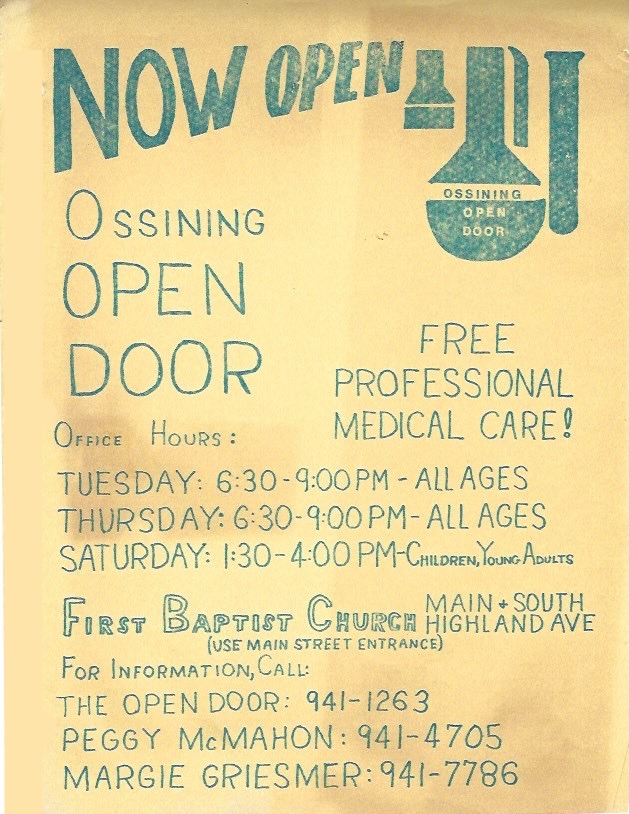
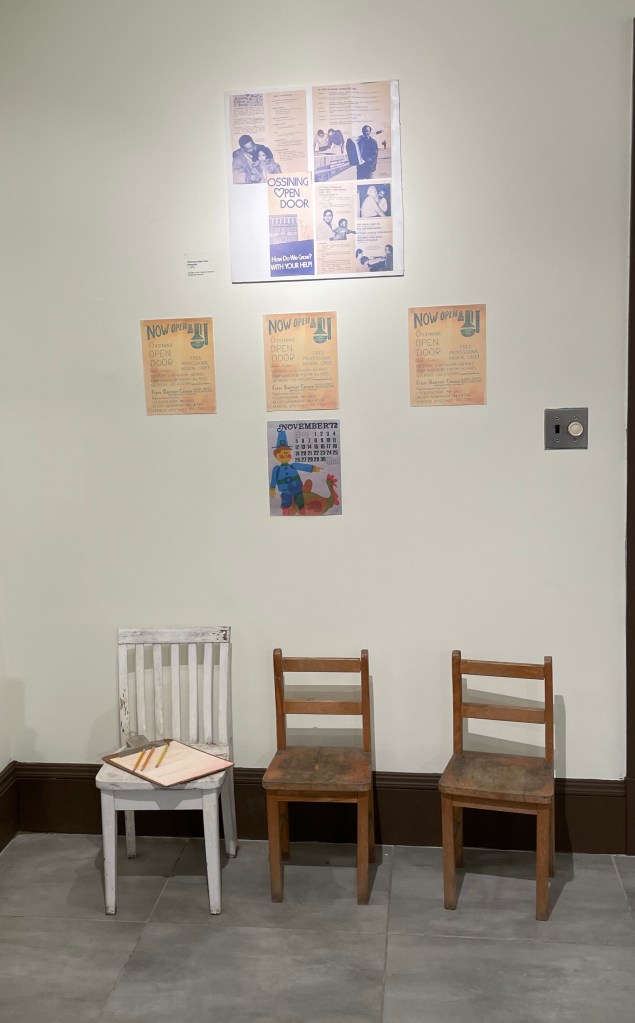
The first Open Door clinic was located in the basement of the First Baptist Church at 1 Church Street, Ossining. With an all-volunteer staff (doctors, nurses, technicians) it was only open Tuesday/Thursday nights and Saturday mornings. The waiting room was the Sunday School room, and the patients sat on tiny little chairs waiting for their appointments. 

Original Open Door Flyer, c. 1972
Courtesy of Open Door Family Medical Center
Artistic re-creation of that first waiting area at the First Baptist Church c. 1972

 That first year, the clinic saw over 1,000 patients. Griesmer reached out to businesses in the community for support, and organizations such as IBM, the Ossining Chamber of Commerce, A.L. Myers and the Junior League of Westchester contributed in various ways to help fit out that first clinic.

The goals were wide-ranging and egalitarian:

“The Ossining Open Door came into being because of an urgent need in Ossining not only to treat the physical illnesses of the underprivileged but to comfort our elderly, counsel our youth, and listen to the lonely.”

Griesmer would be named Executive Director in 1973, a position she held for over 20 years.

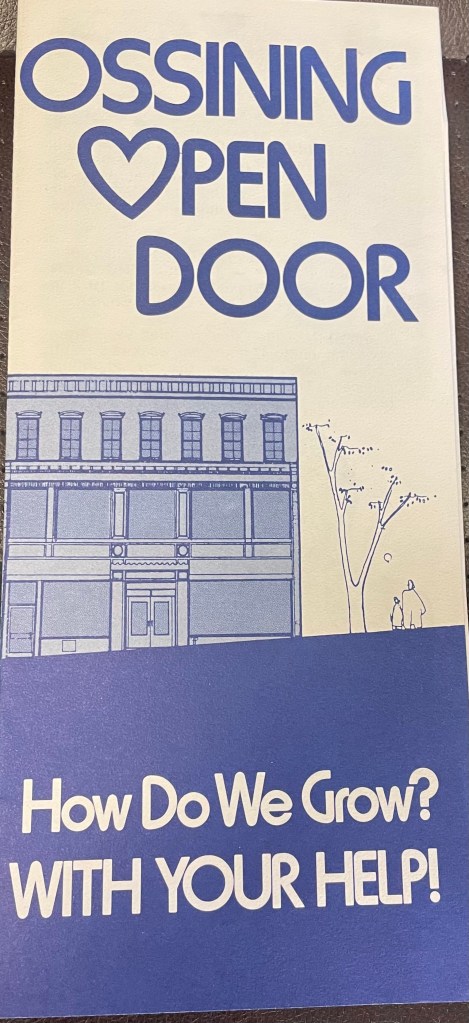
In 1976, Open Door moved to 165 Main Street (formerly Hilliker’s Department store) and in 1988, took over the adjacent building at 163 Main Street.  Since then, they’ve hired full time physicians, nurses, technicians, dentists, specialists, social workers, psychologists, started a pre-natal program in collaboration with Phelps Hospital, opened clinics in Mt. Kisco, Brewster, Mamaroneck, Port Chester, Sleepy Hollow, Saugerties and pioneered school-based health centers in nine schools throughout the region.
Pamphlet for new location at 165 Main Street
Courtesy of the Ossining Historical Society and Museum

Griesmer was a visionary with a solid medical background who also happened to excel at relationship building and fundraising. It was a powerful and effective combination.

With Assemblywoman Sandy Galef, c. 1980
Courtesy of Open Door Family Medical Center

An excellent judge of people, she filled the ever-expanding Open Door with dedicated professionals who shared her drive to improve and grow the services offered to the community.

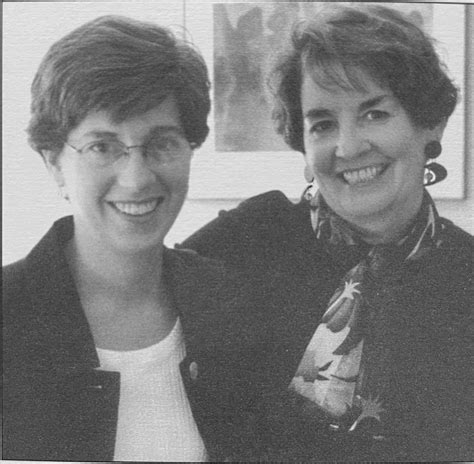
In 1998, Griesmer tapped Lindsay Farrell as her successor. A volunteer who started helping out in 1986,  Farrell continues in the CEO position today, carrying on and expanding Margie Griesmer’s vision to make quality health care available to all.

Today Open Door serves over 60,000 patients at seven locations throughout Westchester, Putnam and Ulster counties, with an additional nine school-based health clinics. And, as has always been the case, care is available to anyone — fees are determined on a sliding scale.

Lindsay Farrell and Margie Griesmer, c. 1990s
Courtesy of the Open Door Family Medical Centers

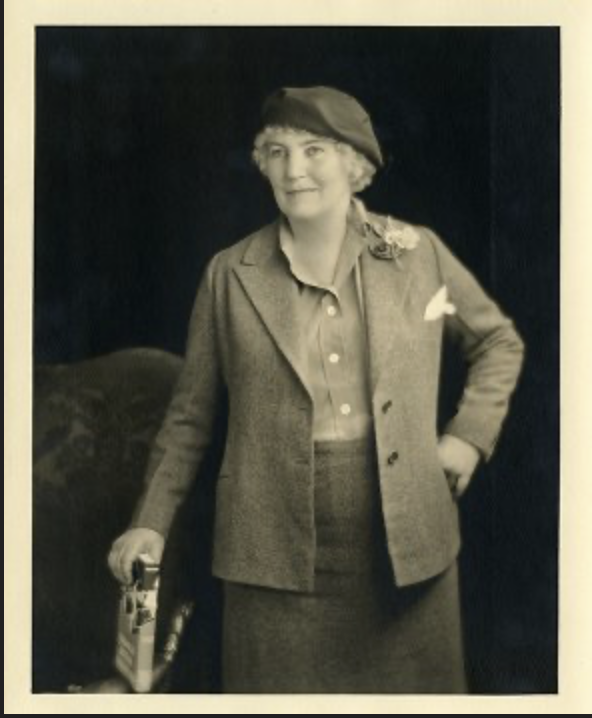
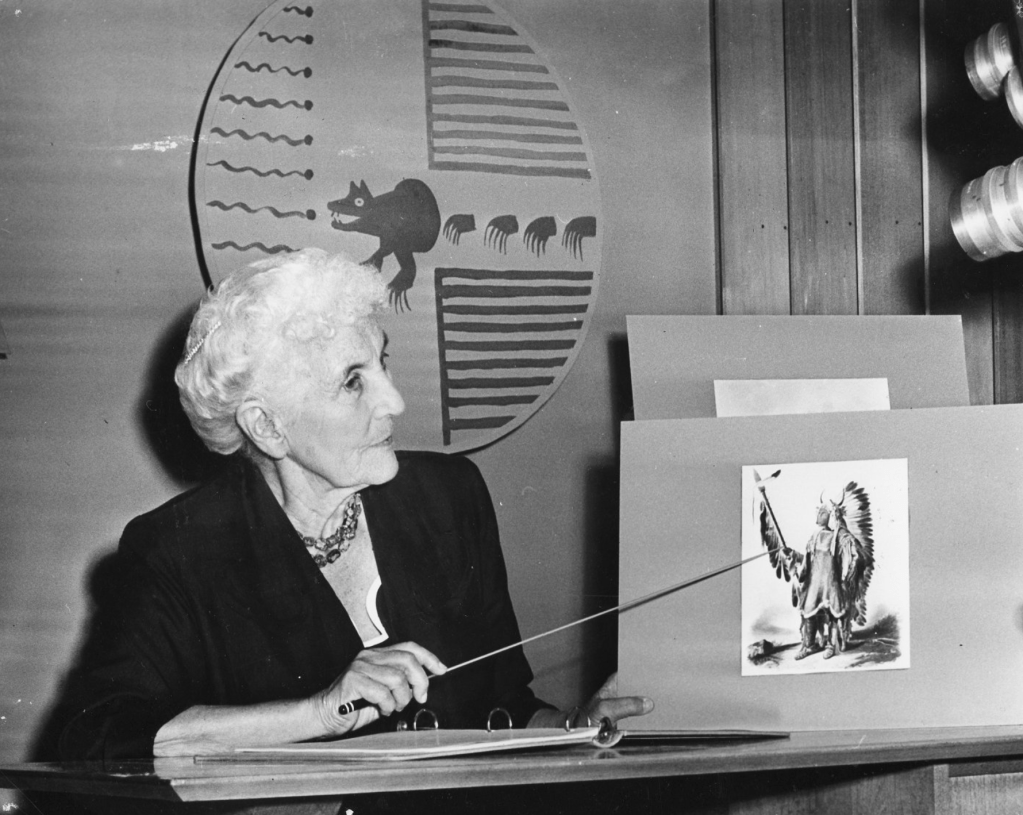
Dr. Ruth Murray Underhill – Anthropologist

Dr. Ruth Murray Underhill
Courtesy Denver Museum Nature and Science Center

Dr. Ruth Murray Underhill
1883 – 1984

Red Cross Volunteer WWI
Anthropologist
Author
Professor
Television/Radio Host

***Local Connection:  Linden Avenue***

Ruth Murray Underhill was an anthropologist known for her work with Native Americans of the Southwest.  She was also a social worker, a writer, a Supervisor at the Bureau of Indian Affairs, a professor, and a local television/radio host.  Multi-lingual, Underhill spoke several Western languages, including O’odham and Navajo.
 
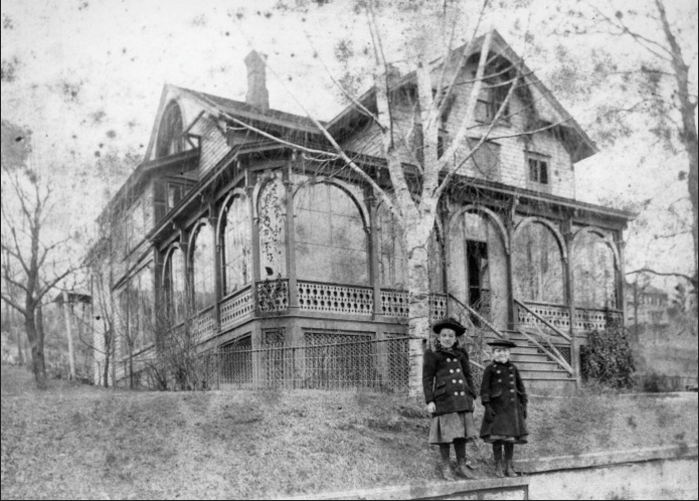
Underhill was born in Ossining in 1883. She grew up on Linden Avenue in the rambling Victorian home built by her father in about 1878. (The building still stands today.)

Ruth Murray Underhill and sister Margaret 
in front of the family home on Linden Avenue
c. 1890
 Courtesy of the Denver Museum of Nature & Science

The daughter of Abram S. Underhill and Anna Murray Underhill, her pedigree stretches back to one of the earliest European settlers of this country – Captain John Underhill, who arrived in 1632.  And, according to a 1934 article in the Democratic Register, going even further back, the Underhills were related to a William Underhill of Stratford-upon-Avon who reportedly sold William Shakespeare his home.  
(It is impossible to ignore the irony that this woman, who spent much of her adult life studying and recording the language and culture of Native Americans, was directly related to Captain John Underhill, a man infamous for his brutal tactics against the Native Americans in the 1600s.  He led several bloody massacres and murdered hundreds (if not thousands) of Lenape during the Dutch era in New York State.) 
 
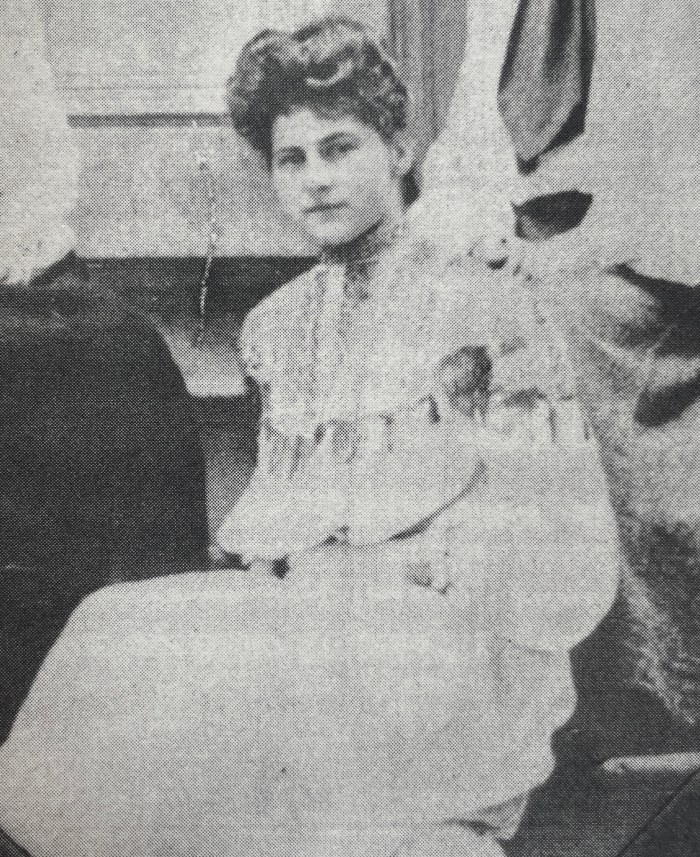
Ruth Underhill attended the Ossining School for Girls (located just across the street from today’s Ossining Public Library):

She would go on to study at Vassar College, graduating in 1905. 

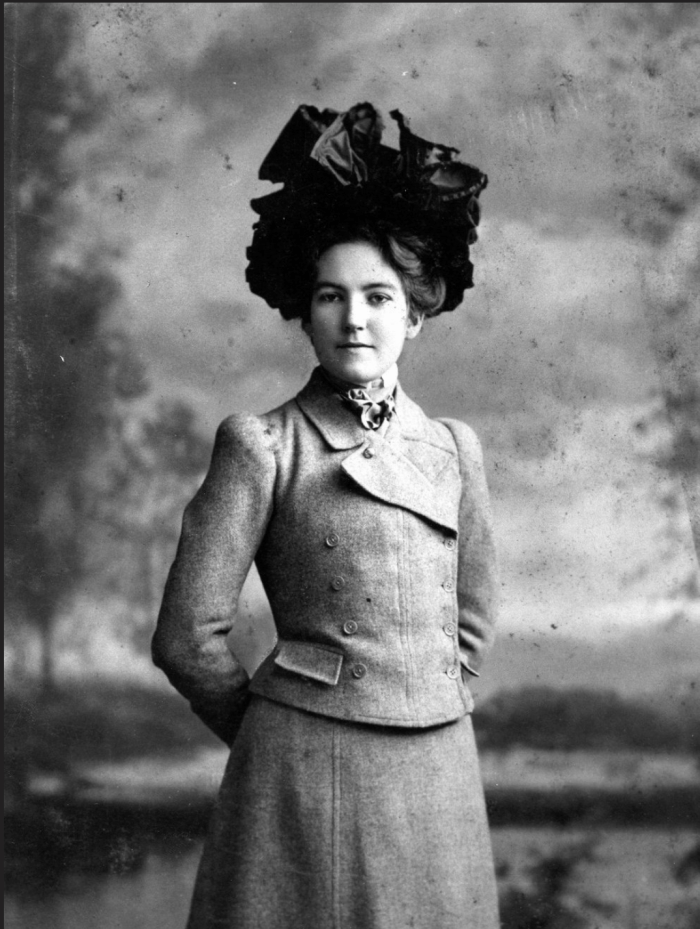
Ruth Murray Underhill, c. 1900
Courtesy of the Denver Museum of Nature & Science

But, as she wrote in her memoir An Anthropologist’s Arrival
 
“I did not start with a career and a goal in mind, not even the goal of marriage – for nice girls did not know whether they would be asked or not. I pushed out blindly like a mole burrowing from instinct.  My burrowings took me to strange places and now in my last hole I am trying to remember how I bumbled and tumbled from one spot to another. This is the story for those friends who wondered how I could even have started the bumbling, for many girls of my era did not.”
 
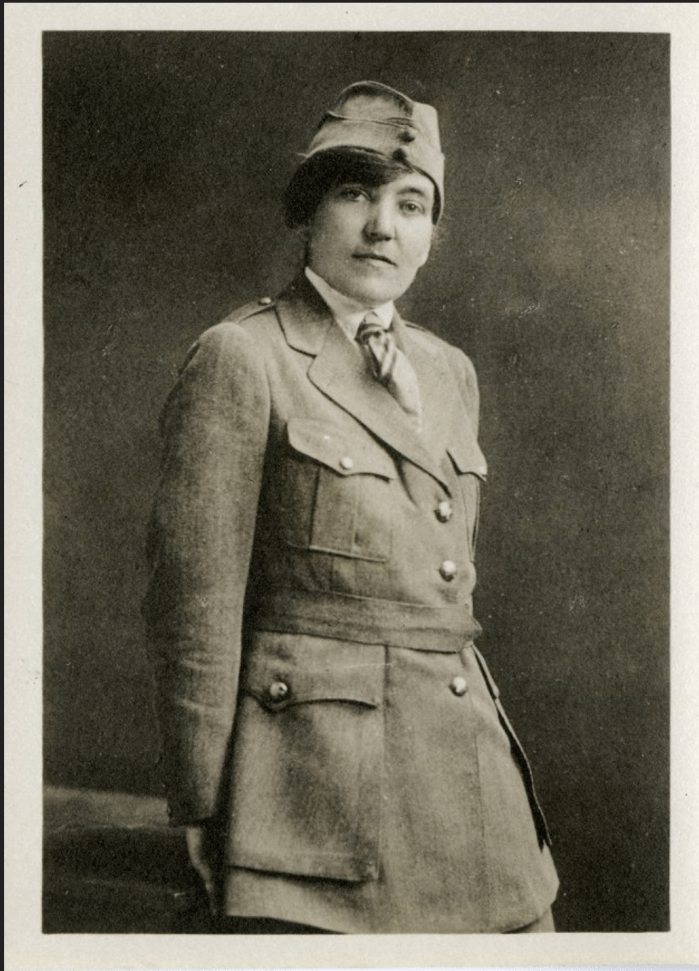
She spent the next decade searching for her calling – briefly serving as a social worker first in Massachusetts, then in New York City, then traveling around Europe with her family. When World War I broke out, she volunteered for the Red Cross, organizing orphanages for the children of Italian soldiers killed in battle.

Ruth Murray Underhill in Red Cross Uniform, c. 1917
Courtesy of the Denver Museum of Nature & Science

In 1919 she married Charles Crawford, but she described it as a loveless marriage on both sides that would end in divorce a decade later. 
 
At age 46, Underhill went back to school, enrolling in a graduate program at Columbia University.  

Ruth Murray Underhill c. 1930s

In her memoirs, Underhill tells the story about how she ended up studying anthropology: 

“I am no longer quite sure which departments I visited before anthropology. I think they were sociology, philosophy, and economics. What I said to them in substance was: ‘I find that social work is not doing what I thought it did. I wonder if what you teach would really help me to understand these people. I want to understand the human race. How did it get into the state it is in?’

Upon asking this question of Dr. Ruth Benedict, a well-respected professor in the anthropology department, she found her answer: “You want to know about the human race? . . . Well, come here. That is what we teach.”
 
At the time, the chairman of Columbia’s anthropology department was Dr. Franz Boas, considered by many to be the “father of modern anthropology.” He seems to have been unusually encouraging towards female students – Margaret Mead and Zora Neale Hurston, among others, who studied with him. Both Boas and Benedict would encourage Underhill to pursue a PhD. [Fun Fact: Dr. Boas is buried in Ossining’s Dale Cemetery.]

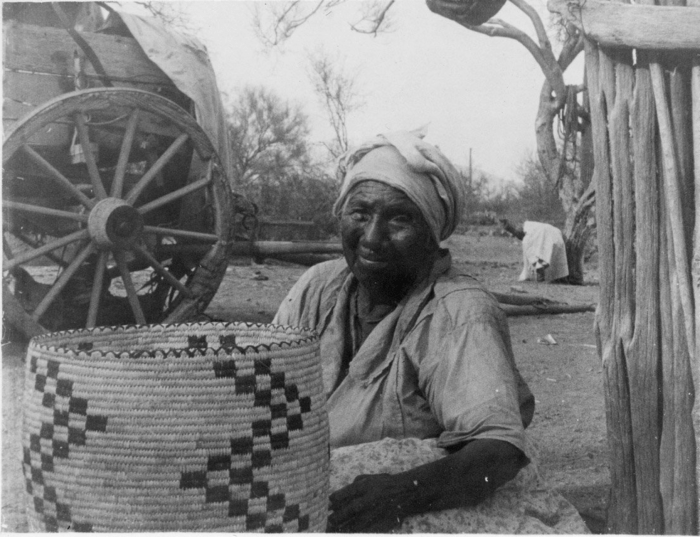
In 1936, Boas financed field work for Underhill to go to Arizona to study the Papago (today known as the Tohono O’odham.) Out of this work came Underhill’s doctoral thesis “Social Organization of the Papago Indians” and the first published autobiography of a Native American woman, Autobiography of a Papago Woman. Living with and studying the Papago in southern Arizona for several years, she became close to Maria Chona, an elder and leader of her tribe.   

Maria Chona, Elder of the Papago (Tohono O’odham) c. 1936
Courtesy of the Denver Museum of Nature & Science
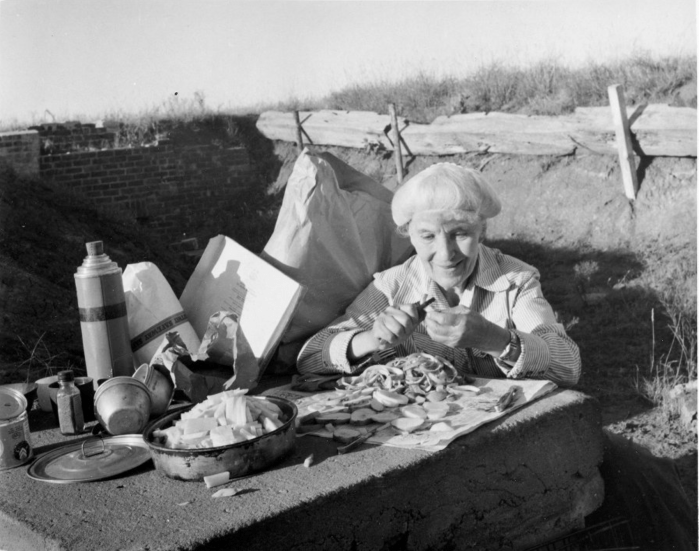
Dr. Underhill peeling potatoes at her campsite in Arizona, c. 1936
Courtesy of the Denver Museum of Nature & Science

In her book, Underhill documented the rites, ceremonies and history of Chona and her tribe.  Underhill even wrote about the rituals surrounding menstruation, which must have been deeply shocking for her readership at that time.

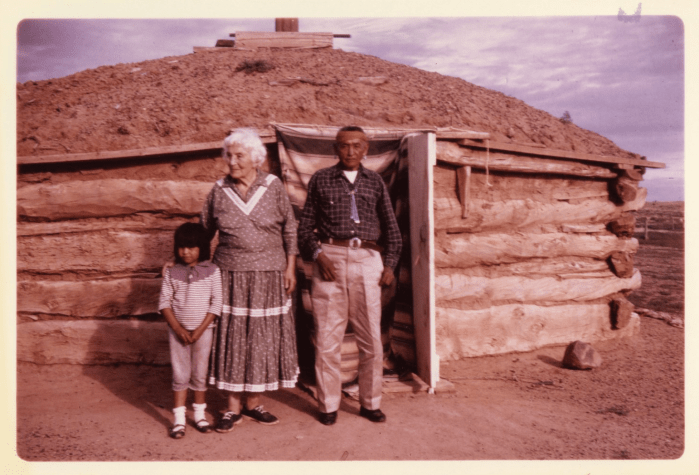
Underhill received her doctorate in 1937 and began studying Navajo culture.

Dr. Underhill with members of the Navajo nation, c. 1940s
 Courtesy of the Denver Museum of Nature & Science

From there, she went on to work for the Bureau of Indian Affairs, becoming Supervisor of Indian Education and helping develop curricula for Native American reservation schools. 

In 1948 Underhill became a Professor of Anthropology at the University of Denver, but “found the students languid.”  

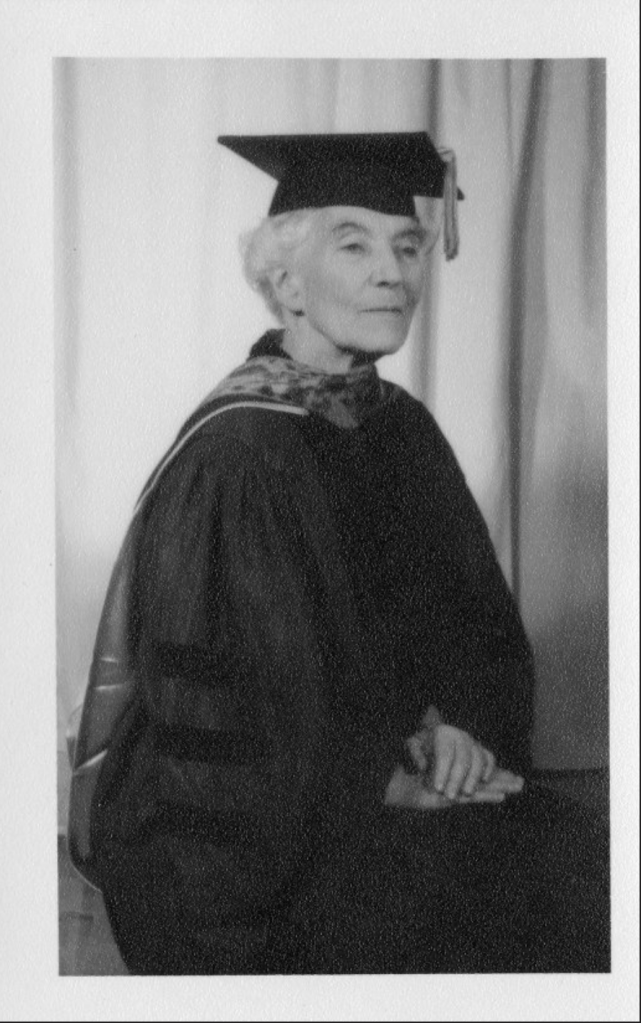
Dr. Underhill in cap & gown for a University of Denver Commencement, c. 1950
Courtesy of the Denver Museum of Nature & Science

She would retire from the University just five years later and travel the world solo.

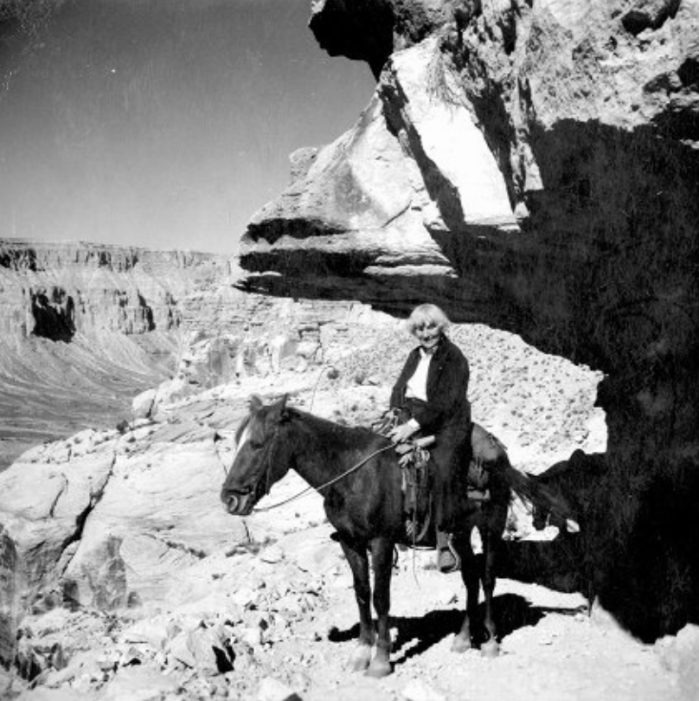
Dr. Underhill at the Rainbow Bridge in Arizona, c. 1950
Courtesy of the Denver Museum of Nature & Science

Upon returning home, she would write what is considered her seminal work, Red Man’s America – a textbook on Native American cultures and histories.  

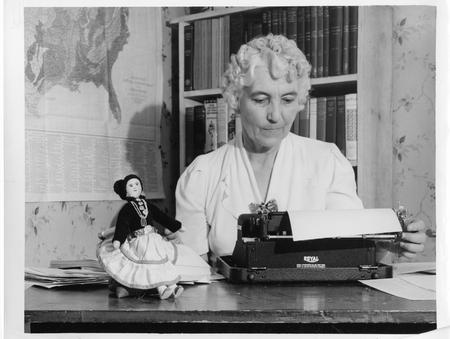
Dr. Underhill c. 1950s
 Courtesy of the Denver Museum of Nature & Science

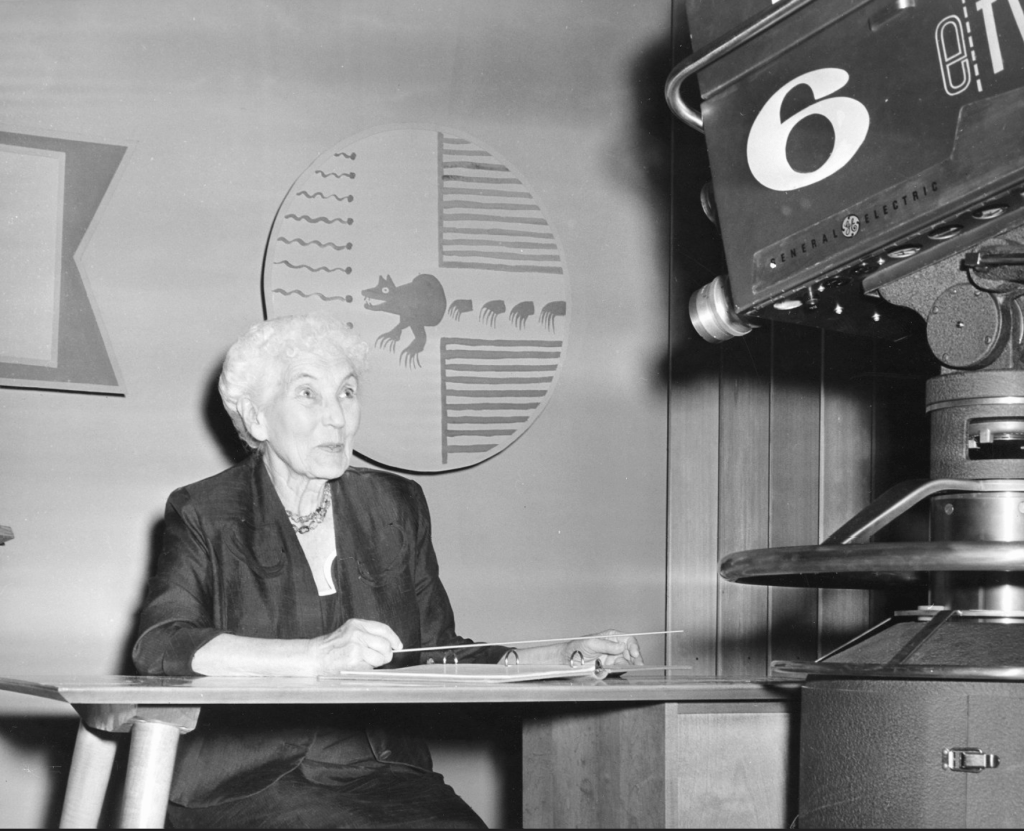
On the strength of that, she was asked to host a public television program of the same name that ran from 1957 – 1962.

Dr. Ruth Murray Underhill on TV c. 1957 
 Filming “Red Man’s America” for KRMA-TV channel 6, an educational TV station owned and operated by the Denver Public Schools.
 Courtesy of the Denver Museum of Nature & Science

Underhill would stay in contact with the members of the Papago and in 1979, they honored her with the following:

“It was through your works on the Papago people that many of our young Papagos, in search of themselves, their past, their spirit have recaptured part of their identities. Your works will continue to reinforce the true identity of many more young people as well as the old.   It is with this in mind that we wish to express our deep sense of appreciation.”

She would die just shy of her 101st birthday.

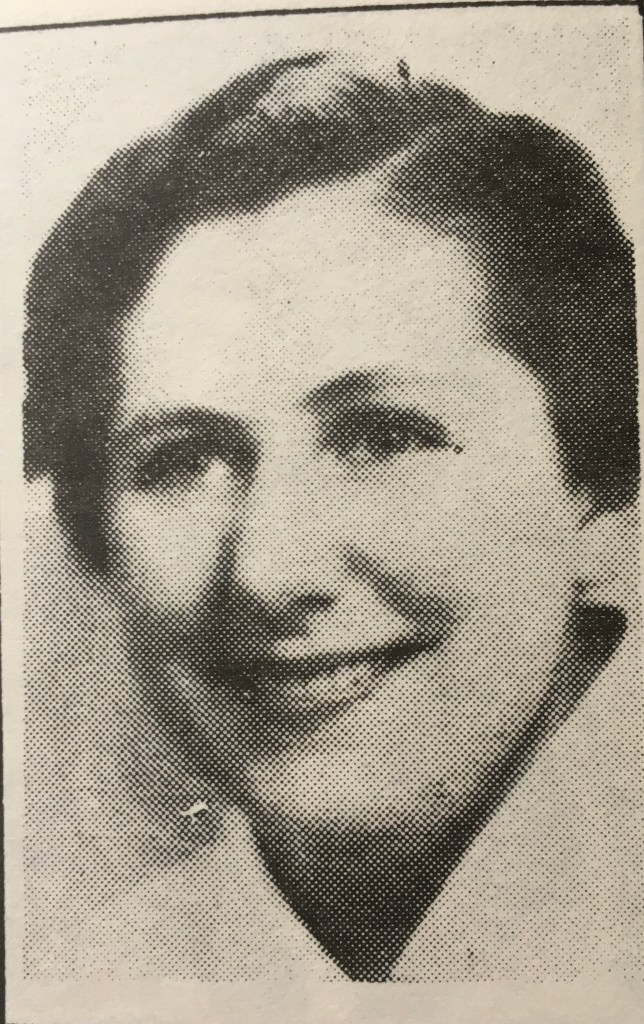
Ensign Mary Feeney Gordenstein

Ensign Mary Feeney Gordenstein
Courtesy of the Ossining Historical Society and Museum

Ensign Mary Feeney Gordenstein
1916 – 1943
OHS 1933


U.S. Navy Nurse, Died in Action , World War II
 ***Local connection:  Hamilton Avenue
***

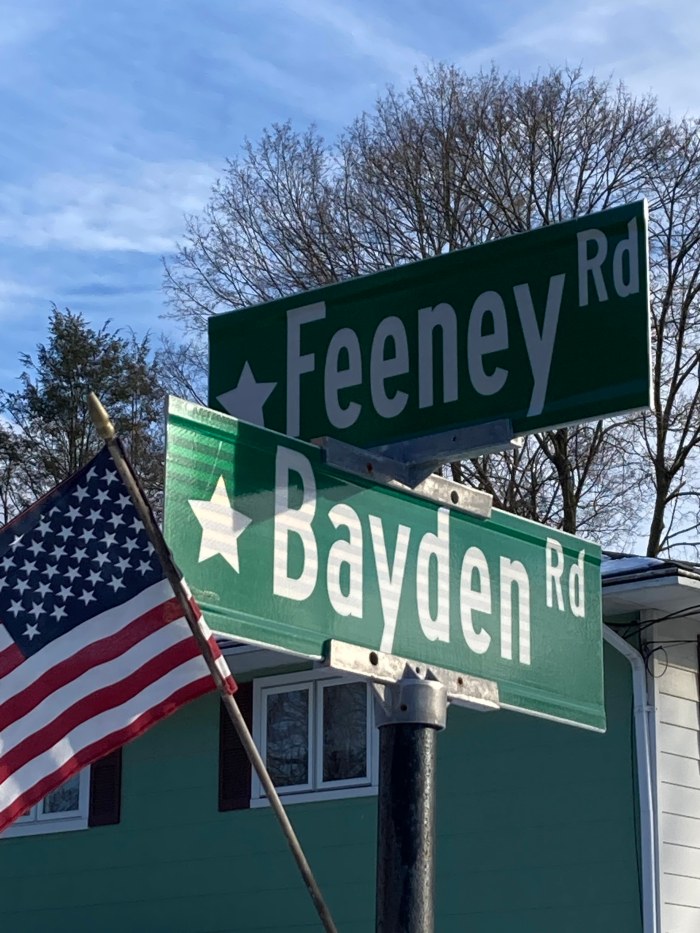
Did you know that Feeney Road in the Town of Ossining is named after Ensign Mary Feeney Gordenstein, a US Navy nurse who died in Pearl Harbor, Hawaii on April 14, 1943?

Mary Feeney was born in Ossining on September 11, 1916, to John and Ida Mae (Farren) Feeney.  Her father was a desk clerk for the Ossining Police.

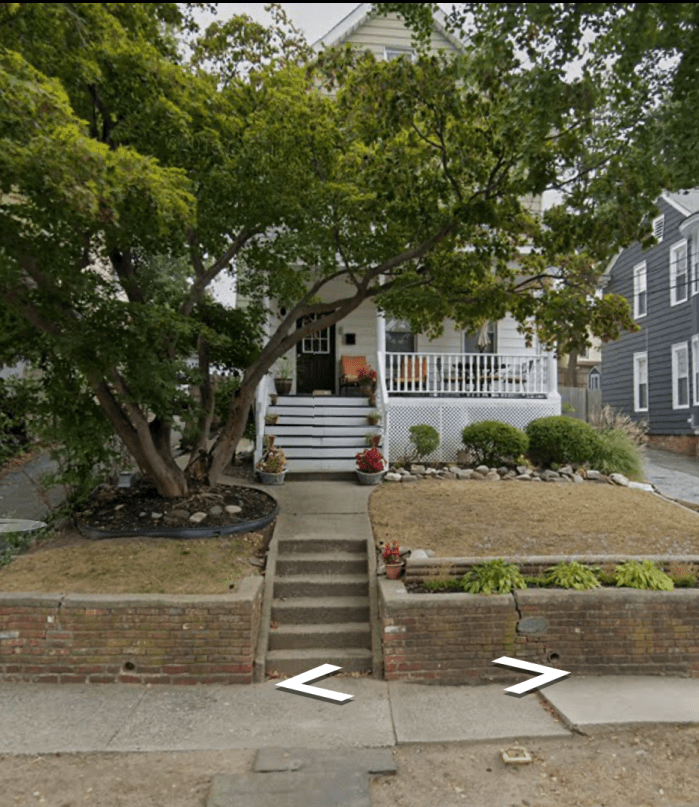
They first rented a house at 72 South Highland Avenue and then moved to 31 Hamilton Avenue.

Both houses still stand today:

72 Highland Avenue. Photo source: Google Streetview
31 Hamilton Avenue. Photo source: Google Streetview

Mary went to Ossining High School, graduating in 1933. She then went on to study at the Cochran School of Nursing at St. John’s Riverside Hospital, Yonkers, graduating in 1937.  

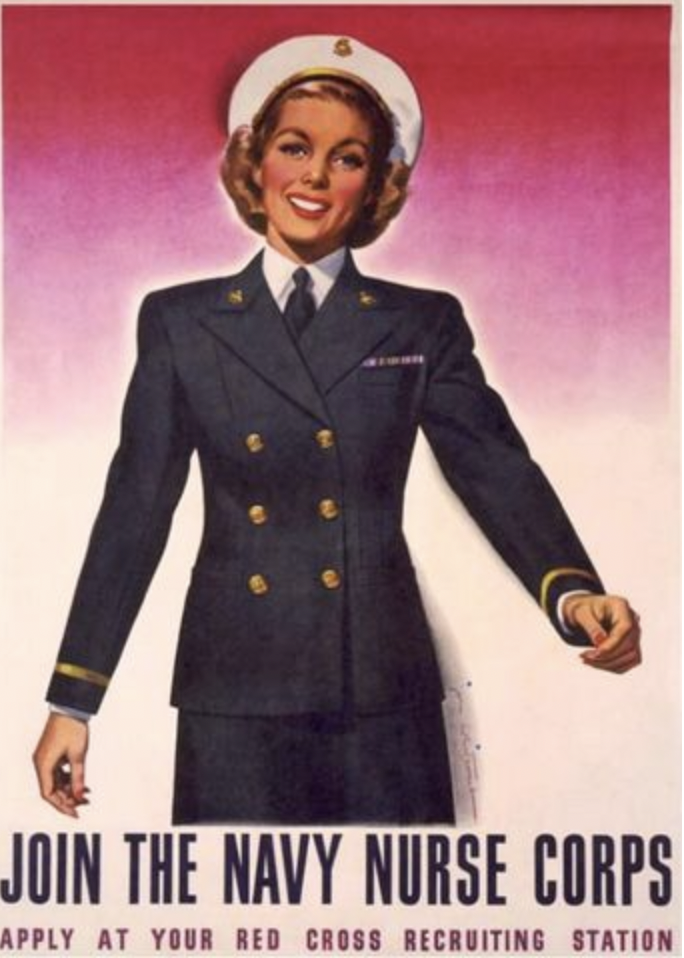
The census for 1940 has her working in “private practice.”  In August 1941, she entered the US Navy Nurse Corps as an Ensign and spent at least four months in training before being shipped out. (For more on the US Navy Nurse Corps see here and here.)

Navy Nurse Recruiting Poster.  
Courtesy of the National Archives

When Ensign Feeney joined up, there were only about 800 Navy nurses on active duty.  By the end of World War II, over 11,000 nurses, both active and reserve, were serving in the Navy.  

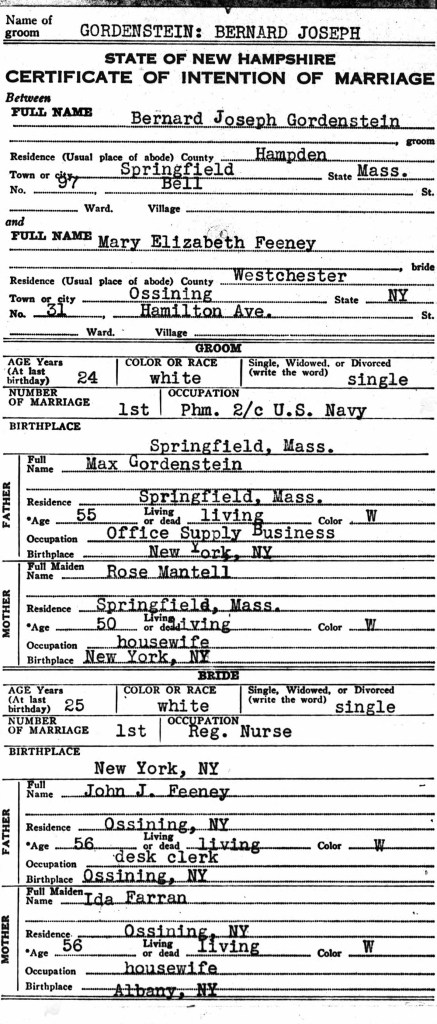
Ensign Feeney’s initial posting is still unclear, but in May of 1942 she married Bernard Joseph Gordenstein in Hillsborough, New Hampshire.  He was also in the Navy, serving as a pharmacist. (This bit of information came as something of a surprise to the members of the Feeney family consulted for this exhibit.  This might explain why the road is named Feeney and not Gordenstein.)

At some point, after the December 7, 1941 Pearl Harbor attacks, Ensign Mary Feeney was posted to Hawaii and served at the Pearl Harbor Naval Hospital.  This was where injured warriors, primarily those from the Pacific Theatre of Operations, were stabilized before they were sent back to the US.

Here’s a 1942 photo from the U.S. Navy Bureau of Medicine and Surgery — while I can’t prove it, I have a feeling that the third nurse from the left, in the back row, might be our Mary Feeney.

Administrative group including Navy nurses and Red Cross workers at the Pearl Harbor Naval Hospital, 1942.
Courtesy U.S. Navy Bureau of Medicine and Surgery

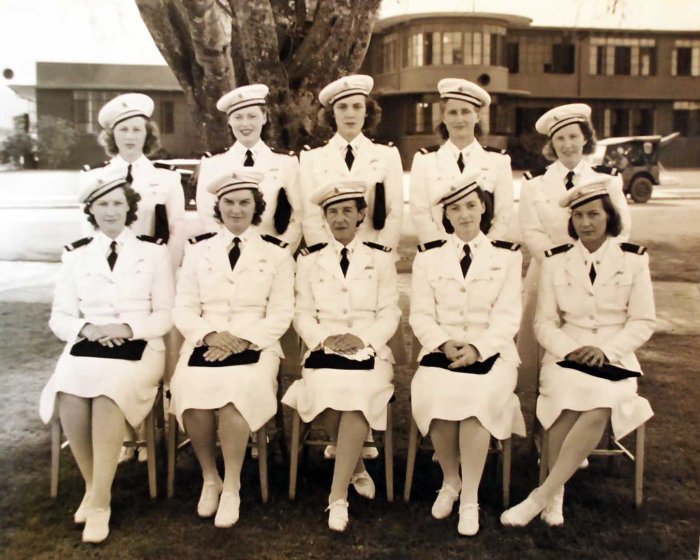
And in the photo below, the nurse seated in the front row all the way on the left actually does look very much like Ensign Feeney. (What do you think?) If it is, it would have been taken just four months before her death.

U.S. Navy Nurses pose for a group portrait at Pearl Harbor, Territory of Hawaii, December 16, 1942.  Photo source: National Museum of the U.S. Navy

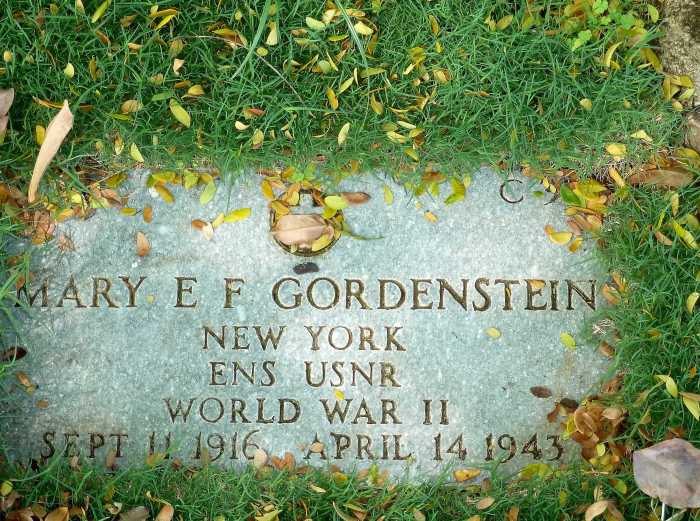
Sadly, Ensign Mary Feeney’s career in the US Navy was brief – she died of pneumonia on April 14, 1943 while stationed at the Pearl Harbor Naval Hospital.   

She was posthumously awarded the Bronze Star for “Heroic or Meritorious Achievement or Service.”

She is buried in the Punchbowl National Memorial Cemetery of the Pacific on Oahu.

And in 1963, the Town of Ossining would name a street in the newly completed Lakeville Estates subdivision after her.

Lorraine Hansberry – Playwright, Civil Rights Activist

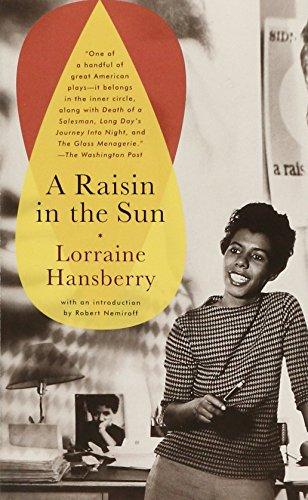
Lorraine Hansberry, c. 1964

Lorraine Hansberry
1930 – 1965

Playwright
Author
Civil Rights Activist
***Local Connection: Bridge Lane, Croton-on-Hudson***

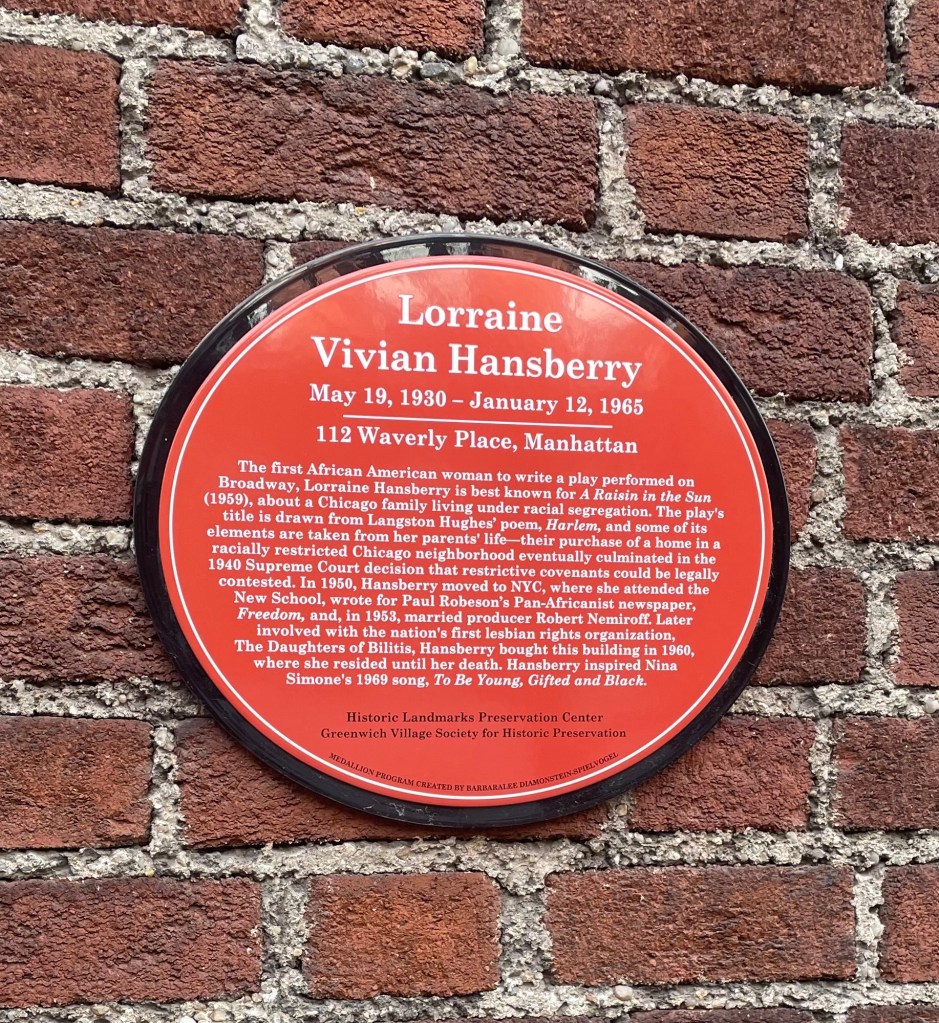
Lorraine Hansberry was born in Chicago, IL to Carl August Hansberry, a successful real estate speculator (known as “The Kitchenette King of Chicago”) and Nannie Louise Perry, a teacher. 

When Hansberry was 8, her parents purchased a house in a white neighborhood, but faced intimidation and threats from the residents who tried to force them to leave. Hansberry remembered rocks being thrown through their windows, and her mother prowling the house after midnight carrying a German Luger pistol when Carl Hansberry was away on business.

Illinois courts upheld the ongoing eviction proceedings and found that by purchasing their house, the Hansberrys had violated the “white-only” covenant of that subdivision. However, Hansberry’s father took the case all the way to the United States Supreme Court and won. 

This experience would inspire Hansberry’s most famous play A Raisin in the Sun.

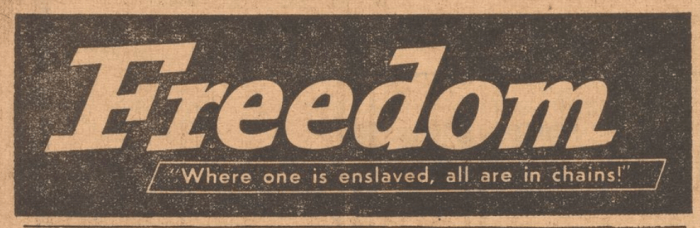
In 1950, Hansberry moved to New York City to pursue a career as a writer.  Landing first in Harlem, she began working for Paul Robeson’s Black, radical newspaper Freedom, a monthly periodical.

At Freedom, she quickly rose through the ranks from subscription manager, receptionist, typist, copy editor to associate editor, along the way writing articles and editorials for the paper.  It was during this time that she wrote one of her first theatrical pieces, a pageant for “The Freedom Negro History Festival” that would feature Paul Robeson, Harry Belafonte and Sidney Poitier, among other luminaries.  

In 1953, she married Robert Nemiroff, a book editor, producer, and composer of the hit single “Cindy, oh Cindy.”  They moved to 337 Bleecker Street in Greenwich Village and it was here, in 1957, that she wrote her semi-autobiographical play A Raisin in the Sun.

It took the producers nearly two years to raise the funds, as investors were wary of backing the first play of an unknown 26-year-old Black woman. Premiering in New Haven, Connecticut, A Raisin in the Sun opened on Broadway in March 1959 and was the first Broadway show to be written by Black woman and the first to be directed by a Black man (Lloyd Richards.)  Starring Sidney Poitier, Ruby Dee and Claudia McNeil, the production was nominated for four Tony Awards.  The original production ran for 530 performances – a remarkable feat in those days and would make a successful transfer to the big screen in the 1961 movie written by Hansberry and starring most of the Broadway cast. Today it is a staple of high school and college curricula and is considered one of the greatest American plays of the 20th century.  It continues to be produced all over the world.

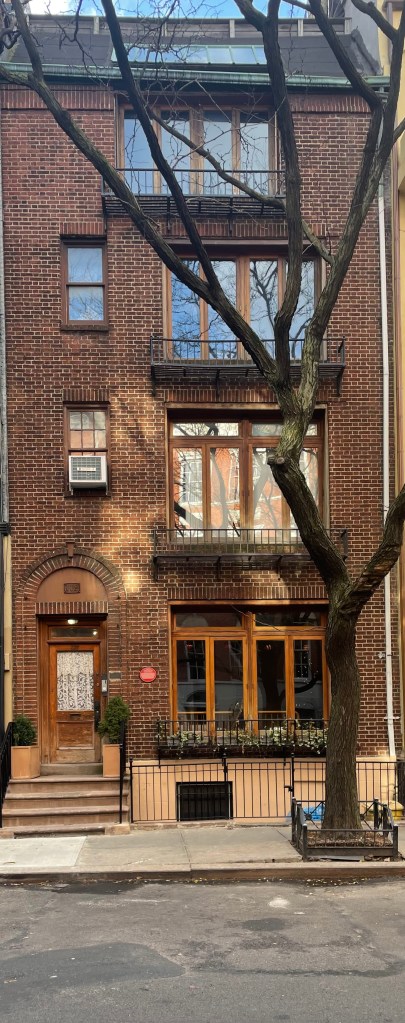
After the success of A Raisin in the Sun, Hansberry purchased a townhouse in Greenwich Village.

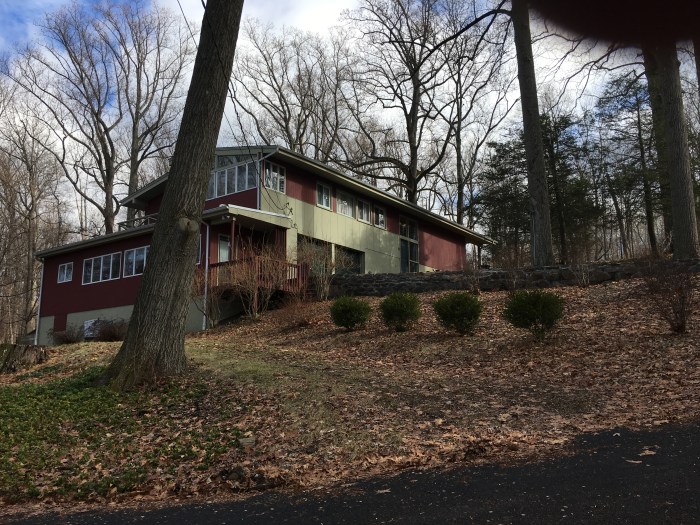
Soon after, she would purchase a house in Croton-on-Hudson. Ironically calling her Bridge Lane home, “Chitterling Heights,” it became her escape from the city, her writing studio, and a place where Black artists and progressives (such as Langston Hughes, Alex Haley, and Ruby Dee) would gather.

Lorraine Hansberry’s house on Bridge Lane, c. 2018

Hansberry’s Broadway success catapulted her into the whirlwind of popular intellectual discourse, and she used her newfound fame to speak out on things that mattered to her.  She became a star speaker, dominating panels, podiums and television appearances.  Her quick wit and provocative stances made her popular with the media as she could always be counted on for spirited discussion.  

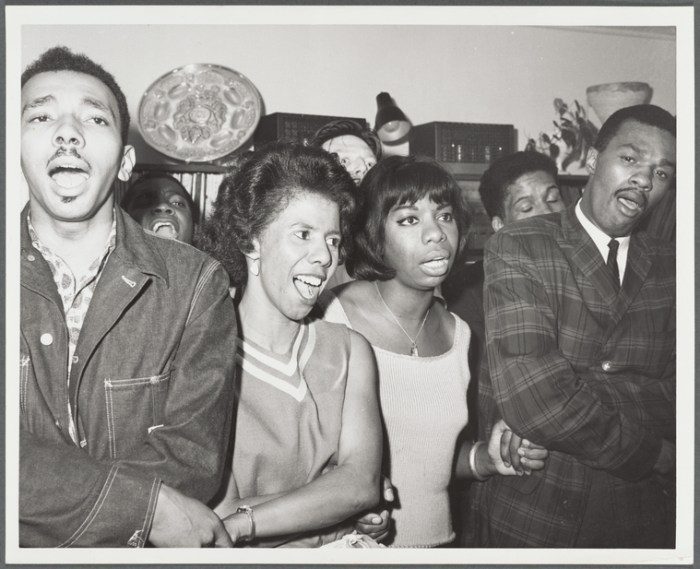
She was deeply involved in the Civil Rights movement, appearing at numerous events and meeting with political leaders:

Hansberry with Nina Simone at a Student Non-Violent Coordinating Committee event, 1963.
Courtesy of the New York Public Library

By 1963, as one of the intellectual leaders of the civil rights movement, Attorney General Robert F. Kennedy would meet with her, James Baldwin, Lena Horne, Harry Belafonte and others for advice on civil rights and school desegregation initiatives.  (Read a May 25, 1963 New York Times article about this meeting here.)

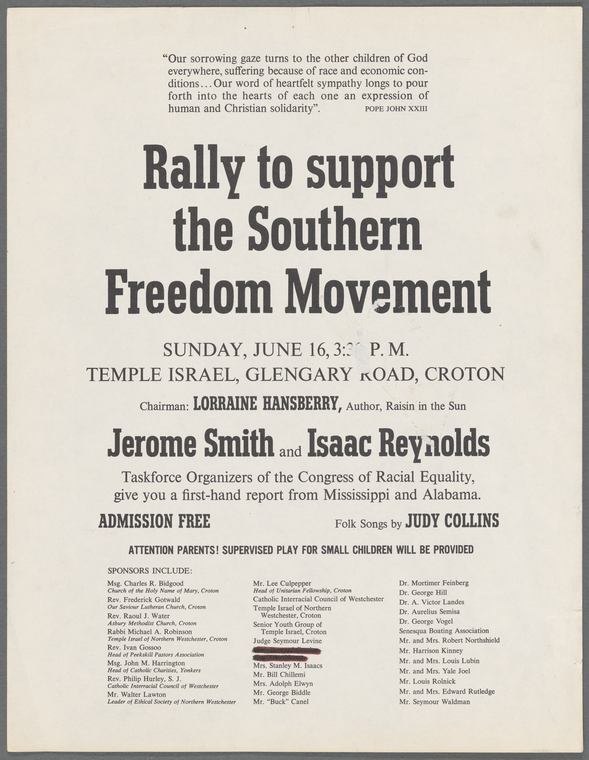
In 1964, Hansberry was integral in organizing and participating in one of the first fundraisers in the New York City area for the civil rights movement, held at Croton’s Temple Israel.   (The 1963 Birmingham church bombings catalyzed many on the East Coast.)  

She was the MC of the event, and brought in other like-minded celebrities, including Ossie Davis, James Baldwin, and Judy Collins. They raised over $11,000 for organizations like the Congress of Racial Equality – Freedom Summer voter registration project (CORE), the Student Non-violent Coordinating Committee (SNCC) and the NAACP.

Some of the money raised went towards the purchase of a Ford station wagon that Freedom Riders James Chaney, Andrew Goodman, and Michael Schwerner were driving the night they were murdered by the Ku Klux Klan in Philadelphia, Mississippi.

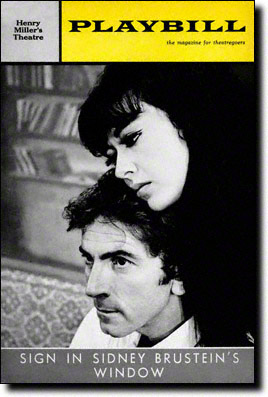
Unofficially separated for several years, Hansberry would divorce Robert Nemiroff in 1964, though they remained close collaborators and business partners to the end of her life.  Nemiroff produced her final play, The Sign in Sidney Brustein’s Window, which opened on Broadway in October 1964.

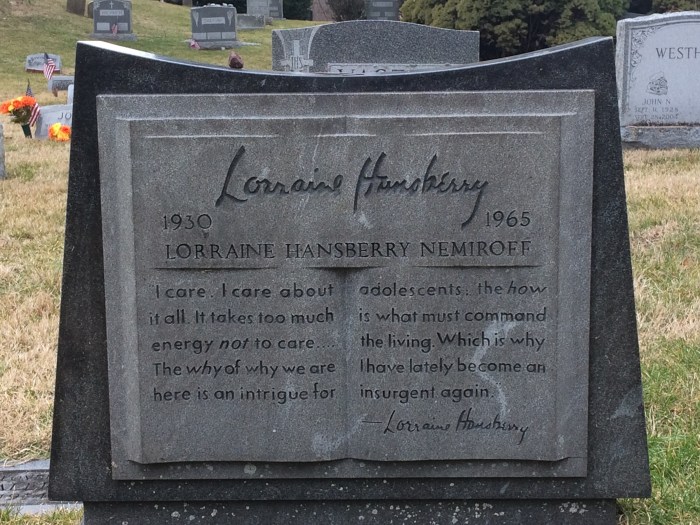
In January 1965, Hansberry would die from pancreatic cancer at the age of 34, two days after The Sign in Sidney Brustein’s Window closed.  

She is buried in the Bethel Cemetery in Croton-on-Hudson, New York.

CODA:

“You are young, gifted, and black. In the year 1964, I, for one can think of no more dynamic combination that a person might be.”

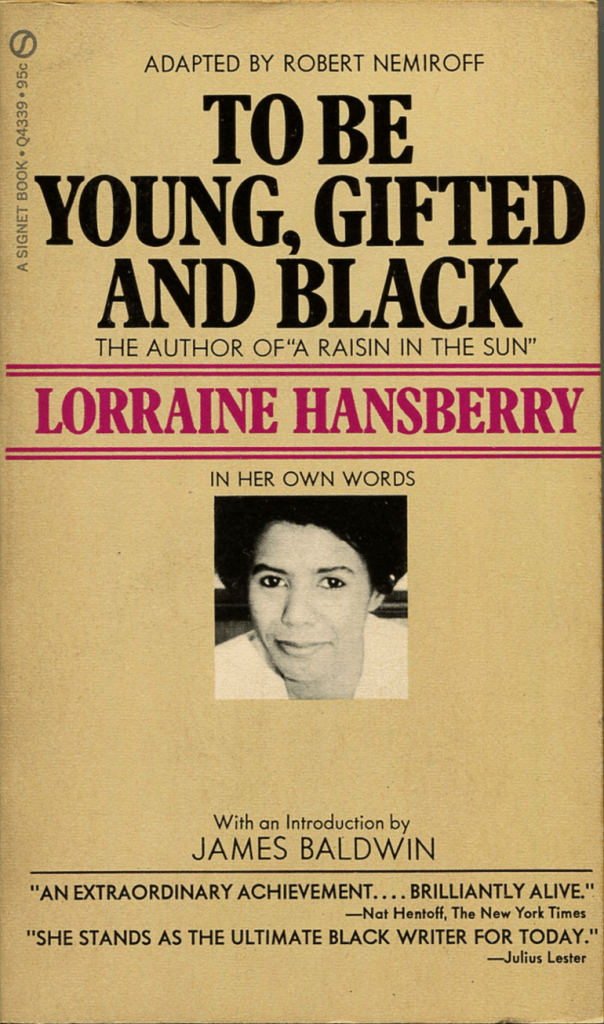
The above quotation comes from a talk Lorraine Hansberry gave to six teenage winners of a Readers’ Digest/ United Negro College Fund writing contest. In 1968, ex-husband and literary executor Robert Nemiroff would compile many of Hansberry’s unfinished and unpublished works into an off-Broadway play called Young, Gifted and Black.  This in turn would be adapted into a posthumous autobiography of the same name published in 1969.  

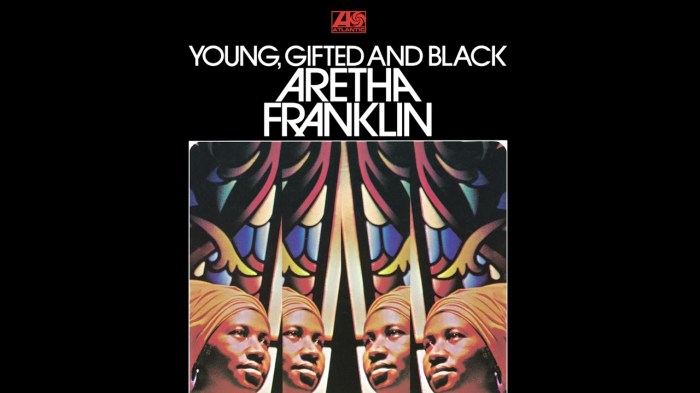
Singer/Songwriter Nina Simone would be inspired to write and record a song with that title and in 1972, singer Aretha Franklin would release an album of the same name.

There have been numerous productions of her seminal play A Raisin in the Sun – on Broadway and off-, internationally, in regional theaters, on television and film. In 1973, a musical version of the play, called Raisin won the Tony Award for Best Musical. In 2010, playwright Bruce Norris wrote Clybourne Park which tells the story before and after the events of A Raisin in the Sun and in 2013, Kwame Kwei-Armah wrote Beneatha’s Place which imagines what happened to the character of Beneatha after the events of A Raisin in the Sun.

It is a play and a story that continue to inspire.

Yet, it took until 2013 for Lorraine Hansberry to be inducted into the Theatre Hall of Fame:

Finally, today, in addition to her other accomplishments, Lorraine Hansberry is now being hailed as a figurehead of the LGBTQ movement. However, this is a little tricky, as Hansberry was not out during her lifetime.  For five decades after her death, ex-husband and literary executor Robert Nemiroff restricted access to any of Hansberry’s writings that explored her sexuality. It wasn’t until 2013 that researchers were allowed to see these previously hidden articles, letters, and journal entries. Since then, Hansberry has emerged as a queer icon. Her published works from this cache, often signed only with her initials, reveal a thoughtful and progressive thinker, while her private writings offer a new perspective on this multifaceted artist.

Mother Mary Joseph – Founder, Maryknoll Sisters

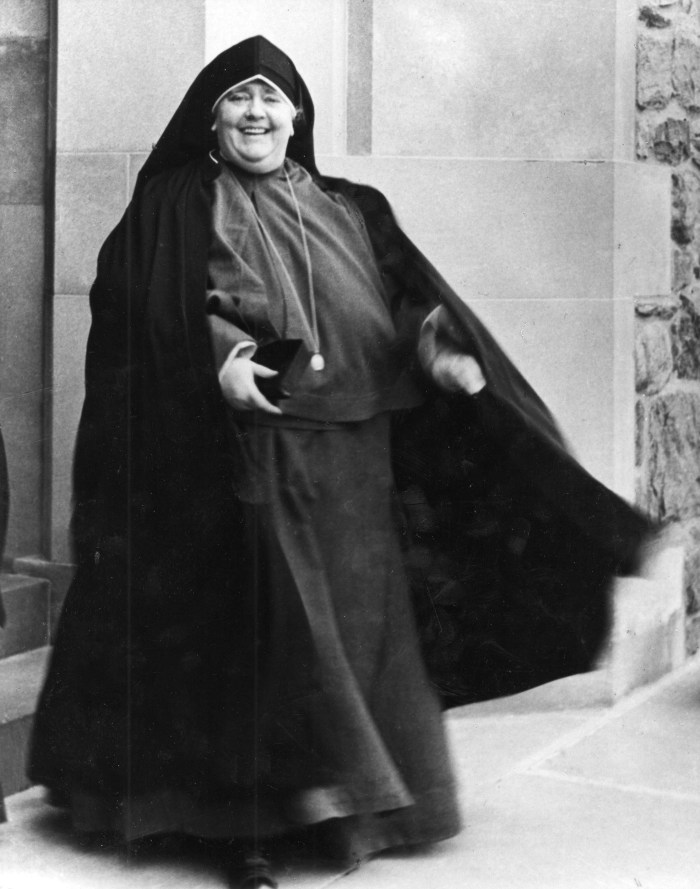
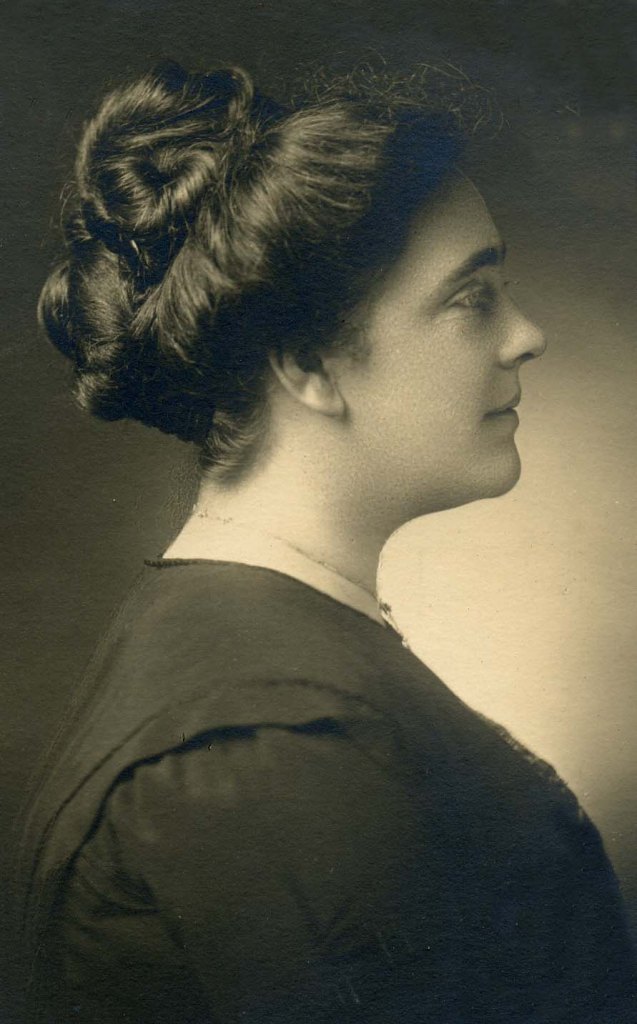
Mother Mary Joseph, c. 1936
Courtesy Maryknoll Mission Archives

Mother Mary Joseph
1882 – 1955

Founder, Maryknoll Sisters
***Local Connection: Maryknoll Sisters, Pinesbridge Road***

Born to an Irish-Catholic family in Roxbury, Massachusetts, Mary “Mollie” Josephine Rogers grew up as a dutiful, observant Catholic.

It wasn’t until she attended Smith College as a Zoology major that she became inspired by the active Protestant Mission Study groups. She wondered, why didn’t the Catholic students have anything similar? 

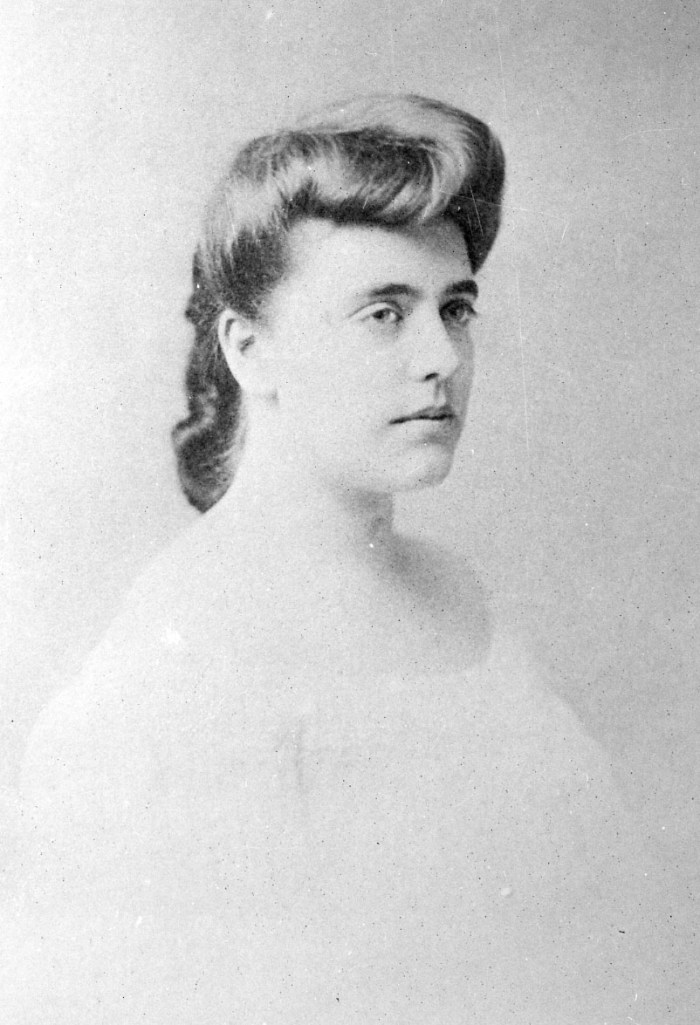
Mollie Rogers, c. 1905
On the occasion of her graduation from Smith College
Courtesy Maryknoll Mission Archives

After graduation, she went on to get a teaching certificate and was invited back to Smith as a “demonstrator” in the Department of Zoology.  It was during this time that she was tapped to lead a Bible and Mission Study class for Catholic undergraduates at Smith.  To prepare, she contacted Father James Walsh, Director of the Society for the Propagation of the Faith in Boston.  At the time, her goal was simply to “inspire the girls to do actual work when they leave college [and] show them how great the Church is.”

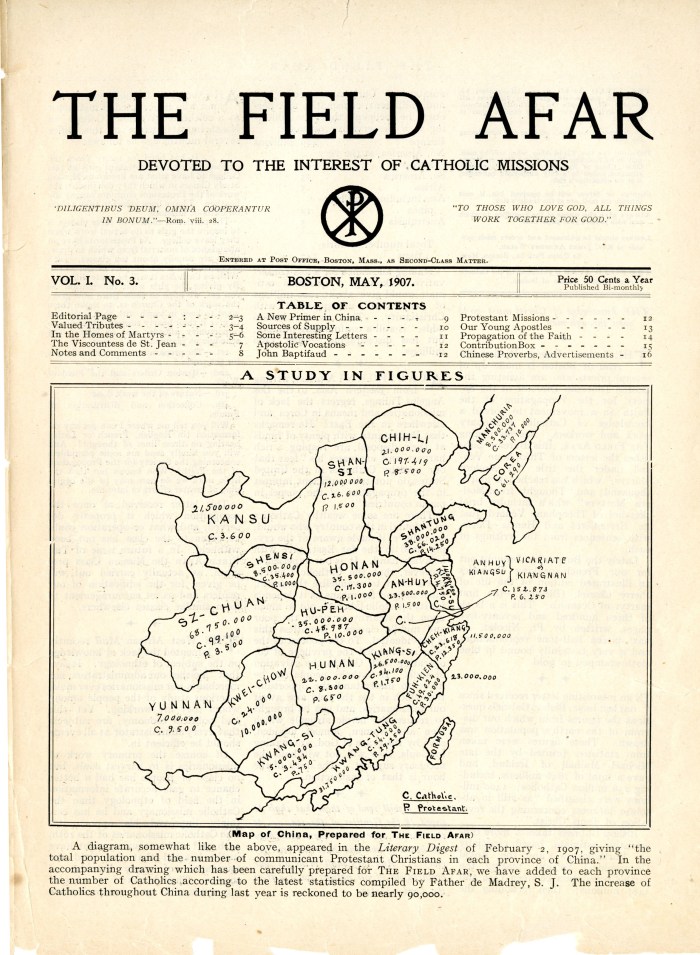
Soon, she was leading a class of Smith students as well as working for Father Walsh as a secretary, helping him publish the first missionary periodical in the United States called The Field Afar:

Courtesy Maryknoll Mission Archives

In 1912, Father Walsh would go on to found the first missionary society in the United States, the Catholic Foreign Mission Society of America.  

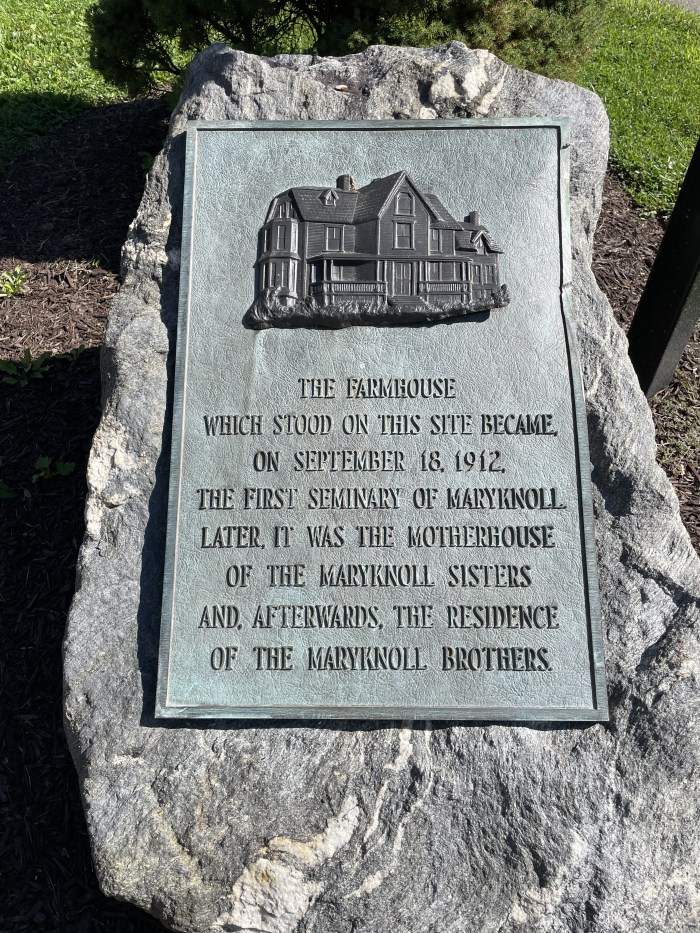
But he was having problems purchasing land for the campus he envisioned. After a transaction in Pocantico Hills fell through, Father Walsh sensed that there might be anti-Catholic sentiment at the root of his difficulties.  To counteract that, he turned to his secretary, Mollie Rogers.  She put on her best Smith College ensemble with pearls, hat and gloves, and, looking like a wealthy Westchester matron, purchased a 99-acre farm on what was then known as Sunset Hill in Ossining. 

Mollie Rogers, c. 1912
Courtesy Maryknoll Mission Archives

From then on, Mollie Rogers would be looked to as the de facto leader of the group of women who were drawn to help Father Walsh.  

Soon, they determined to form a religious community of their own.  As Mollie charted a course through unmapped waters – theirs was the first group of American religious women whose goal was overseas missionary service – she took on the name Mother Mary Joseph.  

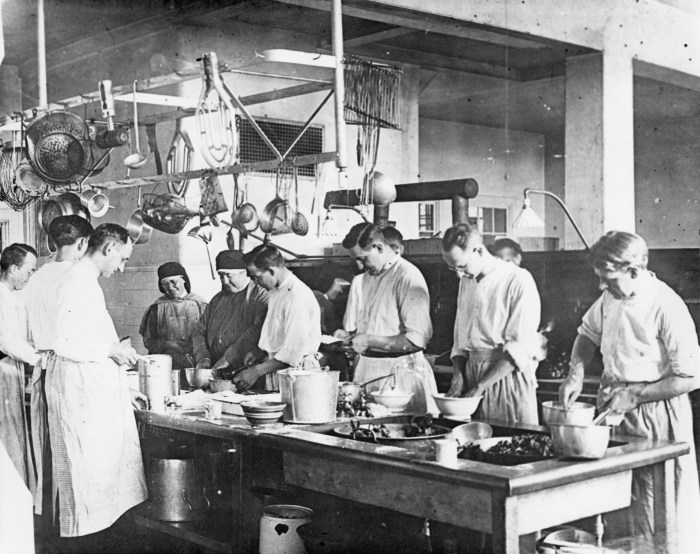
Mother Mary Joseph cooking with the Maryknoll Brothers in 1925
Courtesy Maryknoll Mission Archives

The women affiliated themselves with the religious order of St. Dominic and worked relentlessly to overcome multiple rejections by church leadership in both the US and Rome. 

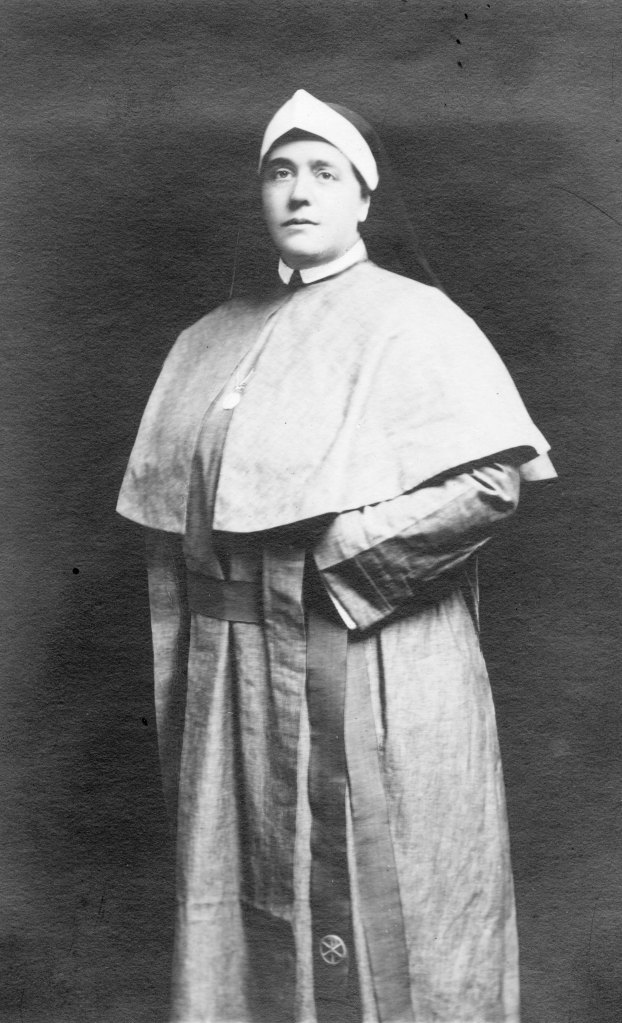
Mother Mary Joseph testing out veil options, c. 1920
Courtesy Maryknoll Mission Archives

It wasn’t until 1920 that they were finally approved to begin their mission work.  Soon, they were serving in faraway places like Manchuria, the Philippines and China, and women from all over the world were joining the community.

Mother Mary Joseph in Loting, China c. 1940
Courtesy Maryknoll Mission Archives

Under Mother Mary Joseph’s guidance, the congregation of Sisters grew rapidly, setting up missions in Asia, Latin America, Africa and the United States.

The new Maryknoll Motherhouse, c. 1932
Courtesy Maryknoll Mission Archives

Mother Mary Joseph would live in the Maryknoll Motherhouse until 1952 when she suffered a debilitating stroke that left her partially paralyzed. She would rally, continuing to encourage and inspire, until she passed away on October 9, 1955.

Today, Maryknoll Sisters continue to serve in 18 countries. Sisters have opened schools, clinics, and hospitals, expanding their reach into Latin America, Africa, Thailand, Japan and South Korea. They’ve nursed lepers in Hawaii, AIDs patients in El Salvador, taught English in Jakarta, prayed with Navajo, worked with Sudanese refugees, helped Vietnamese asylum seekers, performed surgery in Guatemala, started health clinics in Tanzania, taught nursing in Korea – Mother Mary Joseph’s mission lives on.

“As one lamp lights another nor grows less, so nobleness enkindles nobleness . . . If we could only be mindful that every act of kindness can beget another act of kindness, and any act of charity can bring forth another act of charity, how little trouble we would have in life.”

PERSONAL NOTE FROM THE CURATOR:

I’ve had the great good fortune to work with some of the Maryknoll Sisters over the years, and they always amaze me with their breadth of knowledge, keen intelligence, and positivity.

In 2020, I spoke with Sister Jean Fallon and asked her what made her want to be a missionary nun.  This is what she told me: 

 “When I was a very little girl, my father took me to see some shacks that had appeared at the end of our very nice street.

‘They’re called Hoovervilles,’ he told me. [Yes, Herbert Hoover was President when she was a little girl!]  

I cried,  ‘But we have to help these people, they can’t live like that.’

My father shook his head – ‘There are too many of them and they need too much.  There’s nothing we can do.’  

Well, I think that was the moment that started me on this path – I was only about four years old, but I’ve never forgotten that moment.  Yes, there ARE too many and they DO need a lot.  But there’s always something we can do.”

Inez Matthews – Opera Singer

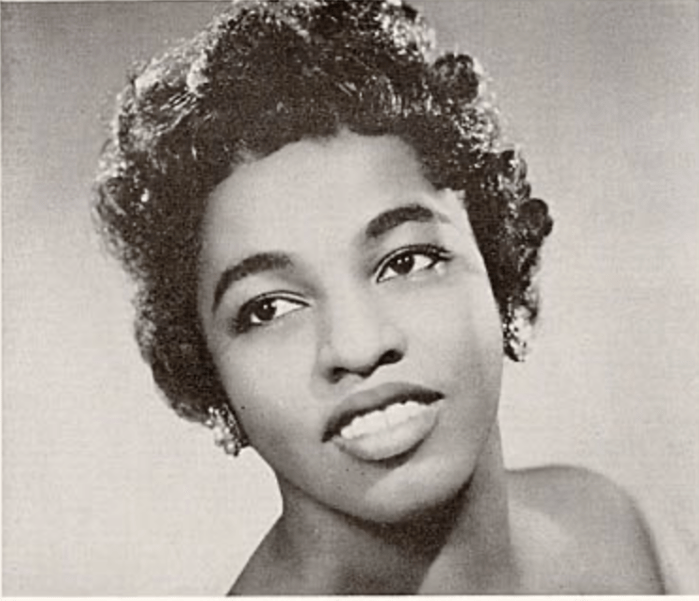
Inez Matthews
c. 1957

Inez Matthews
1917 – 2004
OHS 1935

Opera Singer
Broadway Star
Teacher

***Ossining connection:  12 Ann Street, Ossining***

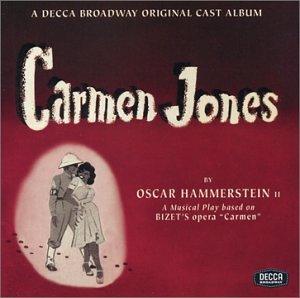
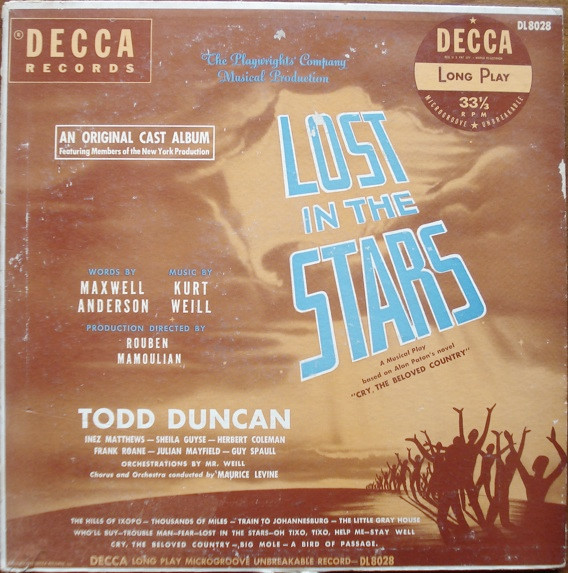
An operatic mezzo-soprano, Inez Matthews is best known for her roles in Broadway’s Carmen Jones and Lost in the Stars by Kurt Weill.  A gifted singer and musical interpreter, a 1954 article described her as follows:

“It is almost impossible to write of Inez Matthews without overworking superlatives. Typed as a mezzo-soprano, she has a splendid, long-ranged voice, so controlled that she can color its dark, lovely timbre with exquisite lyricism, and flute a sparkling coloratura with an always prevailing limpid clarity of tone. The instrument is remarkable. But that is not all.  Her teachers insist that she is an earnest, intelligent student (no detail is too much trouble), and seems unaware of her great personal beauty.

Born into a musical family, Inez’s father was Reverend Edward J. Matthews of the Star of Bethlehem Church.  Her mother Mary sang in the church choir and the Matthews children would have their first public singing experiences at Star. (Inez’s older brother, Edward, was also a well-respected classical singer, creating the role of Jake the Fisherman in George Gershwin’s Porgy and Bess [click here to hear him] and as well as Saint Ignatius in Virgil Thomson and Gertrude Stein’s 1928 opera Four Saints in Three Acts.  He would go on to enjoy a successful operatic and recital career before a car accident claimed his life in 1954.)

Brother Edward would give concerts around Westchester at hospitals and veterans’ homes, and the story goes that Inez (who was ten years younger) would tag along, ending his recitals with her rendition of “Rock-a-Bye Baby” sung to her doll dressed in matching clothes, to enthusiastic applause.

While at Ossining High School, she studied voice with Katherine Moran Douglas, a Briarcliff Manor singing teacher whose operatic career had included singing Wagner’s Parsifal in Bayreuth, Germany, Madama Butterfly with Enrico Caruso under Giaccomo Puccini’s supervision, and appearing in the first Metropolitan Opera production of Manon Lescaut. The connection came through Inez’s brother who began his vocal studies with Douglas after she heard him singing as he mowed her lawn after school one day.

After graduating from Ossining High School in 1935, Inez continued her vocal studies.  In 1942, she auditioned for the famed acting duo Alfred Lunt and Lynn Fontanne and was cast in their Broadway play The Pirate.

The next year, she would perform as a soloist in the Broadway revival of Hall Johnson’s 1933 folk opera Run, Little Chillun.  [Fun Facts:  The production also starred actor Earle Hyman in his Broadway debut, and Leslie Uggams’ aunt Eloise Uggams.]

1943 would see her cast in the Broadway premiere of Carmen Jones, a Broadway opera based on the music of George Bizet’s Carmen, but with an updated storyline.  Initially a member of the chorus, Inez would stay for the entire run, understudying and then taking over the lead role.

But American opera houses were not open to Black singers at the time — remember, it wasn’t until 1955 that New York’s Metropolitan Opera would hire Marian Anderson (to sing the small role of Ulrica in Giuseppe Verdi’s Un Ballo in Maschera.) 

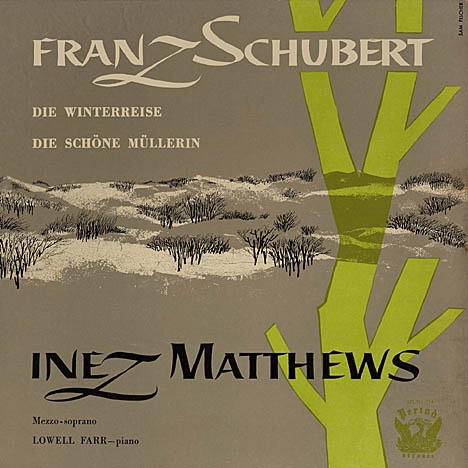
Inez would tour as a soloist with various Black-helmed choirs, such as the De Paur Infantry Singers and the Juanita Hall Chorus.   Making her Town Hall recital debut in New York City in 1947, Inez sang a varied repertoire that ranged from Shubert lieder to operatic arias to spirituals.  The New York Times noted that her “work impressed because of the keen intelligence, the grasp of style and the emotional warmth displayed throughout the various offerings.  Here was an artist with a real understanding of the nature of the music presented and interpretive ability far above the average.”  

1949 would find her on Broadway again, in the role of Irina in the premiere of Kurt Weill’s Broadway opera Lost in the Stars.

Click on this image to hear Inez Matthews sing!

She would marry the Rev. Ulysses Jackson in 1950 and continue to perform, touring internationally in a production of George Gershwin’s Porgy and Bess (with her brother Edward).

Inez would return to Broadway in 1952 for a ground-breaking production of the 1928 opera Four Saints in Three Acts.  (Both Inez and Edward would appear together in this production, as would a young mezzo-soprano named Betty Allen* and diva-to-be Leontyne Price.)

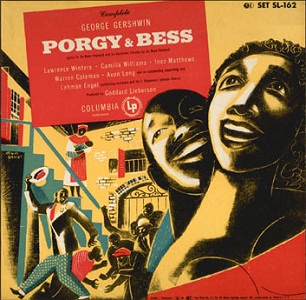
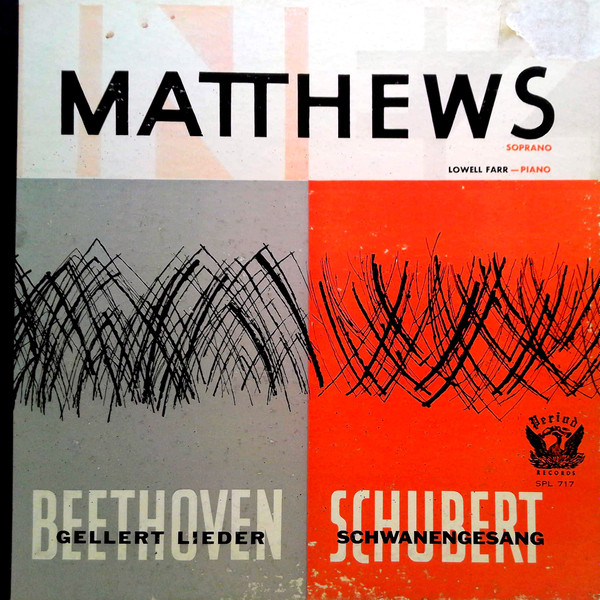
Inez would enjoy a successful recital career for the next decade, recording several albums of Shubert lieder and spirituals to add to her cast albums of Porgy and Bess, Lost in the Stars and Four Saints in Three ActsShe would close out the 1950s dubbing the role of Serena, played onscreen by Ruth Attaway, in the Samuel Goldwyn-produced film of Porgy and Bess.

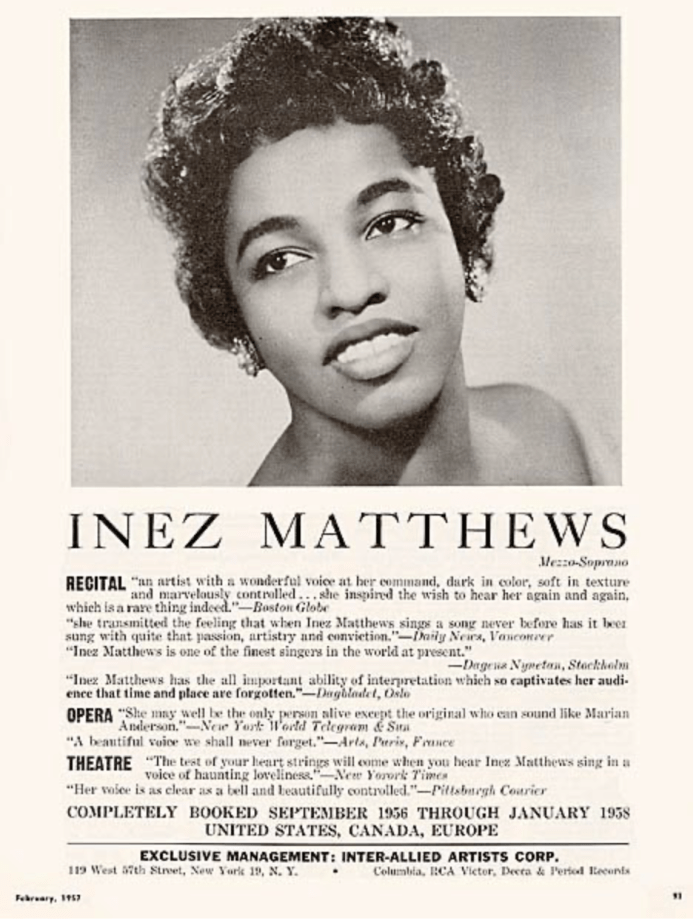
Inez Matthews’ Inter-Allied Artists Management Flyer, 1957 noted that she was
“Completely booked, September 1956 through January 1958”

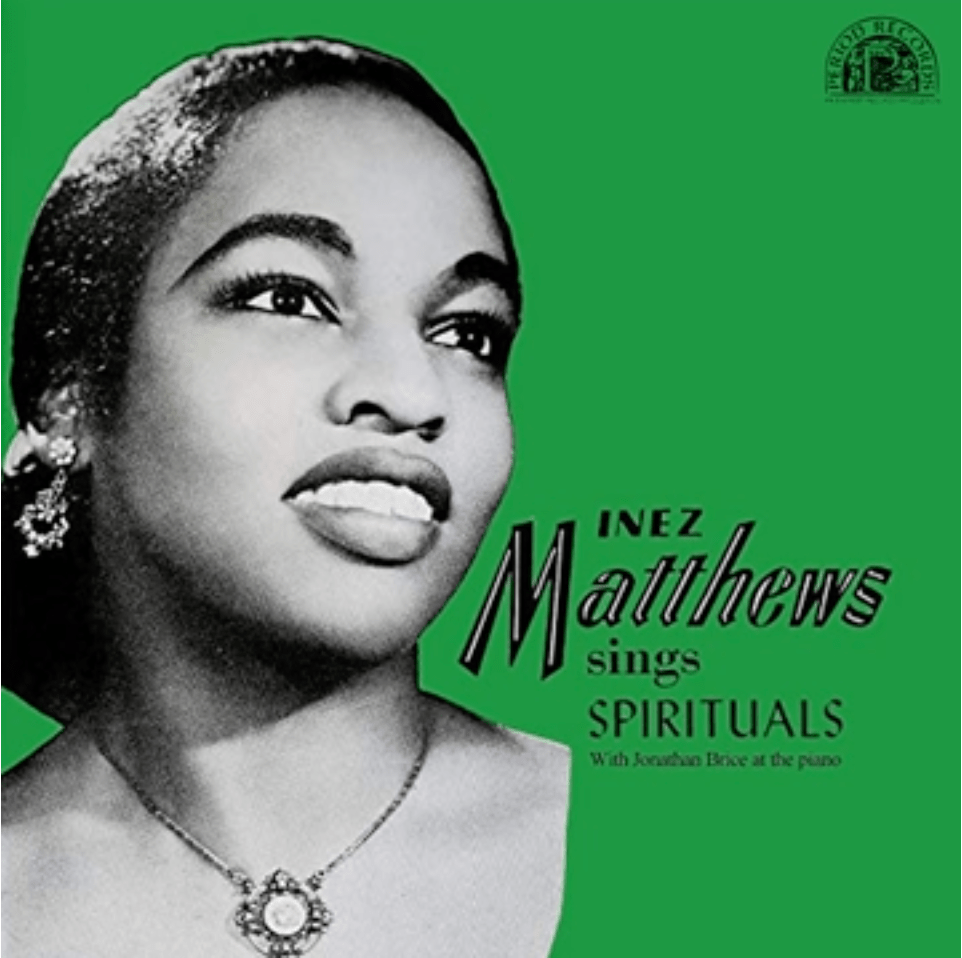
Click here to hear selections from “Inez Matthews Sings Spirituals.”

Click here to hear Inez Matthews sing “My Man’s Gone Now” from a 1959 recording of Porgy and Bess.

Click here to hear Inez Matthews sing “Stay Well” from the 1949 cast album of Kurt Weill’s Lost in the Stars.

In the 1960s, she would scale back her performing, teaching several generations of students both privately and at Virginia State College.  Her occasional participation in productions – a 1970s Four Saints in Three Acts for example — as well as solo recitals in the New York area were consistently noted and enthusiastically praised by the local press.

She passed away in the Bronx in 2004.

*PERSONAL NOTE FROM THE CURATOR: Back in the 1980s and 1990s, I studied voice with mezzo-soprano Betty Allen who performed with Inez Matthews in several productions of Four Saints in Three Acts. I was quite thrilled to discover this connection as I researched Matthews’ life for this exhibit.

Sources:

Story, Rosalyn M.  And So I Sing. 1990, Warner Books, Amistad. (p. 89)
“Conversation with Inez Matthews” by Kari Paulson, 1997
“Found in the stars” by Mary Craig, Musical Courier, August 1954 

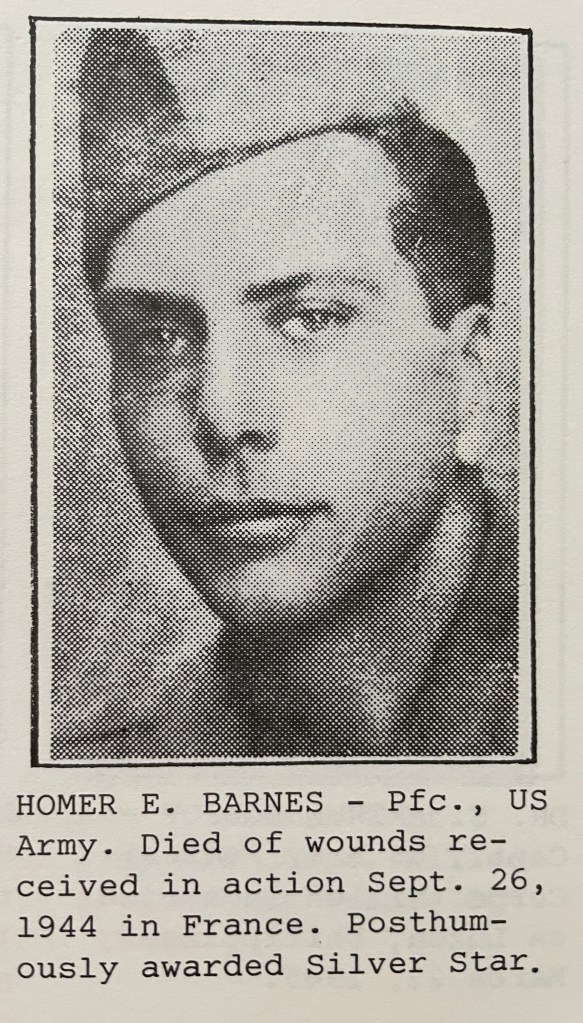
Ossining War Casualty — Homer Barnes

Ossining War Casualty — Homer Barnes
Courtesy of the Ossining Historical Society

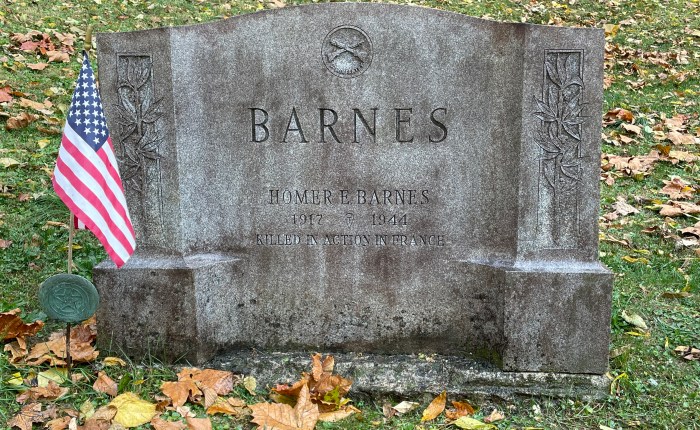
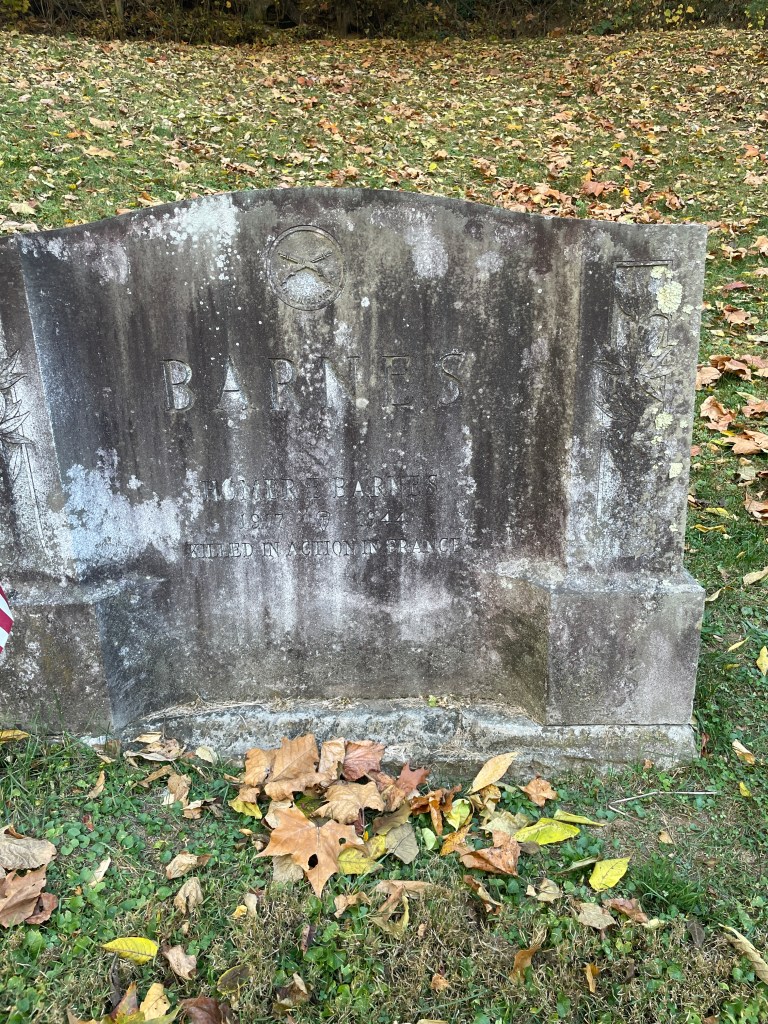
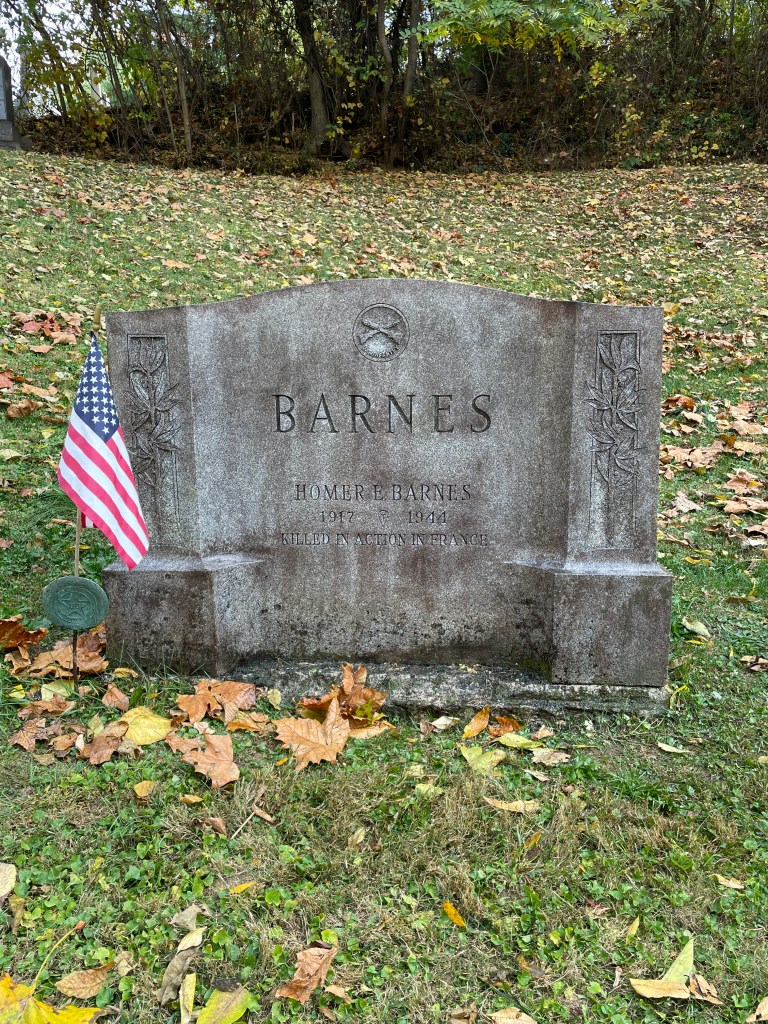
Thanks to the ongoing efforts of the Ossining Historic Cemeteries Conservancy, I recently had the privilege of cleaning this grave, that of Private Homer Barnes, who died in France on September 26, 1944:

I must confess that I chose this grave specifically because it had a Veteran’s flag stuck into the earth in front of it and because the date of death clearly indicated that he had died in WWII.  I felt that there was a story to uncover here, and I was not wrong.

Homer Barnes was born in Hamilton, Ontario in 1917 – at the time his father, Dr. Edmund Barnes, was serving as a Major in the Army Medical Corps stationed at Fort Dix during WWI.  Homer’s mother had gone home to live with her family while she awaited the birth of her son.

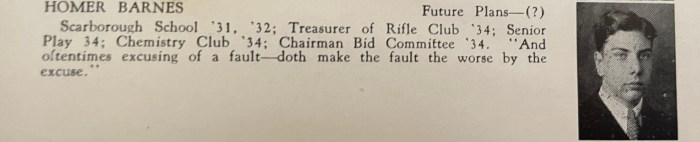
The Barnes family would move to Ossining after the War, and Homer would attend the Scarborough School and then graduate from OHS in 1934.  

Courtesy of the 1934 Ossining High School Yearbook

According to his October 23, 1944 obituary published in the Citizen Register, he then attended Pennington Seminary, New York University, and the New York Technical School.  The 1940 census has him working as a “chauffeur, self-employed.”

Homer Barnes registered for the draft on October 16, 1940, and was inducted into the service on December 16, 1942[1] at Camp Upton.

He would serve in the 36th Infantry Division, 143rd Infantry Regiment, Company A, 1st Battalion.  (I learned all this from the 36th Division Archive, which also notes that his address was 120 North Highland Avenue, Ossining.  Today this is the site of Mavis Discount Tire.)

Private First Class Barnes married Ruth Treanor on April 10, 1943 while he was on furlough from Camp Phillips, Kansas to attend his mother’s funeral in Ossining. Ruth would apparently accompany him back to Camp Phillips and stay there until he went overseas on November 1, 1943.  PFC Barnes would see some extraordinarily heavy action, first in Italy, then in France.

Now, I’ve never learned much about the Italian campaign of WWII.  Just quickly researching PFC Barnes’ Army service has already taught me more than I ever knew about this part of the war, thanks to the detailed after action reports kept (and digitized) by the 36th Infantry Division archive.  Here’s a link to the entire thing, if you’re interested.

I’m not yet exactly sure when PFC Barnes entered the field of battle, but the 143rd Infantry Regiment was engaged in some pretty hot fighting in Operation Avalanche, and the Battles of Monte Cassino, and San Pietro during the last few months of 1943.

By February 1944, PFC Barnes had been awarded a Purple Heart for wounds received while crossing the Rapido River near San Angelo, Italy that January.  The after-action report for the 36th Infantry offers some excruciating details about this Rapido River offensive:

Enemy artillery and mortar fire began falling as the first troops reached the river and when Company “A” [PFC Barnes’ company] sent the first wave across, it met with heavy machine gun fire. . . Reports from men who returned the next day indicate that the German machine gun positions were wired in and the bands of fire were interlocking.  Many men were wounded in the lower extremities or the buttocks by low grazing fire as they moved or crawled forward.” (52)

 PFC Barnes would have shrapnel lodge in his thigh and end up hospitalized for a month after this.

He returned to the front and continued advancing towards Rome with his regiment.  The after-action report almost waxes poetic here:

Never in the entire Italian campaign was there so brilliant a division operation as that employed by the 36th Infantry Division in flanking the enemy bastion at Velletri…. never before in history had the “Eternal City” been captured from the south and as was evidenced by the swiftness with which the enemy was forced to reel back, he was surprised and outwitted by this brilliant maneuver.” (77)

That said, there was deadly fighting throughout, with the German defense “skillfully located and carefully prepared, with first class infantry and strong supporting fire of artillery.” (77)

However, by June 5, 1944 (yes, the day before the Normandy Invasion D-Day!)

“The 143rd Infantry Regiment moved through the city in all available transportation, past the Colosseum, the Ancient Forum, Vatican City and splendid Saint Peter’s Cathedral, through the Arch of Triumph of the Caesars amid cheering throngs of Romans throwing garlands of flowers –  greeted as true liberators in a grandiose but sincere reception. No infantryman will forget this experience and he may well be proud to remember it.  Following this triumphal turn through Rome, all troops of the 143rd Regiment terminated their gruelling advance, and took a well-deserved rest, bivouacking on the outskirts of the city.” (78)

I sincerely hope that PFC Barnes got to experience this – it must have been rewarding and remarkable.  Because after a short break, his regiment would continue to pursue the Germans north.  As Captain Douglas Boyd, the Adjutant of the 143rd Infantry Regiment and author of this part of the after-action report writes: “There is no praise too great for the officers and men of the regiment who uncomplainingly, with true soldierly spirit and without regard to self, fought their way those 240 miles in hot pursuit of the enemy.” (90)

After this, PFC Barnes and the 143rd engaged in a Normandy-like invasion of  beachheads in Southern France, landing between Cannes (to the north) and Saint-Tropez to the south.  PFC Barnes would spend the last month of his life engaged in daily life and death battles, pushing up into the French Alps and encountering stiff resistance from German troops the whole way.  

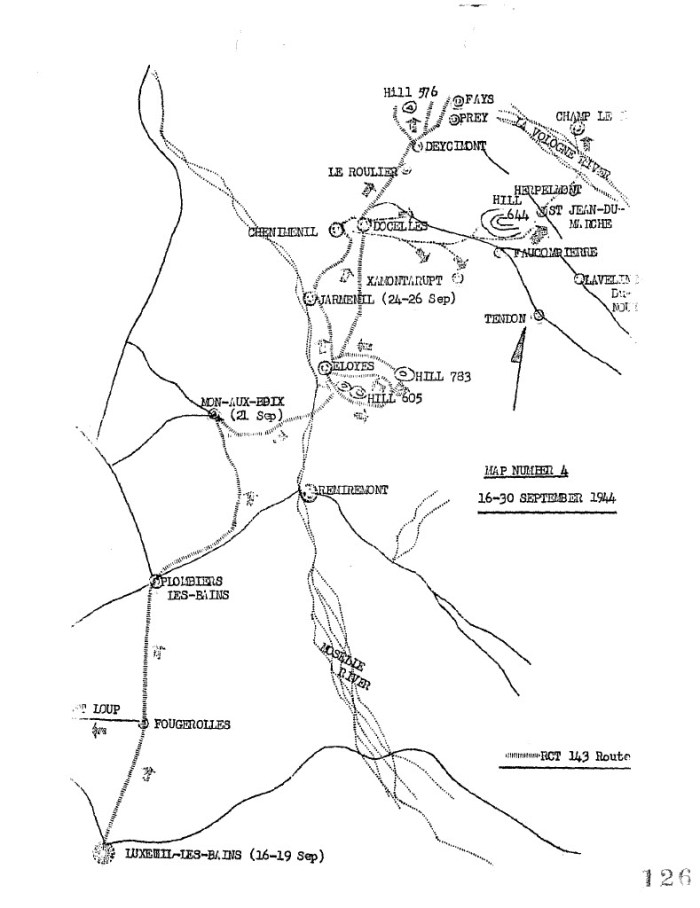
While I can’t be 100% certain, it seems that the last fight PFC Barnes engaged in took place around the Moselle River near a town called Remiremont.  

Courtesy of the 36th Division Archive, 143rd Infantry After-Action Reports

The after-action report describes the attack as follows:

“The 143rd began to cross the Moselle River in a column of battalions, the troops waiting and hand carrying their weapons . . . The 1st Battalion – [PFC Barnes’] moved towards its objective, Hill 605 southeast of Eloyes, while under enemy artillery, mortar and machine gun fire. The enemy, approximating battalion strength, engaged the first battalion units in a fierce fire fight. During the night of 21 September 1944, a company of Germans infiltrated Company A’s [PFC Barnes’] positions, and at the dawn of 22nd  September, bitter hand to hand fighting ranged until the Germans were cleared.” (133)

PFC Barnes died on 26 September 1944 from wounds received on 22 September, so I’m going to make the assumption that he was wounded in this “bitter hand to hand fighting.”

He would be posthumously awarded the Silver Star for gallantry and this decoration would be presented to his two-year-old son, William E. Barnes.


[1] October 23, 1944 obitiuary published in the Citizen Register

Tonga, where “A great feast of piglets, taro, yams, bananas and cocoanuts was offered. . .” (Post #8)

Tonga, where “A great feast of piglets, taro, yams, bananas and cocoanuts was offered. . .” (Post #8)

Today’s post will detail the very important cultural ritual of the Polynesian feast, something I was privileged to experience while in Tonga.

First, some context and history . . .

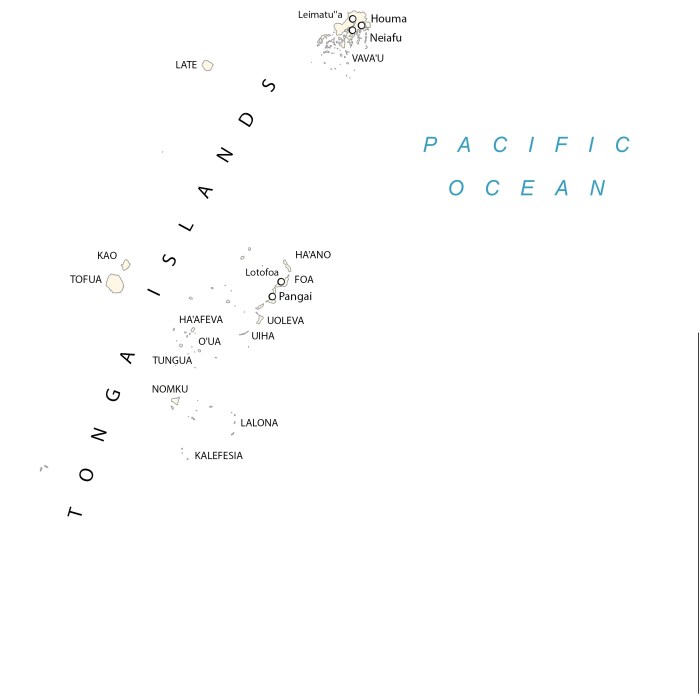
From July 24 – 27, 2024, I was on Vava’u, an island in the Kingdom of Tonga.   Tonga is an archipelago that consists of 169 (or so) islands, of which 36 are inhabited.  Vava’u is, unsurprisingly, one of the largest islands in the northern Vava’u group.

Map of Tonga
Courtesy of GISgeography.com

Interestingly, Tonga is the only Polynesian country that has never been officially colonized.  In 1900, it became a British protective state but did not relinquish its power or independence.

Tonga and neighboring Samoa are considered the western gateway to what we call the Polynesian Triangle (which consists of Hawaii to the north, Easter Island to the east and New Zealand to the west.)  According to Christina Thompson’s excellent book Sea People,  Tonga is where the “oldest languages, longest settlement histories and deepest Polynesian roots” can be found.

It’s believed that Tonga and Samoa have been inhabited for about 2,500 years. Traditional Tongan and Samoan histories tell of an empire that was ruled by Tui Manu’a – both a man and a god.  In about 950AD, the first Tu’i Tonga, Aho’eitu (considered the son of god Tangaloa) began expanding his reach, turning Tonga into a superpower that controlled much of what is today’s central Polynesia.  Tongan hegemony would hold through the 13th century when civil wars in Tonga and Samoa weakened the empire.

As far as the European presence goes in Tonga, the Dutch first put these islands on maps.  First, Schouten and Le Maire stopped here in 1616 (the year William Shakespeare died, just for a bit of context) learning some of the local language while trading for yams, pigs, bananas and fish.  In 1642, Dutch explorer Abel Tasman limped through here after his disastrous encounter with the Maori of Aotearoa (New Zealand) and was relieved to note that the islanders in Tonga seemed friendly and eager to trade.  

Captain Cook of Great Britain passed through here in 1773 and dubbed them the “Friendly Islands” due to the royal reception he received from the locals.  And we can’t forget that the infamous mutiny of the Bounty happened about 30 miles east of the Tongan island of Tofua. Captain Bligh and his 18 loyalists would land their open launch and briefly take shelter in a cave on the northwest coast of Tofua Island.  Bligh would write up his report of the mutiny here, as well as a letter to his wife as he directed his men to assess their supplies.  

And in April 1840, our US Exploring Expedition briefly stopped at Tongatapu (today considered the main island of Tonga) for about a week. Expedition leader Lt. Charles Wilkes primarily planned to use it as a rendezvous point for his four remaining ships, as some had gone south to explore Antarctica, and some had been in Sydney for repairs.  

Unfortunately for us, Wilkes had little interest in the islands, as he was much more concerned with getting to Fiji and securing advantageous treaties for the US regarding the lucrative whaling and bêche de mer industries.

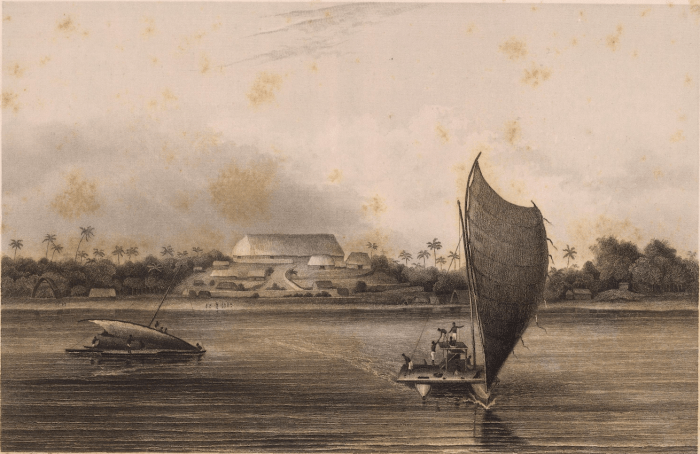
However, while in Nukualofa on Tongatapu, Wilkes inserted himself as a negotiator into a local war between two native groups – the Christians, led by King Josiah (or Tubou) and the (so-called) “Devils,” those who did not follow the Christian teachings of the London Missionary Society. I am hard-pressed to understand Wilkes’ part in a peaceful end to this feud, as his writing on this is as impenetrable as it is condescending.  Suffice to say, the disagreement seems to have resolved itself in spite of Wilkes’ meddling.  And today Tonga considers itself a Christian nation, with 99% of the population identifying as Christian.

Here’s an illustration by Alfred Agate of the residence of King Josiah (Tubou) on Nukualofa: 

Illustration by Alfred Agate from The Narrative of the US Exploring Expedition, volume 3
Courtesy of the Library of Congress

Now, onto feasts!

One of the things that Lt. Charles Wilkes constantly writes about in his Narrative are the feasts and rituals he attended. These could take hours or even days and were essential to attend to meet and connect with the various chiefs and leaders.  

And while Wilkes was the big chief of the USXX, other officers were also tapped to attend these feasts in his stead at times.  I know that Alfred Agate attended many of these himself, though perhaps not one in Tonga.

While in Vava’u, I was privileged to be invited to an umu, a traditional Tongan feast, hosted by Europa crew member Vi Latu and her extended family.  As Vi explained to us, this was her family’s way of welcoming us to Tonga.

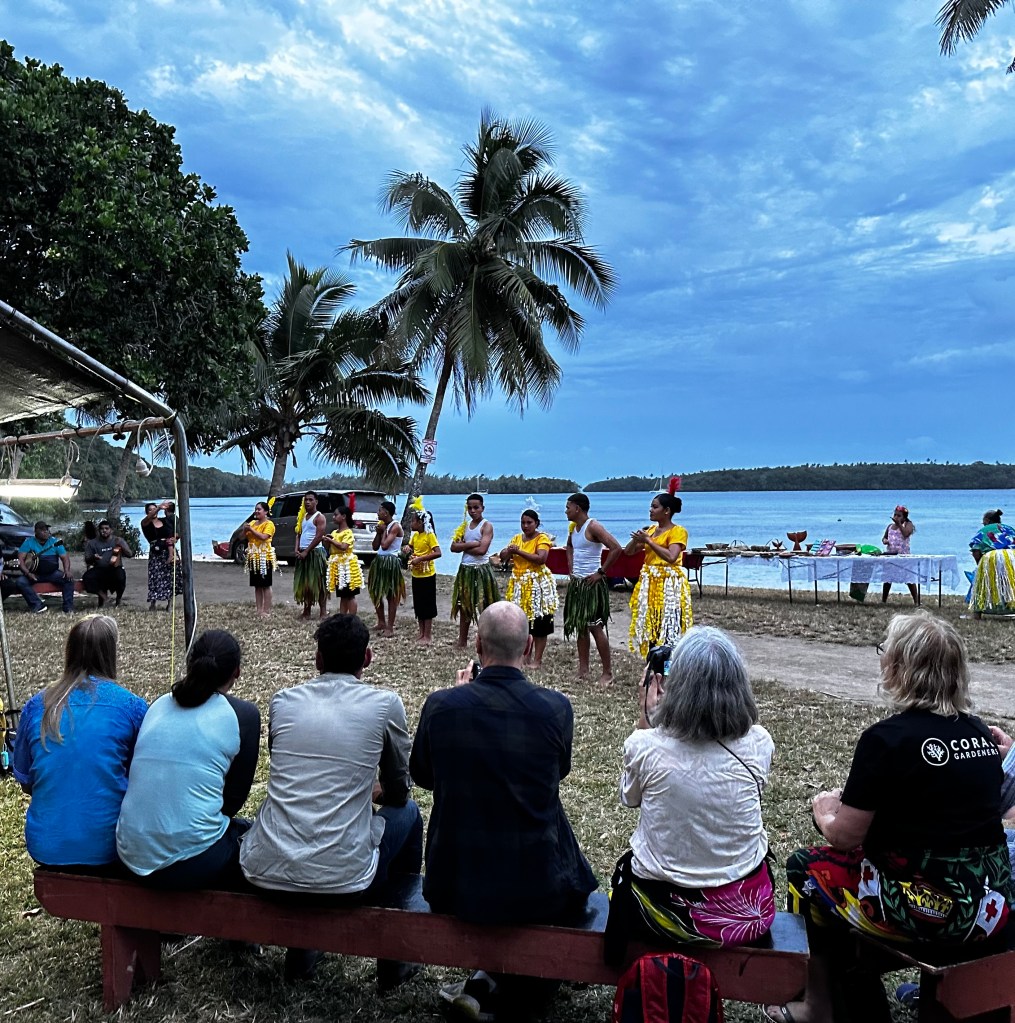
As we arrived on Ano Beach, the palm trees were gently blowing and the sun was setting. The entire area was taken up with an underground oven, an enormous tent and long table, an area for musicians and dancing, and local artists displaying their crafts.  

What’s remarkable, is that many of the traditions on display in 2024 are quite similar to those described by Wilkes in his Narrative.  So please indulge me as I’ll describe the traditional feast I attended using lightly edited excerpts from the Narrative of the US South Seas Exploring Expedition (published in 1845), and illustrated with photos from 2024.  

Note that what follows is a compilation of observations Wilkes made throughout the South Pacific (primarily Tahiti, Tonga, Samoa, Fiji and Hawaii.) Taken together like this, we get a sense of the deep cultural connection between these Polynesian nations, as well as seeing how the ancient traditions are still intact and observed today.

Wilkes’ observations are italicized below.  Mine are not.

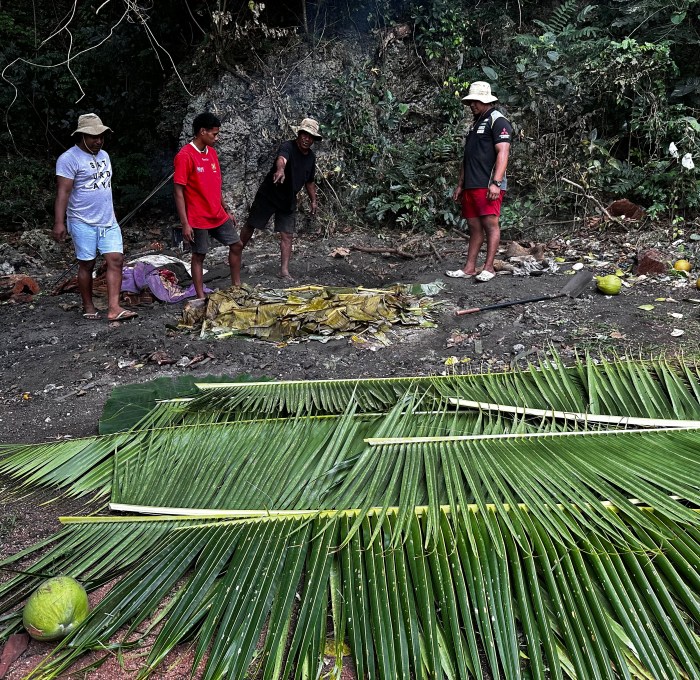
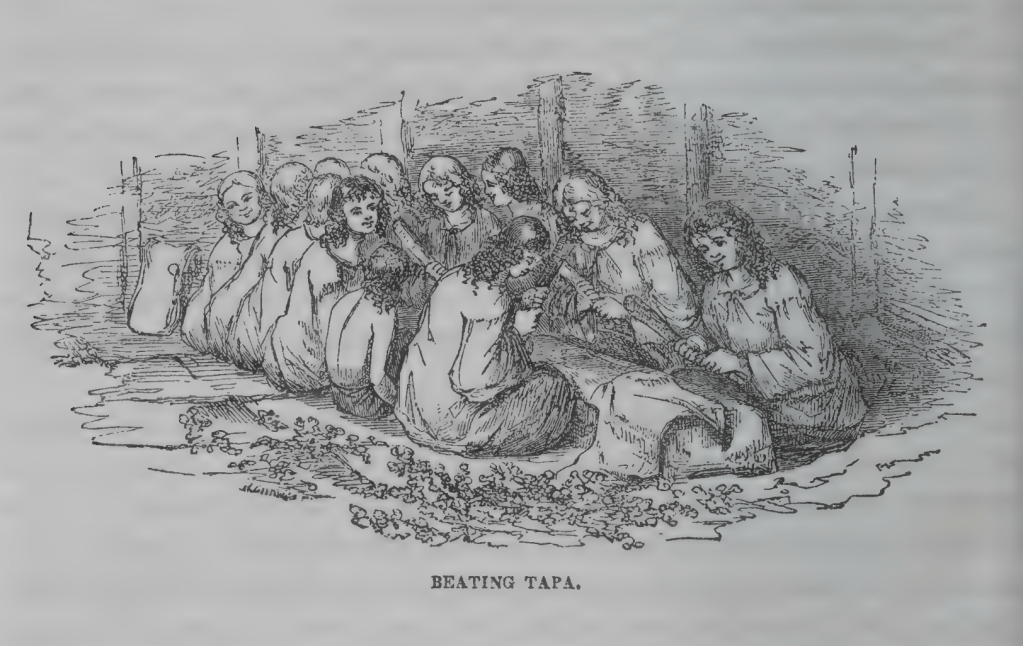
The feast takes many hours to prepare and is generally directed by the women, with the men performing the labor. First, the cooking-place is excavated, a foot deep and about eight feet square:
Traditional Polynesian underground oven, Tongan-style
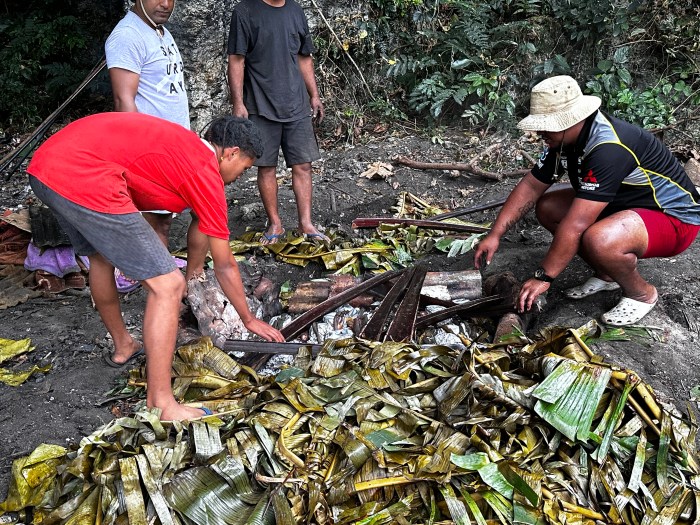
The meat is placed upon hot stones after which taro, yams and coconuts are placed. Finally, it is all covered with banana leaves and earth.   After many hours, the oven is unpacked of all its good things . . .
 
“After many hours, the oven is unpacked of all its good things . . .”
There is an abundance of fish. They likewise have fine crabs, and they are also generous with fowls and pigs.
Their feasts are attended with much ceremony and form . . .
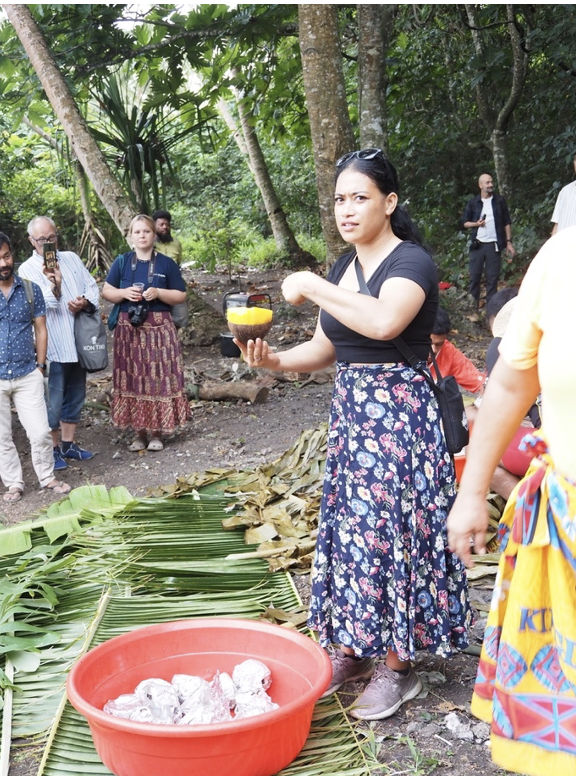
Our feast began with Vi explaining all the delicious foods that were being served to us and how best to eat them.
Vi Latu explaining how to eat papaya and coconut steamed in a coconut shell.
Photo courtesy Andrew Willshire
Then we were asked to take our seats at the long table, and the most senior man of Vi’s clan blessed the meal. (I did not feel comfortable taking a photo of this.) 
Then, we were encouraged to dig in, using our hands (although forks were provided.)
Photo courtesy Sandy Gale
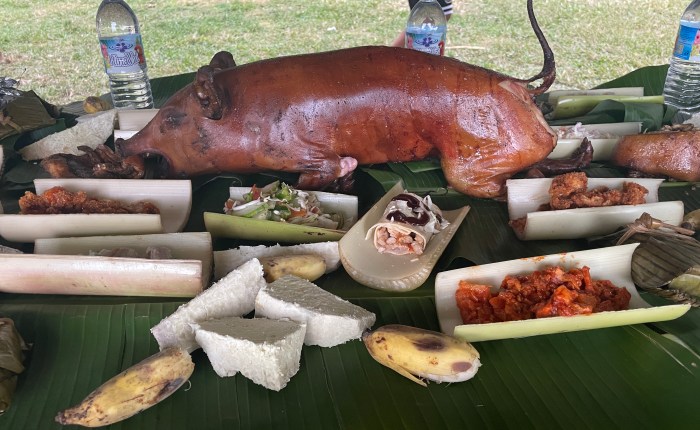
The first course consists of fish, some steamed in banana leaf, and some served in banana trunks. The second course is taro, yams & kumara, with fruit and bananas offered as well.  The third and principal course consists of meat – whole piglets are served and then disjointed.
Still the same . . .
The piglet was sliced at the table with a machete.  We were encouraged to tear off chunks and enjoy.

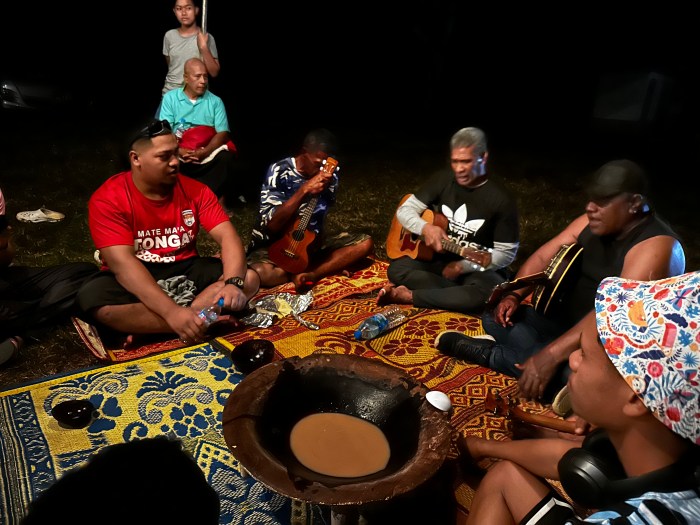
After the third course, dancing, music, stories, and kava-drinking succeed . . .
Dancing . . .


Music and kava.
What is remarkable to me is how little the traditions have changed.  One of the only differences I noted between Wilkes' descriptions and what I experienced was that the feast I attended only took four hours.
Also, I think it’s edifying to note that kava, which is a soporific that makes one a bit loopy and anesthetizes the mouth, is no longer prepared in the way Wilkes observed in his Narrative:
The younger women prepare the kava and are required to have clean and undecayed teeth.  They  are not allowed to swallow any of the juice, on pain of punishment. As soon as the kava-root is chewed, it is spit into the kava-bowl, where water is poured on it with great formality. The king's herald, with a peculiar drawling whine, then cries "Sevu-rui-a-na," (‘make the offering.’) After this, a considerable time is spent in straining the kava through cocoa-nut husks. Kava is made from the Piper mythisticum, and it is the only intoxicating drink they have.
Wilkes in fact refused to drink the kava thus prepared and his hosts, on at least one occasion, gave him coconut water instead. (I feel the need to note that Captain Cook often drank the kava.)  After speaking to Vi, her family and others throughout Polynesia, it’s been reinforced what an important part of the culture kava drinking still is.  Back in the 1840s, refusing to participate fully in a kava ceremony would, I think, have been curious at best and a terrific insult at worst.

Fun fact: Later on, I visited the village of Naseva, on the island of Beqa in Fiji and took part in a traditional kava ceremony where I got to see how the kava is made:
Making kava
Today, dried kava root is ground into a powder then rehydrated and strained through a cloth when needed.  Chants are still sung as this takes place.
You’ll note that we are all wearing sarongs and have our shoulders covered.
Wilkes’ description of a kava ceremony in Fiji is completely recognizable to me, as it is quite similar to what I experienced:
The kava-bowl was three feet in diameter. In drinking the kava, the first cup was handed to [the chief], and as there was more in it than he chose to drink, the remainder was poured back into the bowl. The ceremony of clapping of hands was then performed. 

We were instructed to clap once before we received the bowl (made of half a coconut shell), then drink the whole thing down, and clap three times after we handed the empty bowl back.  (And yeah, if someone didn't finish their bowl, it was poured back into the big kava bowl. And then served back out.) 

And what is kava like?  I cannot tell a lie, I did not enjoy it much – it tastes like it looks, like gritty, muddy water.  And your mouth feels like you’ve just had the rinse the dentist gives you before a root canal.  Other than that, I don’t think I drank enough to feel the full effects . . .  However, I greatly appreciated the ritual and attention to welcoming visitors.  We could all stand to take the time to greet people expansively and properly.

Still more to come . . .

Sign up here if you’re interested in following this 2024 voyage to the South Pacific:


Tahiti, the Society Islands, French Polynesia (Post #7)

I am back in the 21st century, with access to speedy internet!  So, in the next few weeks I will be playing catch up and posting about Tahiti, Tonga and Fiji – all sites our Sparta artist Alfred Agate visited and memorialized on the US Exploring Expedition of 1838 – 1842, and all places that I too visited this July/August of 2024.

*********************************************************************************************************

Sign up here if you’re interested in staying in the know:

*********************************************************************************************************

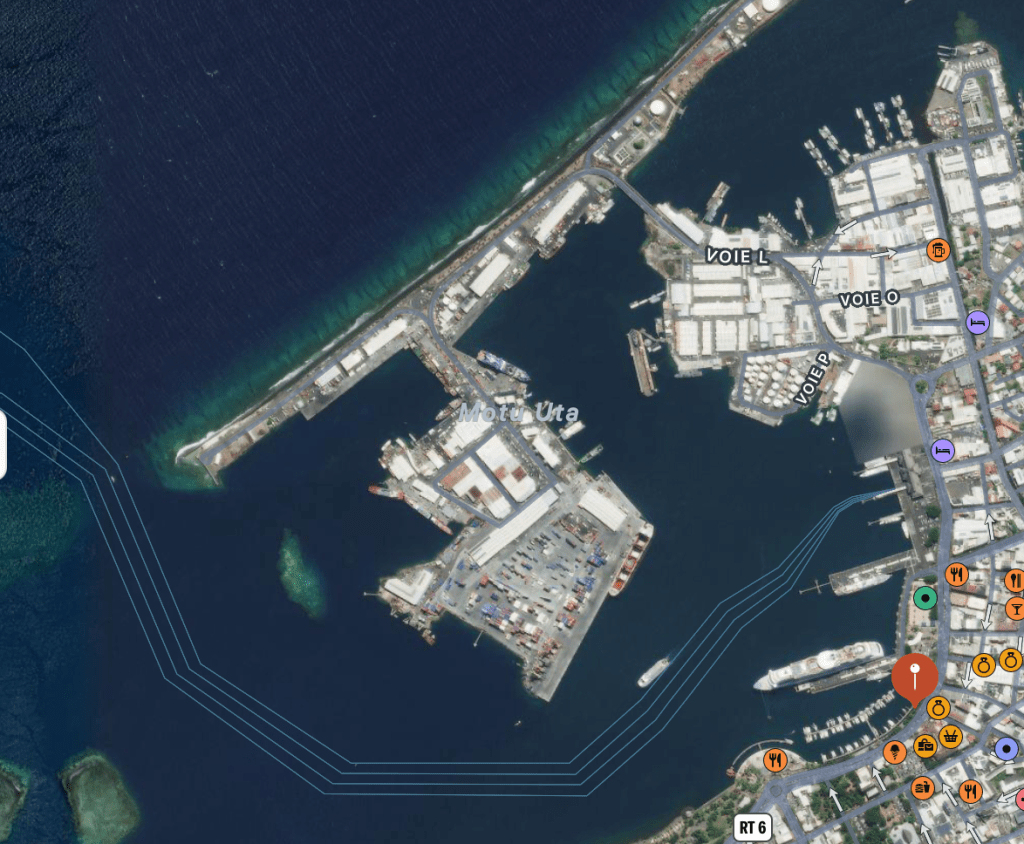
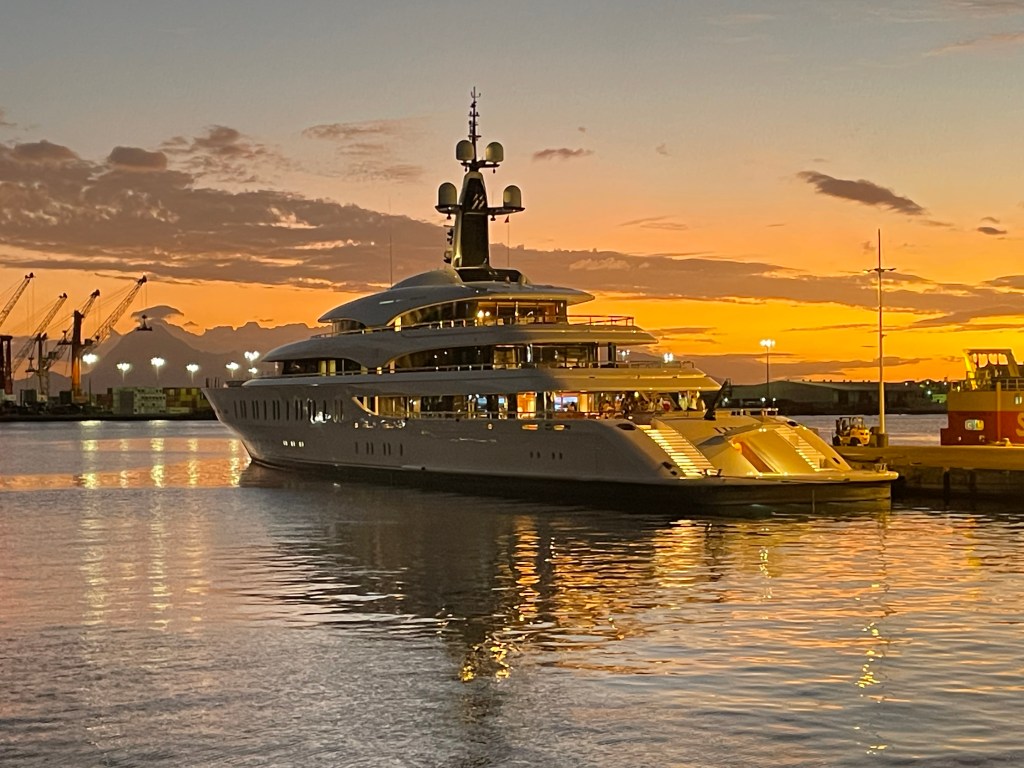
Tahiti!!  I joined my ship, the Bark Europa, on July 3, 2024.  We were moored in the harbor of Papeete next to a small cruise ship and a couple of giant yachts.

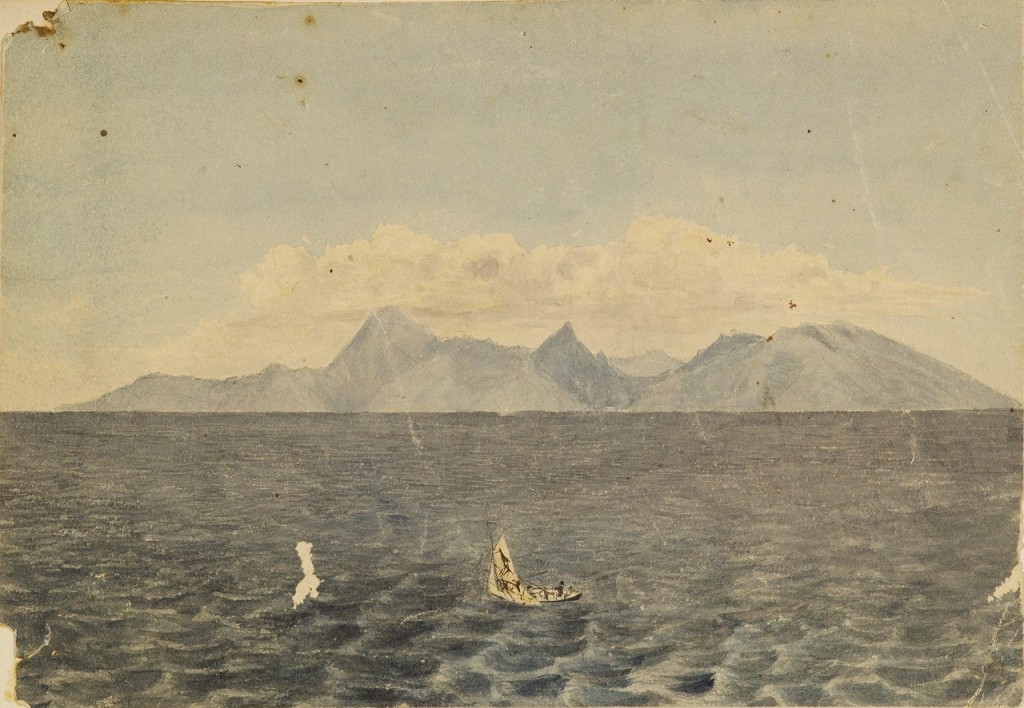
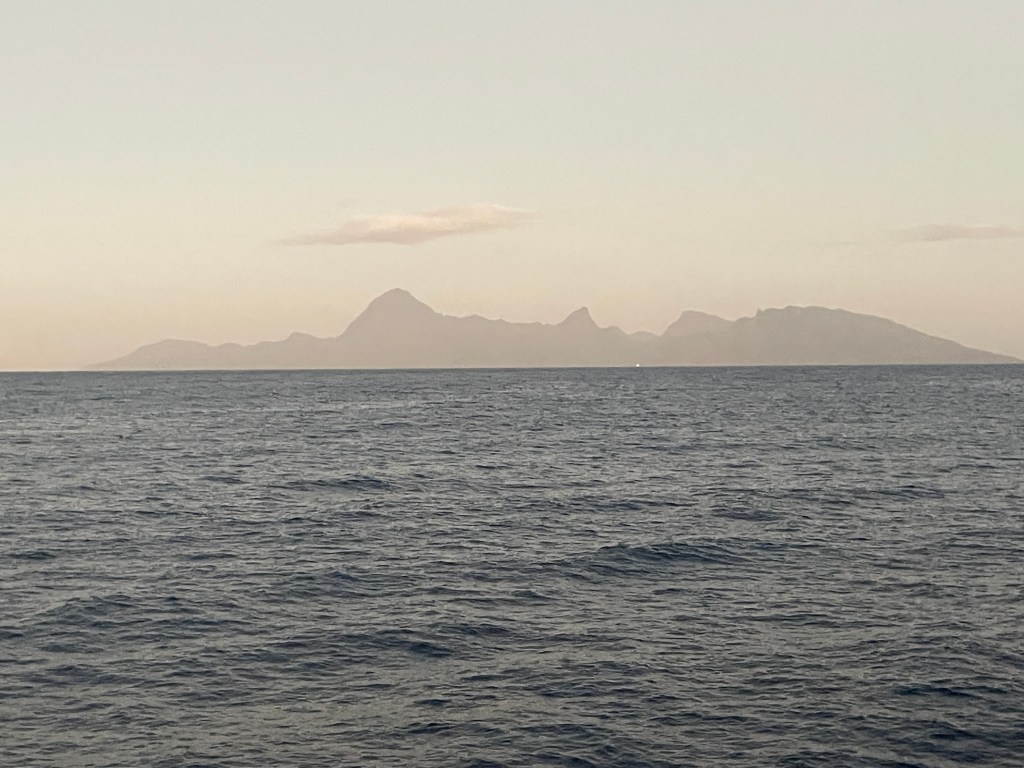
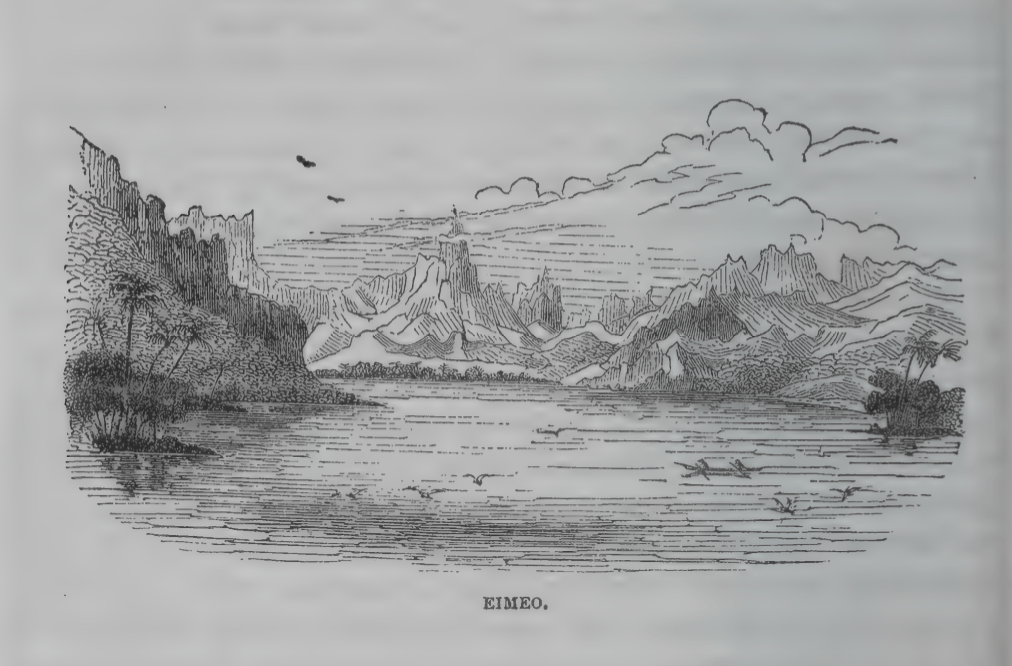
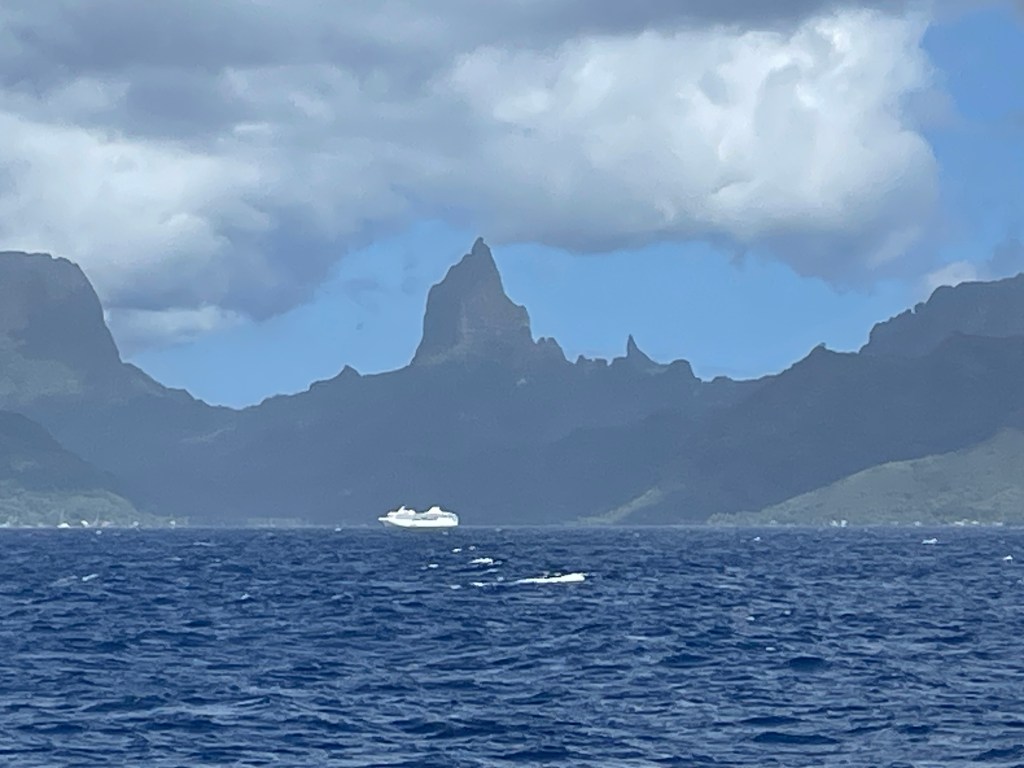
Now, I know I posted these pictures of Eimeo/Moorea before (taken from Papeete), but I continue to be thrilled by this first view that I shared with Alfred Agate, over a 185 years apart:

In this post I’m going to give a brief history of Tahiti and include more images from Alfred Agate.

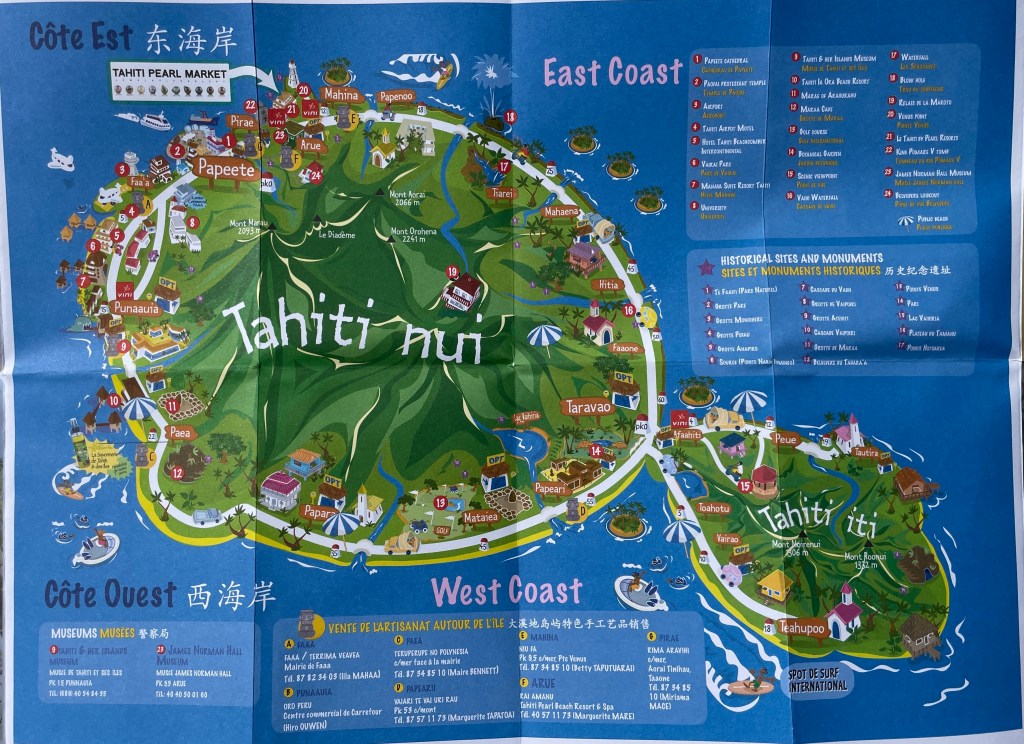
Volcanically formed about a million years ago (don’t you love stories that go back before humans arrived on the scene?) Tahiti actually consists of two major land masses – Tahiti Nui, where Papeete is located, and Tahiti Iti, a smaller but attached land mass to the south.  [Fun fact: The surfing competition of the 2024 Olympics took place off Teahupo’o, a beach located on Tahiti Iti.]

Fun tourist map the likes of which Alfred Agate couldn’t even imagine!

But Tahiti is just one of many islands that comprise the Society Islands (Mo’orea, Raiatea, Bora Bora, Taha’a and Huahine are some of the next biggest.) This island group was named by Captain James Cook, supposedly to honor the Royal Society who bankrolled his 1769 voyage of exploration.  Today, along with the Tuamotus, Marquesas, Gambier and Austral island groups, these archipelagos comprise what is today known as French Polynesia, one of the remaining overseas colonies of France. 

Current thinking is that Tahiti was first settled around 500 BCE.  Originating in what is today considered Southeast Asia (think Taiwan, Indonesia, Singapore) these proto-Polynesians were skilled sailors and navigators who island-hopped to Fiji, Samoa and Tonga in outrigger canoes that were up to 90 feet long and could transport people, animals and supplies.

Theirs was a complex society, a clan-based system with a hierarchy of chiefs and nobles and religious leaders. Their culture, language, art, ritual, dance and music would be disseminated throughout what is today considered Polynesia.  

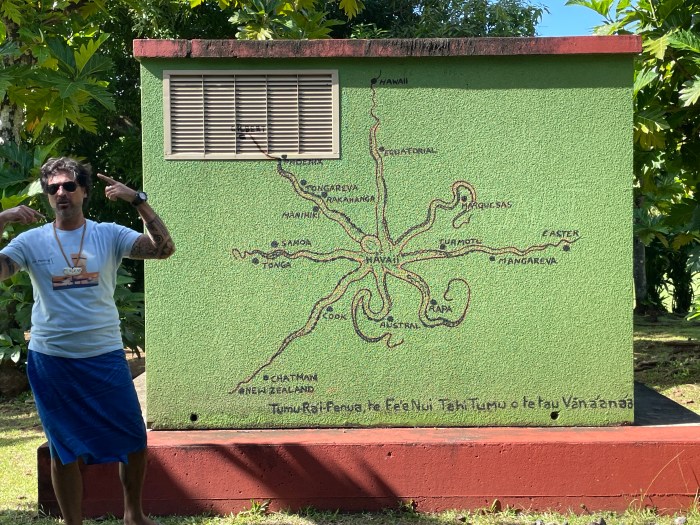
Tumu-Ra’i-Fenua or the Grand Octopus of Prosperity.
This image represents the Polynesian method of navigational wayfinding. The octopus’ head, “Havai’i”, is centered on the island of Raiatea in what is today’s French Polynesia. (Tahiti is just to the east, near Tuamotu.)

It’s not clear exactly when Tahiti was first visited by Europeans or by whom – Spanish explorer Juan Fernandez might have been the first to land in the 1570s, but then some think it was a Portuguese explorer Pedro Fernandes de Queiros in 1606.  The historical record is also unclear about what happened next, until 1767 when British Captain Samuel Wallis in the HMS Dolphin, definitively landed in Matavai Bay in Tahiti and, using his guns, steel (and probably a few germs) forced the local Chief, Oberea, to, uh, cooperate with the British.

Ahem.

The next year, the French explorer Louis de Bougainville anchored his ships La Bordeuse and Etoile off Tahiti for about 10 days and was apparently favorably impressed with the welcome he received from the Tahitians.  (Paul Theroux, in his curmudgeonly book These Happy Isles of Oceania, tells a likely apocryphal story about this visit, when a “barebreasted Tahitian girl climbed from her canoe to a French ship under the hot-eyed gaze of 400 French sailors who had not seen any woman at all for over six months.  She stepped on the quarterdeck where she slipped the flimsy cloth pareu from her hips and stood utterly naked and smiling at the men.”  And thus the Edenic myth of Tahiti began.  Sigh.)

1769 was Captain James Cook’s first visit, in the HMS Endeavour, to observe the transit of Venus.  (He would return twice more in the 1770s.)

1787 is of course the year the infamous Captain William Bligh would dock his HMS Bounty at Point Venus and spend five months collecting breadfruit plants in an unsuccessful attempt to find cheap food with which to feed enslaved Caribbean sugarcane workers.  And yes, Mutiny on the Bounty was a real thing (though there are those who take great exception with this enduring portrayal of Bligh.  A gifted navigator, there was more to him than just all the floggings he ordered . . .)

By the end of the 18th century, whalers had expanded their hunts into the Southern Ocean and Tahiti was a popular stop for resupplying their ships.  The Tahitian people quickly learned how to trade with the Europeans, and a flourishing economy of weapons, iron, alcohol and prostitution was established.

In 1797, the first missionaries landed to convert the “heathens.” Today, most Tahitians identify as Christians.

When the US Exploring Expedition arrived in September 1839, Tahitian culture had been irrevocably changed.  For starters, the population is thought to have plummeted from an estimated 180,000 to about 8,000.  And by the time the USXX showed up, Christian missionaries had made their mark — nudity was banned, as were tattoos, dances and other rituals.  

Still, our Alfred Agate was able to create numerous images of Tahitians going about their daily lives.  And I was able to see another site from aboard ship that Alfred Agate had also seen and drawn from almost the same vantage point:


Tahitian girl with the hau, sketch by Alfred Agate, September 1839
From The Narrative of the US Exploring Expedition, volume 2

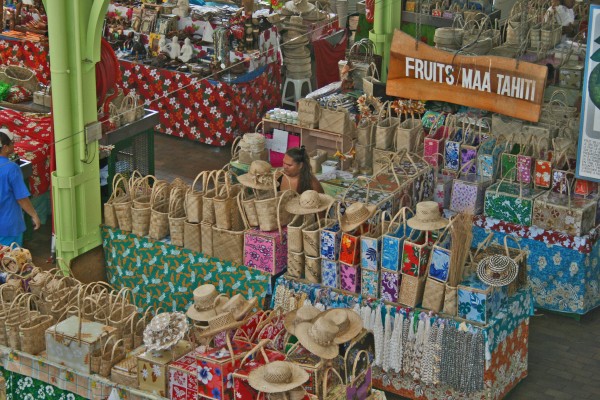
Today, you won’t see anyone wearing the hau, but you will find numerous crafts made with pandanus leaves in the same braided fashion:

The hat on the man below was likely woven from pandanus:

Tahitian man in his trading canoe, sketch by Alfred Agate, September 1839
From The Narrative of the US Exploring Expedition, volume 2

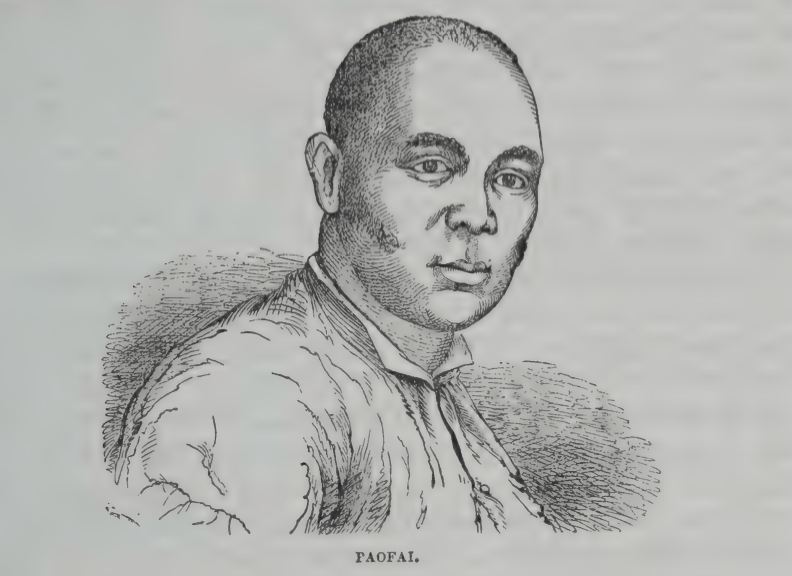
Now, below is an example of Alfred Agate’s artistry being deployed as a form of diplomacy. This is a portrait of Paofai, a chief and an advisor to Queen Pomare IV. Expedition leader Lt. Charles Wilkes wanted a meeting with Queen Pomare to present grievances from US sailing crews regarding their treatment in Tahiti. The Queen was due to give birth so was unable to meet, but sent Paofai as her emissary. Having Agate sketch a portrait of local leaders was a tactic Wilkes would employ on numerous occasions to encourage good feelings and cooperation:

Paofai, Tahitian chief. Sketch by Alfred Agate, September 1839
From The Narrative of the US Exploring Expedition, volume 2

And if you slog through volume 2 of Charles Wilkes’ Narrative of the US Exploring Expedition, you’ll read the following description of Paofai, which exemplifies Wilkes’ confusing interpretations and style of writing: “Paofai, a chief who holds the office of chief judge, and who is generally considered as the ablest and most clear-headed man in the nation, is accused of covetousness, and a propensity to intrigue.”

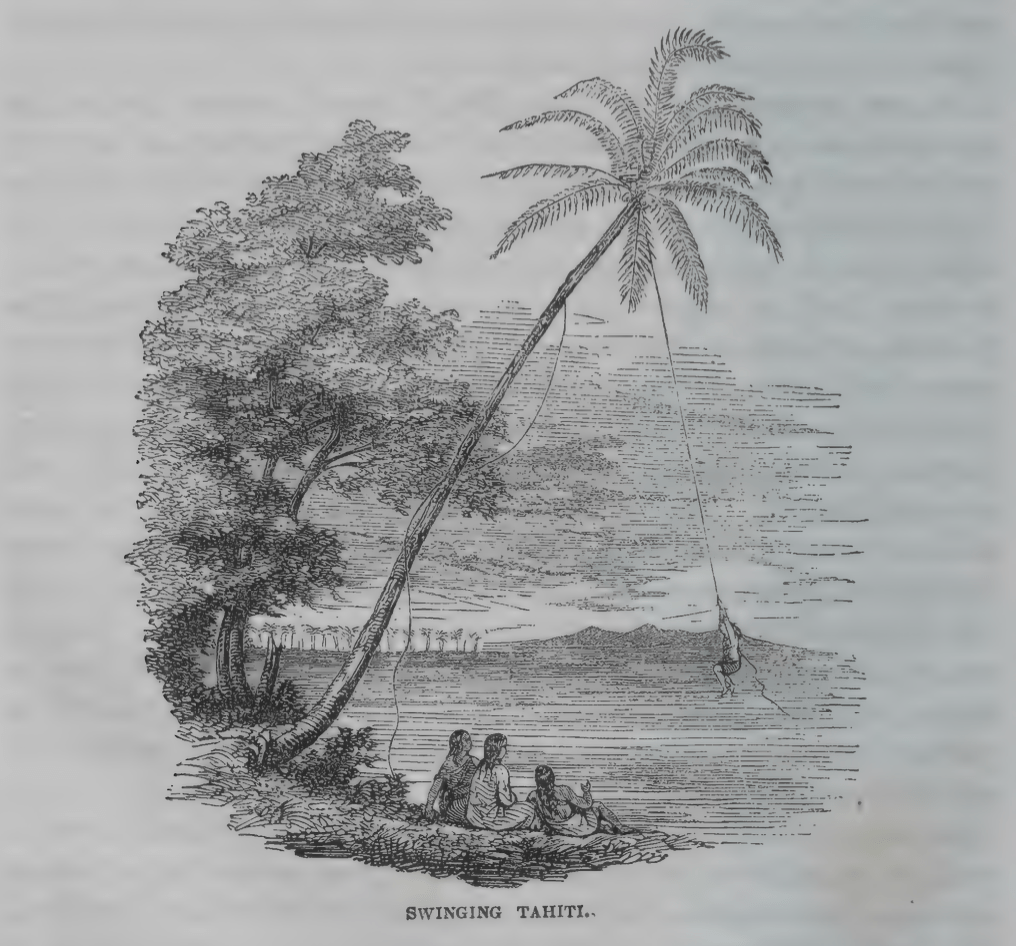
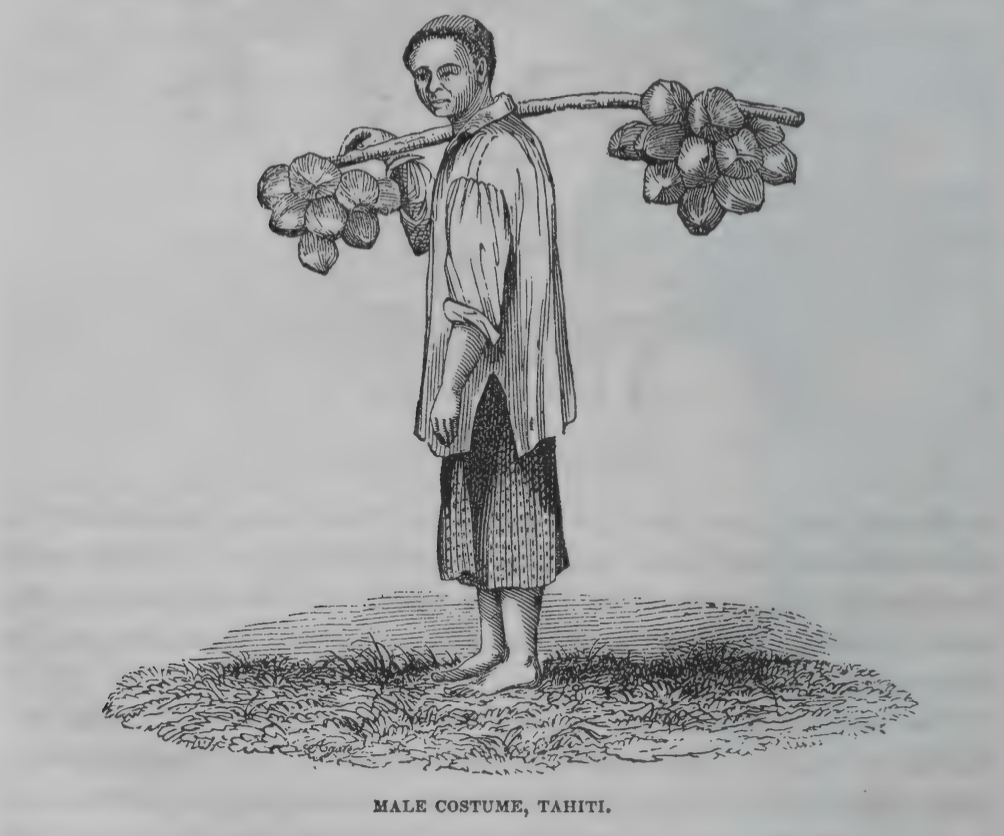
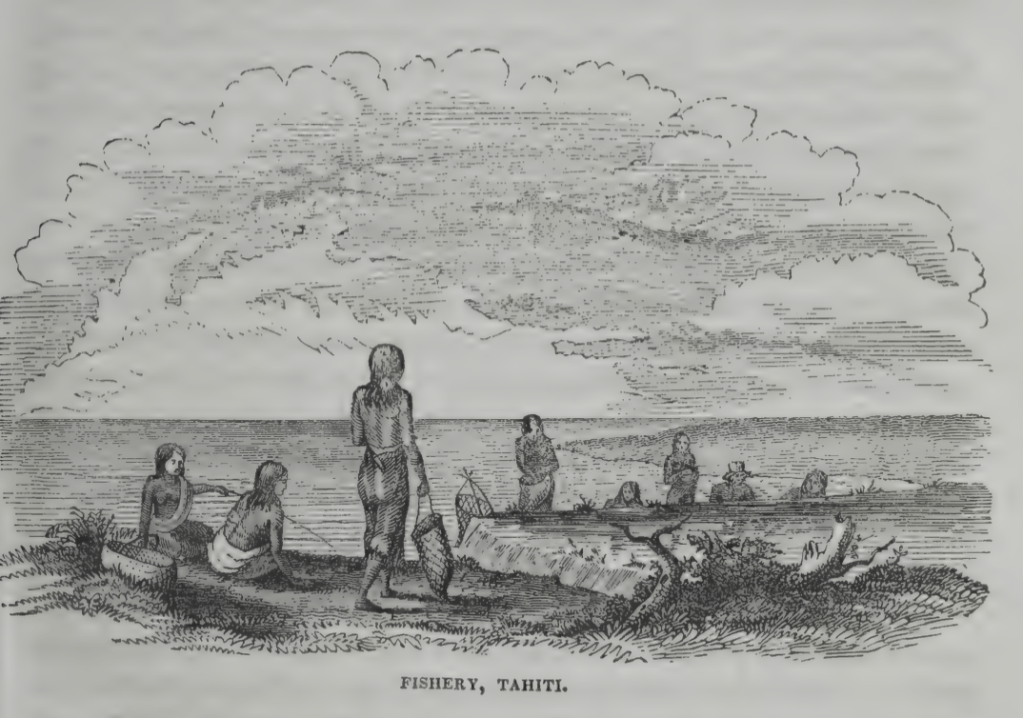
Finally, here are some more Agate images of daily Tahitian life from the Narrative . As you can see, for the most part the people are dressed in demure, European-style clothes.

Check back soon for Posts #8 and 9 and learn all about the realities of tall ship sailing, kava (a traditional intoxicant) and a Tongan umu (feast).

Some Boat talk (Post #6)

I’ve received a number of queries asking me to compare the Bark Europa, the ship I’ll be sailing on, to the ship that Alfred Agate was on for the US Exploring Expedition.

First, Alfred was on a total of three ships during the course of the US XX.  

He started on the USS Relief, a supply ship that was 109’ long with a 30’ beam. 

Commanded by Lt. Andrew K. Long, the Relief was not built for speed.  But then, it was meant to be a storeship, so what could you expect?  Still, her sluggishness infuriated Lt. Charles Wilkes and after berating Lt. Long mercilessly for months (as much as one could do from another ship with no radio), and after the ship was almost wrecked off Noir Island,  Wilkes sent the ship home from the port of Callao. (Fun fact that gets grosser in some accounts – when the Relief was fumigated in Callao, anywhere from 3 – 8 barrels of dead rats were unloaded from her hold.)

Here is Alfred Agate’s rendition of the USS Relief struggling off Noir Island in the Straits of Magellan, February 1839.
Courtesy of the Naval History and Heritage Command

 Alfred Agate and William Rich, the naturalist, are transferred to the USS Peacock at Callao.  

The USS Peacock was a sloop-of-war, 119’ (36m) long with a 32’ (10m) beam.  

USS Peacock drifting listlessly in Antarctic waters, c. 1839
This image was likely sketched by Lt. Wilkes and then cleaned up by Alfred Agate later as Agate did not embark on either Antarctic mission of the US XX.
Courtesy of the Smithsonian Institution

Lt. William Hudson was the very capable commander who eventually, as it seems did everyone, got on Wilkes’ bad side.  

Alfred was on the Peacock until it was wrecked on or about July 16, 1840 while trying to cross the bar into the Columbia River.  All hands were saved, but Alfred is said to have lost many illustrations on his escape from the sinking ship.

Wreck of the USS Peacock at the mouth of the Columbia River, c. 1840 by Alfred Agate
Courtesy of the Naval History and Heritage Command

From there, after some overland expeditions in southern Oregon and northern California (during which Alfred got so ill from “fever and ague” that he had to be transported to San Francisco for treatment.)  At this point, he was placed on the USS Vincennes, the flagship of the Expedition and the one under Lt. Charles Wilkes’ direct command.  

USS Vincennes in Disappointment Bay, attributed to Lt. Charles Wilkes, c. 1840
Courtesy of the Smithsonian Institution

The Vincennes, also a sloop-of-war, was 127’ (39m) with a beam of 34’ (11m).

In comparison to the three ships listed above, the Bark Europa is a three-masted steel barque,  131’ (40m) long with a beam of 25’ (7.5m).  And of course, unlike all the ships on the US Exploring Expedition, she is equipped with engines. However, unlike the Europa, the two sloops-of-war were equipped with numerous cannons of various sizes. These were used to frighten the various native peoples to “encourage” them to cooperate with the demands of the Americans and to retaliate against said natives when they did not.

The Bark Europa in full sail, c. 2007.
Courtesy of Wikimedia Commons

This is likely to be my last post for a while, as I am about to board the Europa in less than an hour. But I will post again!

If you haven’t already subscribed and are interested in following this journey, you can do so here: