Ossining’s Connection to the Heisman Trophy

In procrastinating today, and you know I was taking it seriously because I got all the way into the sports section, I saw a story about Reggie Bush, former USC star player, who was just (April 2024) re-awarded his 2005 Heisman Trophy. (Long story short, in 2010, the NCAA decided that Bush had taken impermissible payments as a college athlete and he was forced to give up the award.)
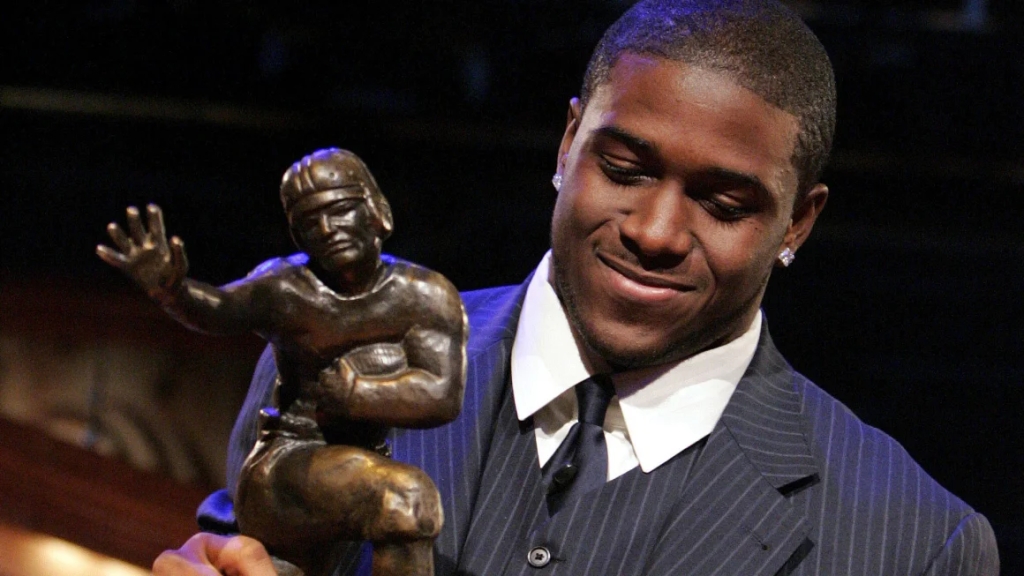
Reggie Bush and his 2005 Heisman Trophy.
Photo courtesy Julie Jacobson/AP

But it made me think about Ossining’s connection to the Heisman Trophy.

I mean, did you know that the trophy was sculpted by Ossining artist Frank Eliscu?

No, this is absolutely true. Created in 1935 by the Downtown Athletic Club and named in honor of John Heisman, the club’s athletic director, the Heisman Trophy has been awarded every year to the Most Valuable College Player.

Now, I’m not exactly sure how 23-year-old Frank Eliscu landed this as his first commission, but he had graduated from the Pratt Institute a few years earlier, and apparently already had had a one-man show of his artwork, so perhaps that had something to do with it.

The story goes that Eliscu modeled the sculpture on his very buff high school friend, Ed Smith, who was a star NYU running back at the time. [Fun fact — Ed Smith had no idea he’d been so immortalized until 1982!]

Wikipedia tells me that Ed Smith demonstrates “the stiff-arm fend, a tactic employed by the ball-carrier in many forms of contact football” in his pose. But of course you all knew that.

But let’s unpack the Frank Eliscu story, because he is one of many important Ossingtonians who have flown under the radar (to use a cliche, sorry Mr. Gilligan!)

Frank Eliscu was born in 1912 in Washington Heights, NY and lived on West 178th Street with his parents, Charles and Florence Eliscu, who had immigrated from Romania, and two siblings. He attended George Washington High School, where he met the aforementioned Ed Smith, and went on to study at the Pratt Institute, graduating in 1931. After sculpting the Heisman Trophy, he apprenticed with sculptor Rudolph Evans, working with on various projects . Like the Thomas Jefferson statue for the Jefferson Memorial in Washington, DC. (!!)

At some point in the 1940s, he married his wife Mildred, and started studying for a teaching certificate at New York’s Teachers’ College. However, the war upended his plans and he left school in 1942 to serve in the US Army. They first had him working on camouflage and maps, but then transferred him to Valley Forge General Hospital where he worked for the plastic surgery department, modeling replacement features for wounded soldiers. He also invented some unique process to normalize the color of these plastic features and may have even patented it (more research to come!)

Discharged in 1945, Eliscu began teaching at what was then called the School of Industrial Art (today the High School of Art and Design) and taught there until 1970.

According to the 1950 US census, Eliscu lived at 195 Croton Dam Road with his wife Mildred and daughter Norma (OHS ’51) and is listed as a High School Teacher. In a 2001 Ossining High School memory book for the class of 1951, Norma is quoted as saying “though Dad became famous, in Ossining they were just Mr. and Mrs. Eliscu.  They knew everyone, spoke with everyone and loved small-town life.  I was not aware Dad was famous.  He was just Dad who taught school and did some sculptures in the evening in his studio.”[1]

Did some sculptures indeed!

According to his 1996 New York Times obituary, Eliscu designed “many larger bronze sculptures for banks and office buildings throughout New York in the 1960’s and 70’s. From 1962 to 1972 he designed the engravings for six glass works produced by Steuben.”
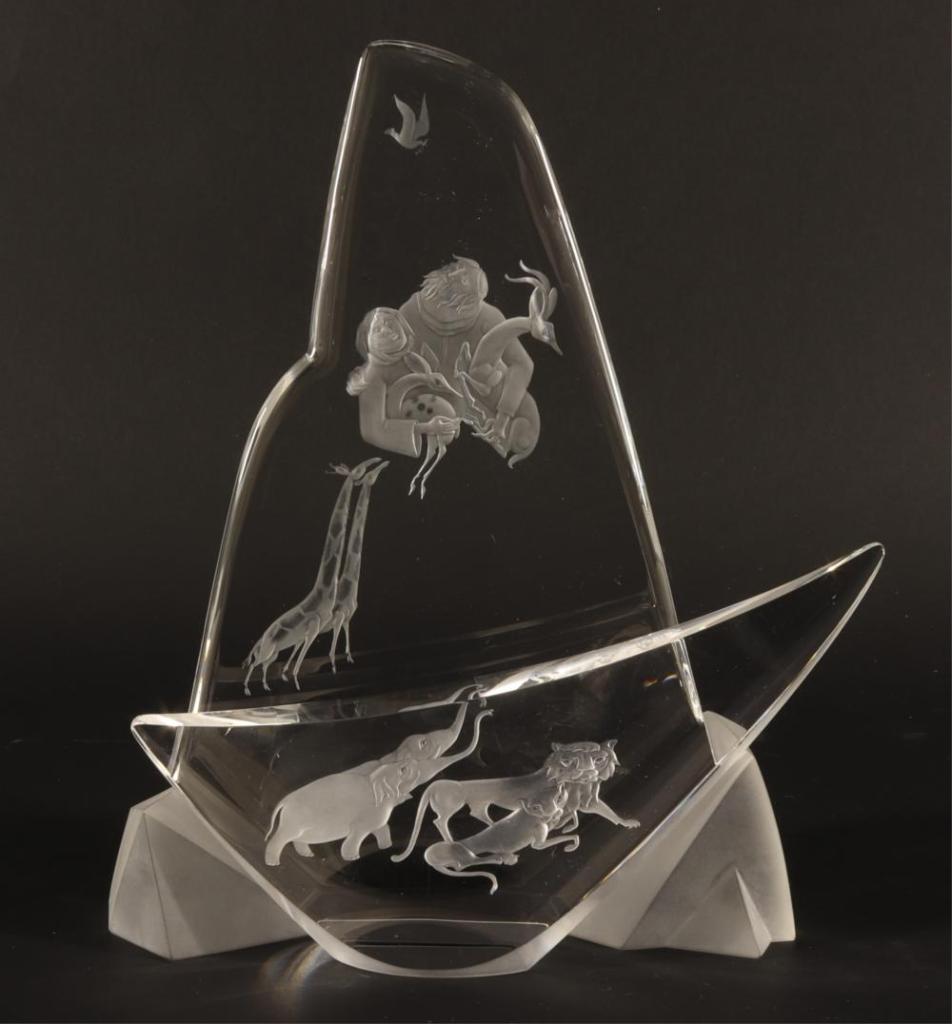
Courtesy of Invaluable.com

The New York Times obit continues: “He was the principal designer of the 1974 Inaugural medals for President Gerald R. Ford and Vice President Nelson A. Rockefeller. President Ford later presented a bronze eagle, an enlarged three-dimensional version of the one on the Presidential medal, to Leonid I. Brezhnev, the Soviet leader.”
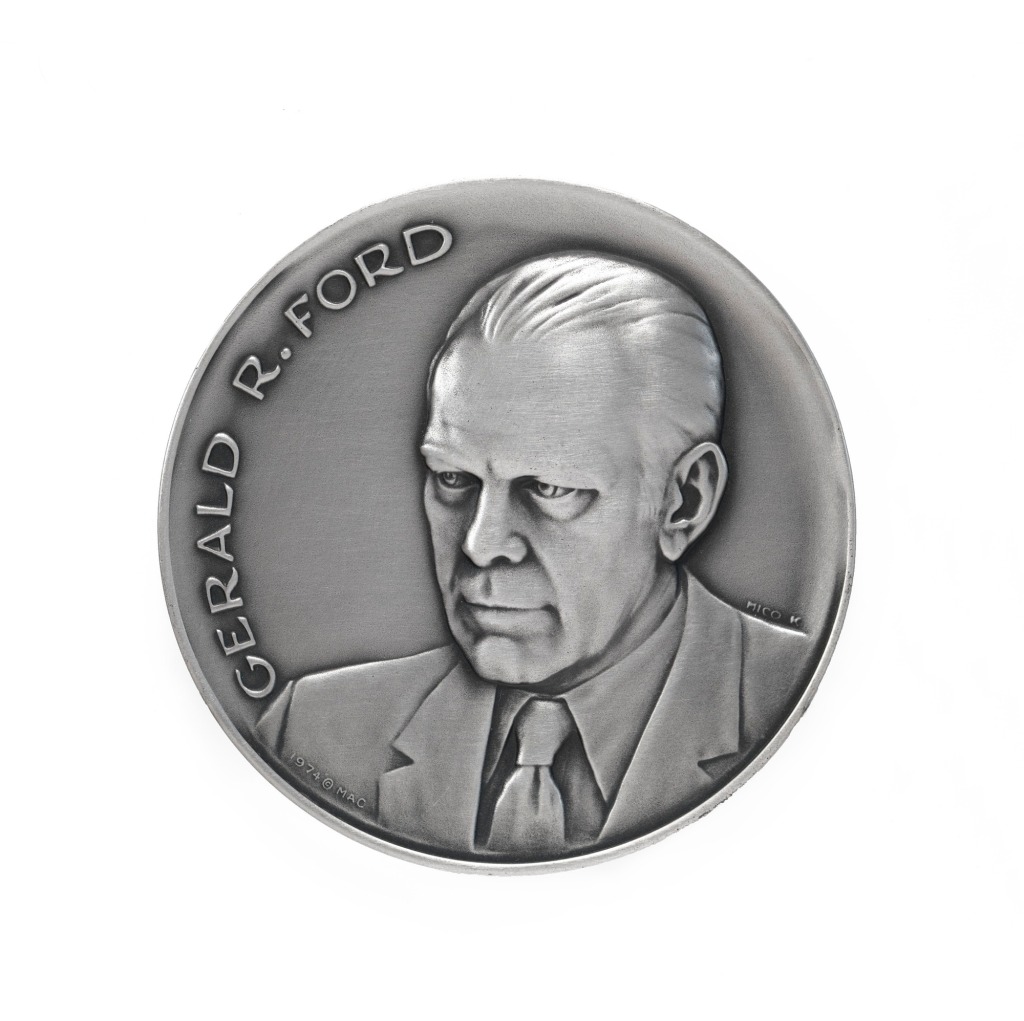
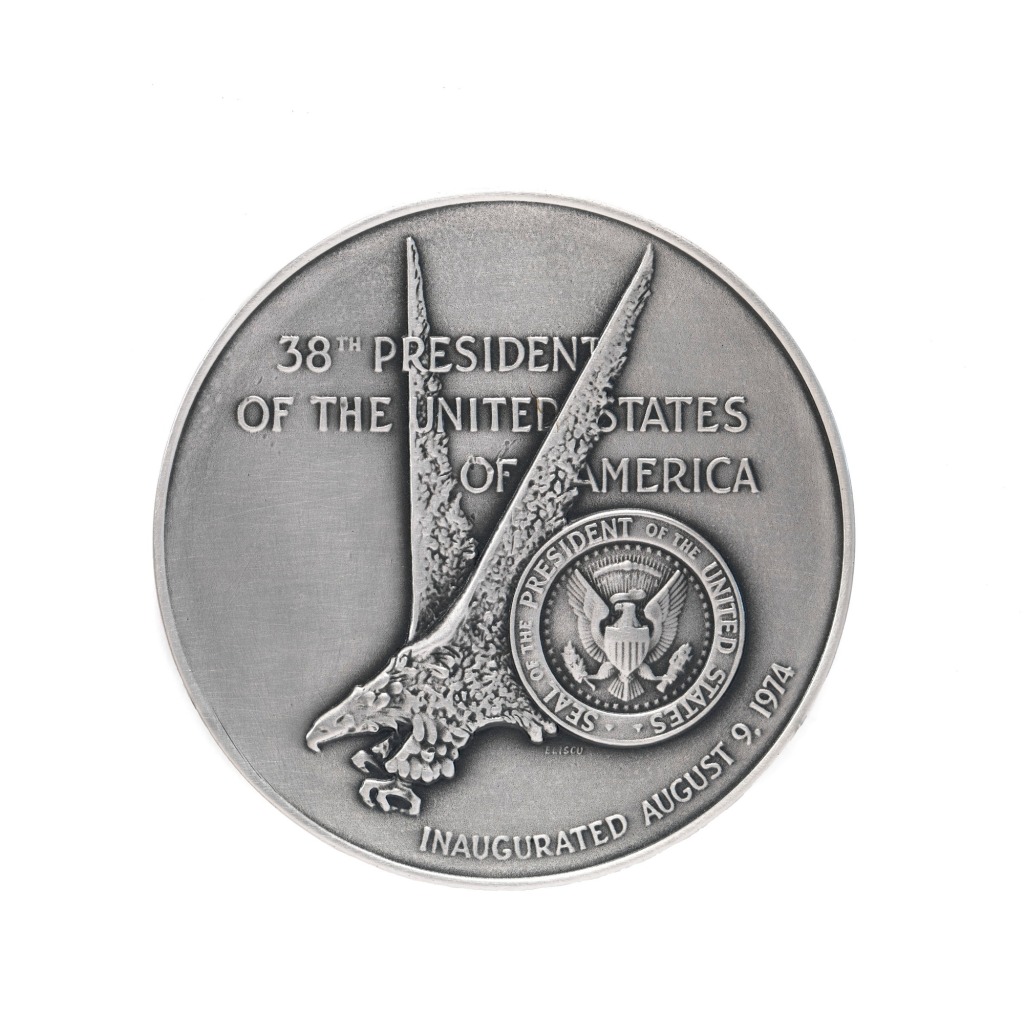
Courtesy of the Smithsonian American Art Museum

In 1983, his sculpture “Falling Books” was installed above the entrance of the Library of Congress:
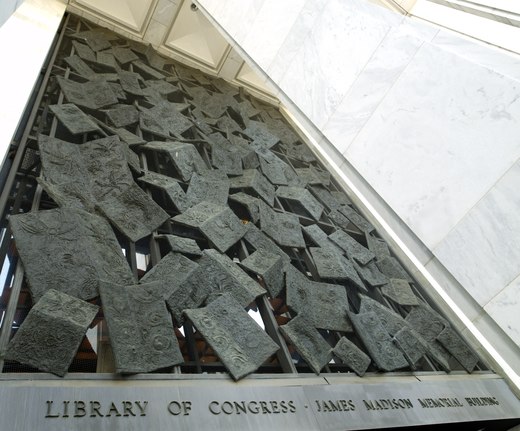
Courtesy of the Library of Congress

In 1967, Eliscu was invited to become a member of the National Academy of Design (and here’s another Ossining connection — the National Academy of Design was founded in 1826 with the help of Sparta son Frederick Agate.)

So there you go — Frank Eliscu, Ossining sculptor and creator of the Heisman Trophy:
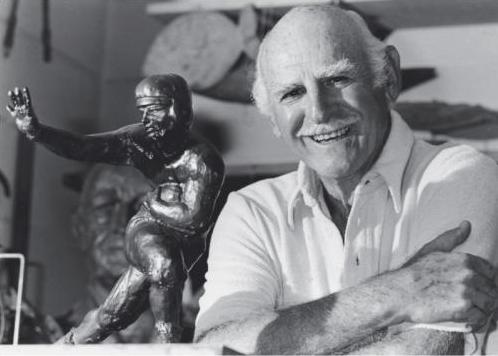
Frank Eliscu with the Heisman Trophy
Courtesy of alchetron.com

[1]  “Ossining Remembered: 50+ Years Later . . . in the 21st century” edited by Tom Schoonmaker, c. 2001
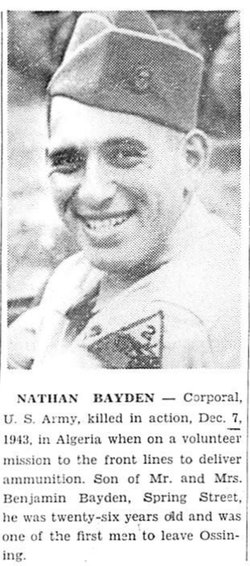
Ossining War Casualty — Corporal Nathan Bayden

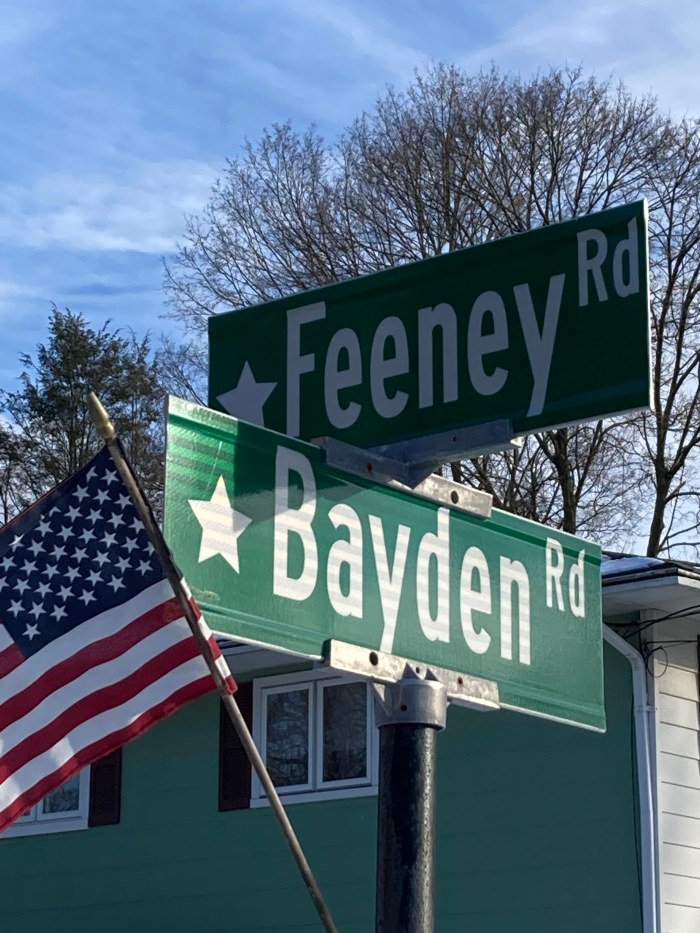
As promised, here’s a post with information on Corporal Nathan Bayden, one of Ossining’s war veterans, honored at the intersection of Feeney Rd. and Bayden Rd.

While Private Benjamin Feeney lost his life in WWI (see full blog post here), Cpl. Nathan Bayden served in WWII and was killed in action in Algeria.

(I do rather wonder how these street names honoring our soldiers are chosen, as this seems a particularly random pairing.) 

Nathan Bayden was born in Ossining on July 21, 1918.  His parents, Benjamin and Fannie, were born in either Poland or Russia (hard to know back then as the borders kept shifting.) The family was Jewish.  

He graduated from Ossining High School in 1935 and immediately went to work, likely as a clerk in his parents’ antique store which they ran out of their house at 107 Spring Street.  

According to the 1940 census, he was a chauffeur, and worked 52 weeks a year, earning the princely salary of $700 a year.  (That works out to about $20,000/year today.)  

Not sure if Nathan was drafted or if he joined up voluntarily, but he officially enlisted on March 5, 1941.  His enlistment record notes that he was a “salesperson”, not a chauffeur, and at the time he enlisted, he wasn’t assigned to a particular service branch at the time.  

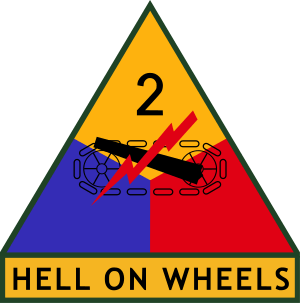
At some point, though, he became part of the US Army, 2nd Armored Division, 67th Armored Regiment.

The nickname for the 2nd Armored Division was “Hell on Wheels” and their shoulder patch looked like this:

If you look closely at Corporal Bayden’s picture above, you can see that same patch on his left shoulder, confirming his Division.

I can’t find out when he joined the 2nd, so I’m not sure which battles he fought in, except for his last.  Killed in Action on December 7, 1942 in Algeria, he was originally interred in a cemetery in Tunisia, but at some point his remains were transferred to Arlington cemetery, where he rests today.

So what was this Ossining boy doing in Africa in 1942?  

Frankly, I always forget that battles were raging in Africa during WWII. All I know is that General Erwin Rommel commanded the German Afrika Korps, it was hot and sandy, and the Kasserine Pass is somewhere there.  I believe these battles in Africa were a plot point in Raiders of the Lost Ark, but the European and Pacific theaters generally seem to take up more space in the version of WWII I’m familiar with.

And I’m not going to lie, military history is far too numbers-oriented and remote for me to engage with too deeply, so I’m not going to get into the weeds on all this.  But I did learn that the famous General George S. Patton was in charge of the 2nd Armored Division in 1942.

And while I can’t pinpoint the battle in which Corporal Bayden lost his life, it was likely in the aftermath of Operation Torch – an Allied invasion of the French Colonies in northern Africa.

In reading about this battle, I’m surprised that Tom Hanks and Steven Spielberg haven’t done a feature film on it, because it’s just as dramatic and heroic as the Normandy invasion featured in Saving Private Ryan.

Operation Torch took place November 8 – 16, 1942.  As he would be for D-day on June 6, 1944, General Dwight D. Eisenhower was the Supreme Commander of this operation. (No wonder the man smoked up to four packs of cigarettes a day!) 

The invasion involved landing over 75,000 troops in Morocco and Algeria. Like D-Day, this operation involved US and British forces working in tandem.

Why was this invasion necessary?  

Why is war ever necessary, I reply.

Now, I’m not going to pretend that I have a nuanced understanding as to the strategy at work here. But, a careful reading of Wikipedia (ahem!) and a brief conversation with my history guru Ken during a run, the ostensible goal was to liberate North Africa from the Vichy French and the Nazis, but Stalin was really keen on the Allies opening up a 2nd front for the Germans to contend with.

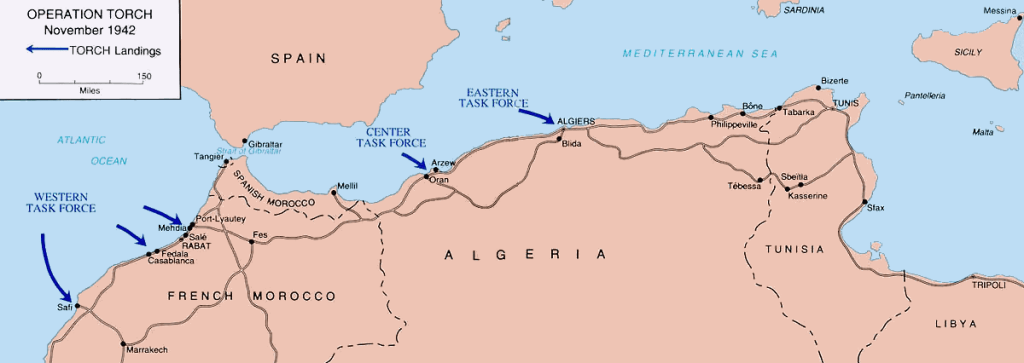
It seems that our Corporal Bayden’s Division was in the Western Task Force on the Casablanca side of things.  General George S. Patton was in direct command of this part of the invasion, and over 35,000 troops were secretly transported there in ships, nonstop from the United States.  Traveling through waters patrolled by U-boats, arriving right on time, at night, in unfriendly territory in bad weather – the logistical portion alone of this story is remarkable.

Here’s a map of the battle sites I downloaded from Wikipedia – it clarified a lot of this for me. (Cpl. Bayden’s Division is all the way on the left, or western side of French Morocco.)

How exactly did Corporal Bayden participate in this battle?  And how did he lose his life nearly one month afterwards?  Alas, I have not uncovered much detail here, except that a hospital admissions record states that that the Causative Agent of his death was “Boat, sinking, by mine or resulting from unspecified enemy action.”  

And then there’s the clipping (above) that I found in in the Ossining Historical Society’s 1983 Memorial Honor Roll – though Bayden’s death year is incorrect, perhaps the description of the cause is accurate?  Hard to know. If anyone reads this who knows more, please contact me!

Taking into account that Bayden enlisted in March of 1941, and knowing that the majority of the soldiers participating in this battle came straight over from the States, I believe this might have been Bayden’s first, and last, experience in battle.

So the next time you drive up Bayden Rd., take a moment to remember Corporal Nathan Bayden, who died far from home at the age of 26.