Henrietta Hill Swope – Astronomer

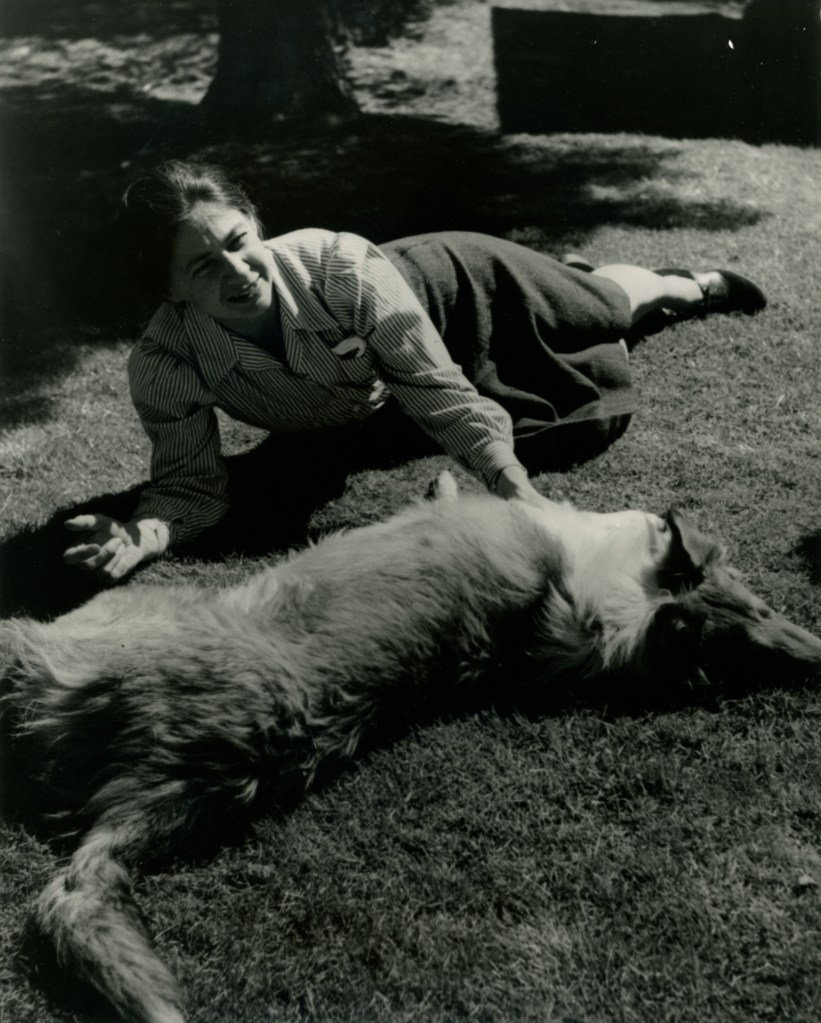
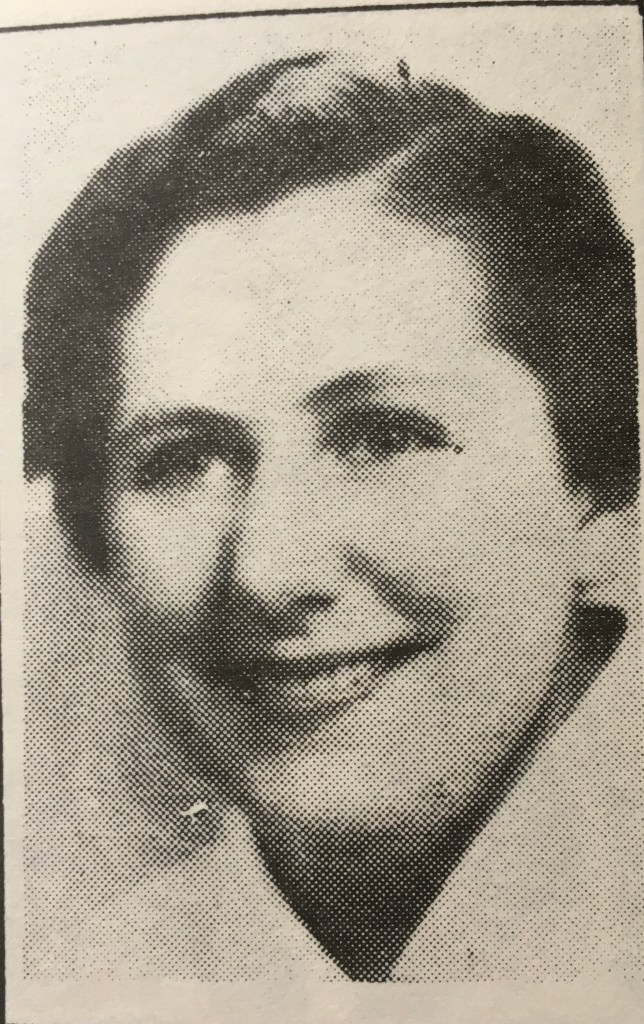
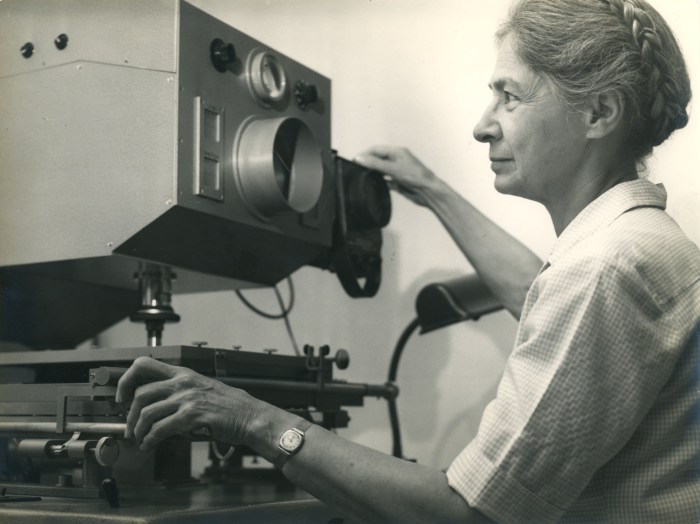
Henrietta Hill Swope, c. 1950s
Courtesy of Kevin Swope

Henrietta Hill Swope
1902 – 1980

Astronomer
Inventor
***Local Connection: The Croft, Teatown, Spring Valley Road***

Henrietta Hill Swope was a quiet, humble, but fiercely driven scientist whose work contributed to our current understanding of the structure of our universe.

Specifically working in the fields of Cepheid variable stars  and photometry, her early work showed that that the Earth and the Sun were not at the center of the Milky Way galaxy as previously believed.  From there, she surveyed all the variable stars within the Milky Way, thus tracing out the structure of that galaxy, something that had never been done before.  She also helped invent LORAN, and contributed to the creation of a new technique to simply and accurately determine the distance of stars and galaxies from Earth.

Born in St. Louis, MO in 1902 to Gerard and Mary Hill Swope, Henrietta came from an extraordinary family.  Her father was a financier and president of General Electric, while her uncle, Herbert Bayard Swope, was a Pulitzer-prize winning journalist, war correspondent and newspaper editor.  Her mother was a Bryn Mawr graduate who would go on to study with the pioneering educator John Dewey, and later work for Jane Addams at Hull House in Chicago.  

Henrietta became interested in astronomy as a young girl, and was taken to the Maria Mitchell Observatory on Nantucket where she heard lectures from Harvard’s Dr. Harlow Shapley and others.

Henrietta went off to Barnard College, where she majored in Mathematics and was graduated in 1925. (She said she chose Barnard because she “didn’t have any Latin.  My father didn’t believe in any Latin. He thought I should spend that time on either sciences or modern languages.”[1])
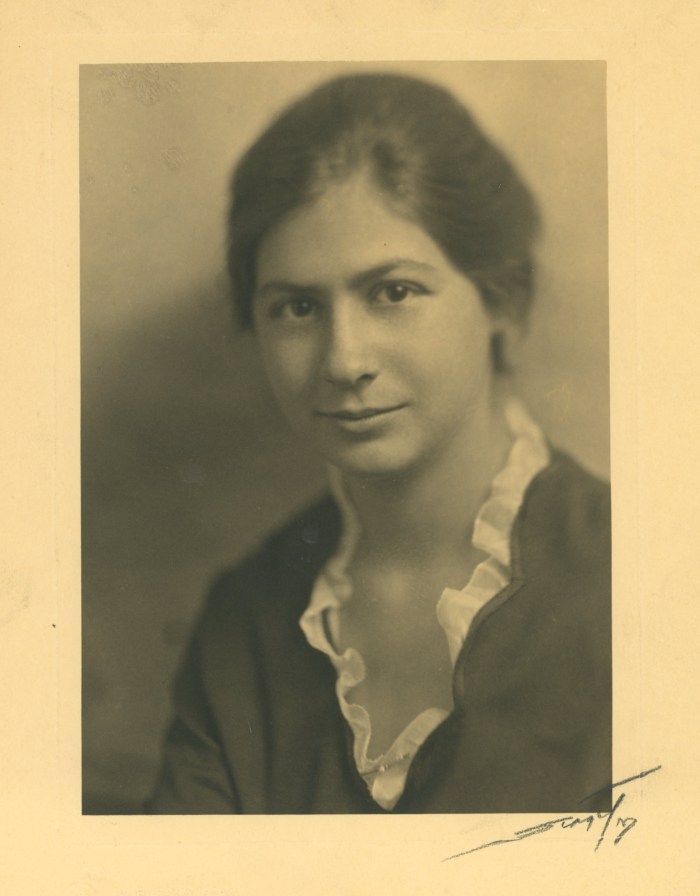
Henrietta Hill Swope
Barnard Class of 1925
Photo Courtesy of Kevin Swope

In 1927, though she had only taken one course in astronomy, a friend alerted her to a fellowship offering for women only sponsored by Dr. Harlow Shapley at the Harvard College Observatory (HCO).  She applied and was quickly accepted. (Her initial interpretation was that he was reaching out to women specifically because he “wanted some cheap workers.”  Ahem.)[2]  

She became Shapley’s first assistant, and while she looked for variable stars on photographic plates taken via the HCO telescope, she earned her Master’s in astronomy from Radcliffe College in 1928.
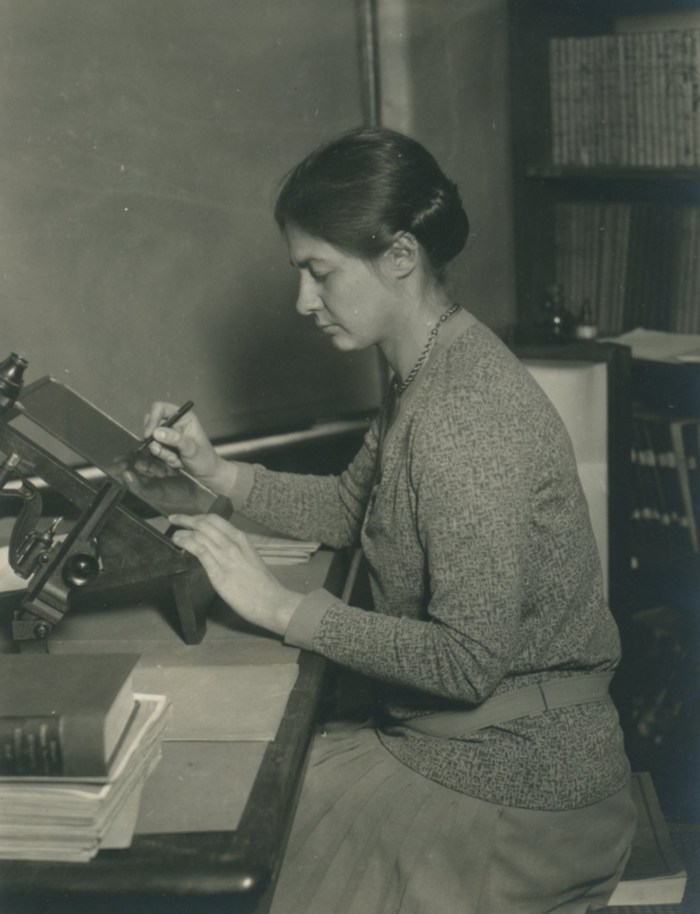
At the Harvard College Observatory, c. 1930s
Looking for variable stars
Courtesy of Kevin Swope

The following year, she became famous when she identified 385 new stars, accurately revealing the composition of the Milky Way galaxy.  By 1934, she was in charge of all the Harvard programs on variable stars which were central to much of the astronomical research at the time.

In 1942, she left Harvard to work at MIT in a radiation laboratory, and the following year was recruited by the US Navy to work on a secret project which would come to be known as LORAN (Long Range Aid to Navigation.)  This innovative technology allowed navigators to use radio signals from multiple locations to fix a precise position.  She was appointed head of LORAN Division at the Navy Hydrographic Office in Washington, DC for the duration of the World War II.

Post-WWII, she would teach astronomy at Barnard College, then relocate to California to work as a research fellow at the Mt. Wilson and Palomar Observatories, as well as teach at the California Institute of Technology (CalTech).   She would visit her family’s home The Croft in Ossining a few times a year, and is remembered by a niece as being “no frills. Very sweet, otherworldly, and decidedly bluestocking, none of us knew how accomplished she was or how important her work was.”
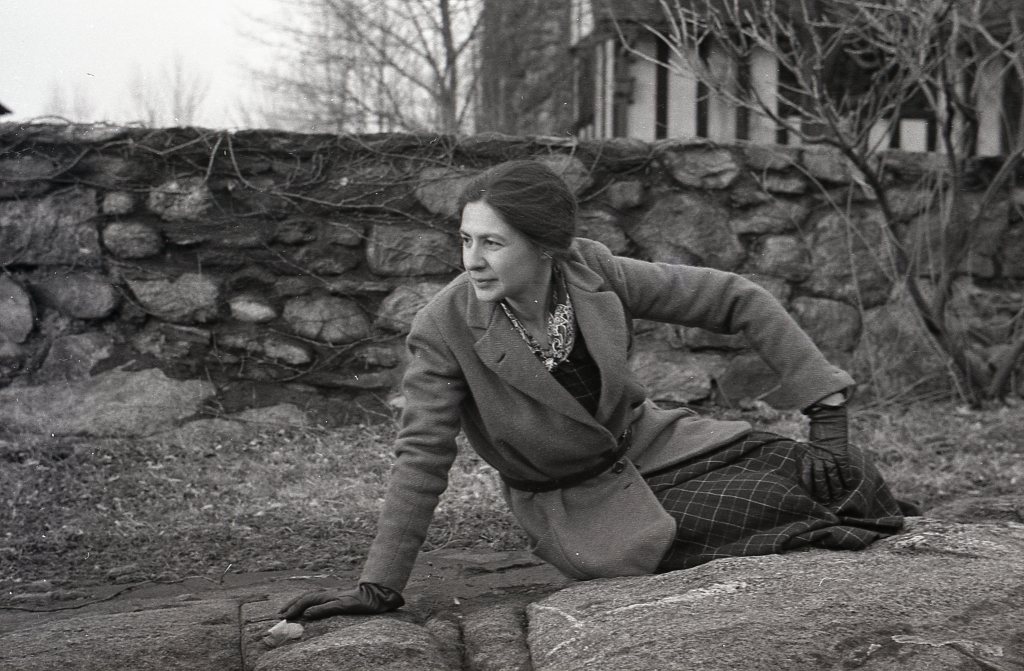
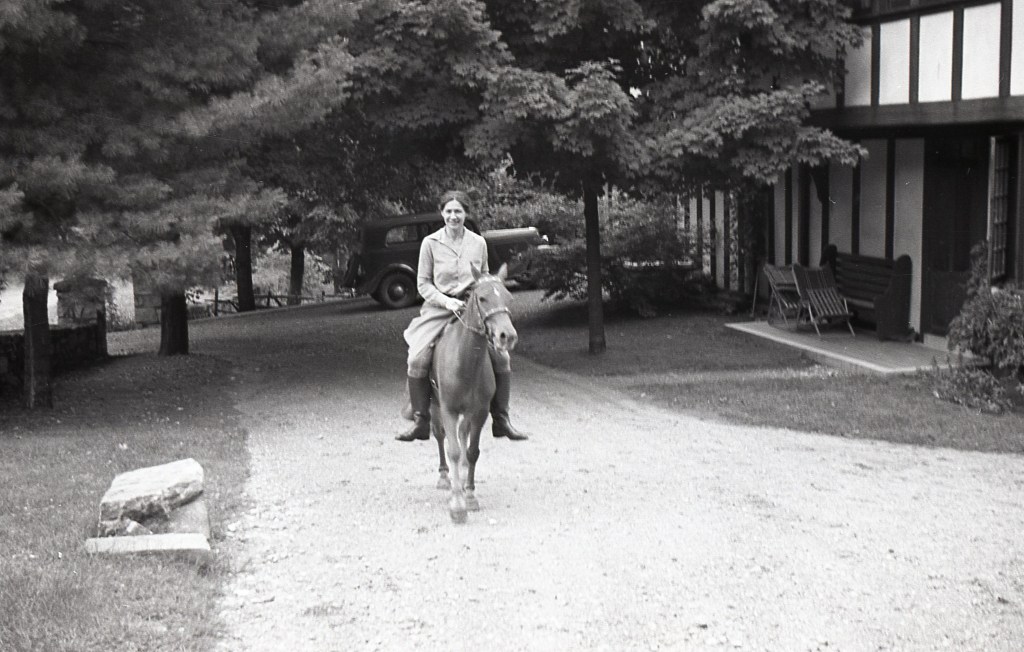
Henrietta Swope at The Croft, c. 1930s/40s
Courtesy of Kevin Swope

During this time, Swope’s research focused on determining the brightness and blinking periods of Cepheid variable stars, and the quality and precision of her work allowed other astronomers to use these stars as “celestial yardsticks” with which to rapidly measure celestial distances. Swope herself used them to determine that the distance from earth to the Andromeda galaxy is 2.2 million light-years.

She remained at the Mt. Wilson Observatory and CalTech until her retirement in 1968.

In the 1970s, she donated funds to the Carnegie Institute of Washington to aid in the development of the Las Campanas Observatory in Chile.

The Henrietta Swope Telescope in Las Campanas, Chile

The 40-inch  Henrietta Swope Telescope began operation in 1971 and though Swope died in 1980, she continues to help people look to the stars.


[1] Interview with Dr. Henrietta Swope, By David DeVorkin at Hale Observatories, Santa Barbara State August 3, 1977.  https://web.archive.org/web/20150112054849/http://www.aip.org/history/ohilist/4909.html

[2] IBID
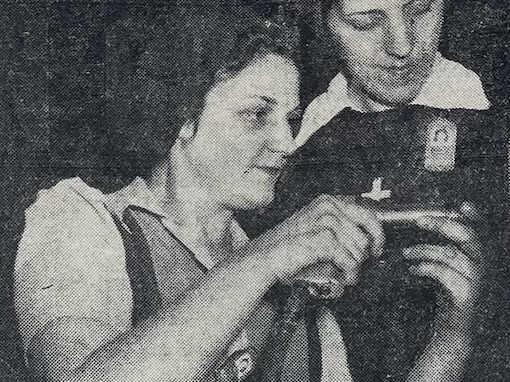
Jennie Chicarelli Fiorito Windas – An Ossining “Rosie the Riveter”

Jennie Chicarelli Fiorito & Rose Bonita
at Eastern Aircraft plant, Tarrytown NY
Courtesy of the Ossining Citizen Register, June 8, 1943

Jennie Chicarelli Fiorito Windas
1916 – 2002

An original “Rosie the Riveter”
***Local Connection: 10 Denny Street**
*

On June 8, 1943, at the north Tarrytown plant of Eastern Aircraft, Jennie Fiorito and Rose Bonavita set a record by riveting an entire trailing edge wing assembly for an Avenger torpedo bomber in less than six hours.  

They started at midnight and finished just as the sun was rising.  

Jennie and Rose had been working together as a riveting team for about six months when they decided to try and set a record.  (Bonevita’s 1996 obituary in The Journal News asserted that the idea came about to help “raise flagging morale at the factory.”)

They asked for approval from their supervisor and were given the go-ahead.  As word spread throughout the factory, the girls were a bit nervous, knowing that everyone was watching them closely. But as Jennie said, “The record doesn’t really mean anything, the main thing, as we see it, is to get out as many wings as we possibly can.  We like to work and we feel that we, personally, are responsible to those boys for producing as much as we can as quickly as we can.”  

For their effort, they received a letter from Franklin D. Roosevelt and the satisfaction of a job well done.

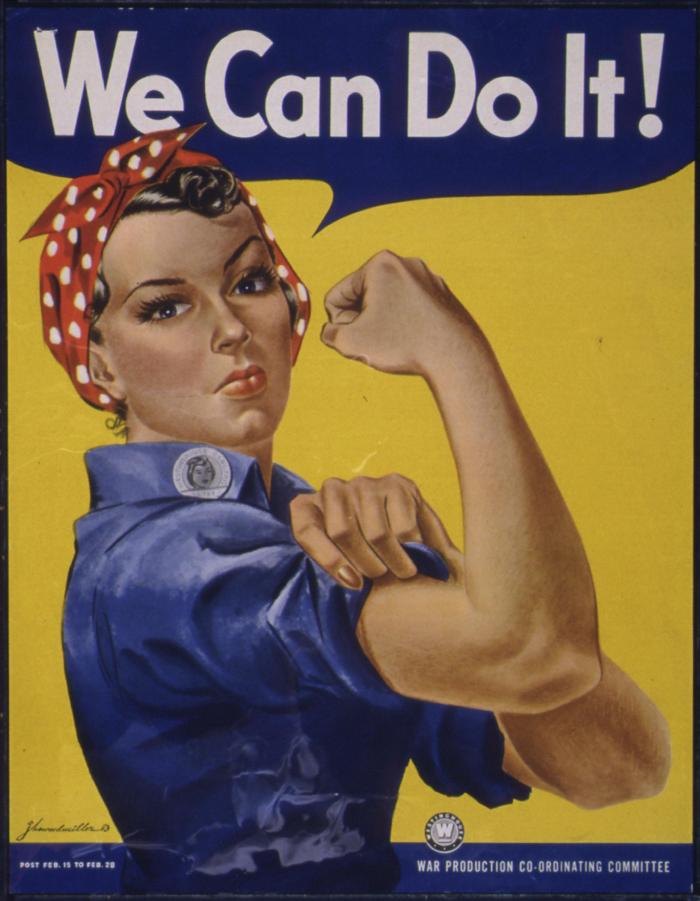
“We Can Do It!” By J. Howard Miller 
Created for in-house use at the Westinghouse Electric Company, it was displayed for only two weeks from February 15 – 28, 1943 to inspire workers to work harder. The poster was rediscovered the 1980s and has been used as inspiration for female empowerment ever since.
Courtesy of the Library of Congress

Born in 1916, Jennie was the youngest of six children whose parents emigrated from Faenza, Italy in 1909.  The Chicarellis lived on a farm next to the Scarborough Country Club, and Jennie and her siblings attended a one-room schoolhouse in the area. Jennie would leave school at the age of 16 to work as a trimmer at the Fisher/General Motors Body Plant in North Tarrytown. With the advent of WWII, that factory was converted to an Eastern Aircraft plant in mid-1942, and primarily built Avenger torpedo bombers

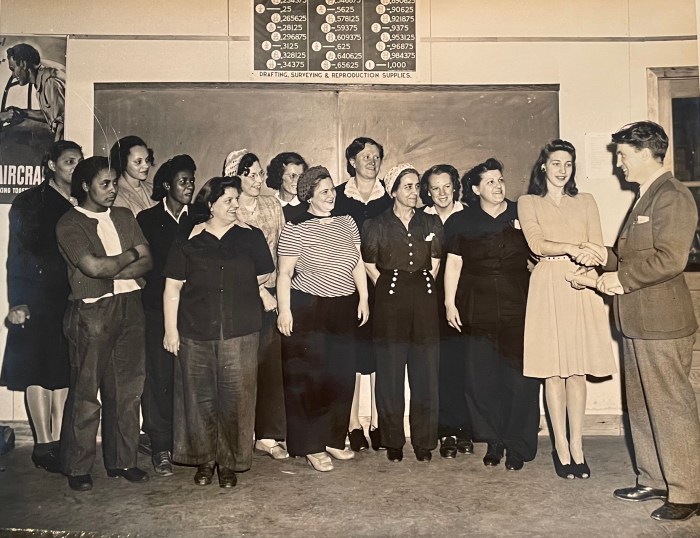
Training the Fisher Body/General Motors workers for war time.
Jennie Fiorito is in the front row, 2nd from the left.
Courtesy of the Tarrytown Historical Society
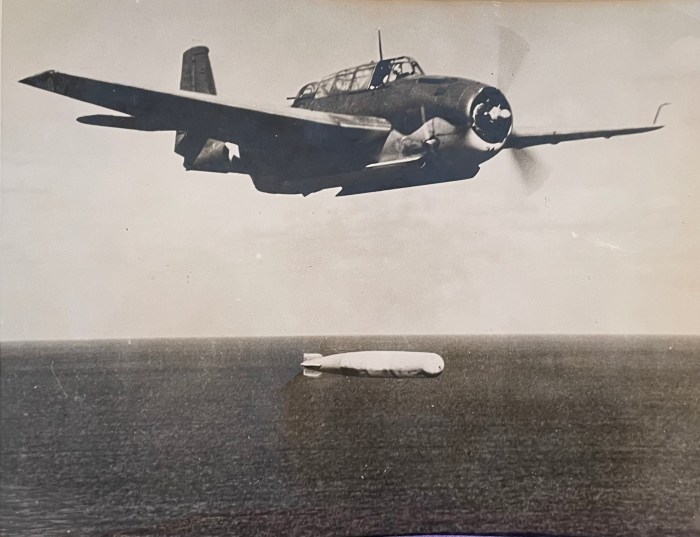
An Avenger Torpedo Bomber dropping a bomb
Over 75% of these aircraft were produced at the
Eastern Aircraft Division of General Motors, Tarrytown Plant
Courtesy of the Tarrytown Historical Society

By April 1944, nearly half of the workers at the north Tarrytown plant were women, a significant increase from pre-war conditions.  However, many would lose those jobs after the war ended and the men began returning home from the front.

After the war, Jennie would go on to work at Bell Telephone in Ossining, then transfer to NY Telephone in White Plains, where she would retire as a Supervisor after 30 years. 

FUN FACT:
“Rosie the Riveter”

Though we’re referring to Jennie and her partner Rosa as “Rosie the Riveters”, it’s a title that does not refer to one single person – there are many who are considered to be “Rosie.”

According to the Library of Congress, the first use of the term “Rosie the Riveter” came from a song of that title, written in 1942 by Redd Evans and Jacob Loeb and recorded by the Four Vagabonds. [Here’s a version recorded by Allen Miller and his Orchestra in 1943.]

The story goes that the songwriters were inspired by a 1942 newspaper article in which they read about Rosalind Palmer, a Connecticut society girl who took a job as a riveter at a Stratford, Connecticut factory that built Corsair fighter planes.

Then there’s that iconic “We Can Do It!” poster (above) – it is now believed that the model for the image was Naomi Parker, who worked in Alameda, California at the Naval Air Station and had been photographed at work on the assembly line.  However, for decades the model was believed to be Geraldine Hoff Doyle.   

Normal Rockwell’s Saturday Evening Post cover published on Memorial Day, May 29, 1943 was modeled on Mary Doyle Keefe, a 19-year-old phone operator from Arlington, Virginia.  This poster toured the country and encouraged people to buy war bonds.

But alliteration works, and Rose Bonavita is as good a Rosie the Riveter as any.  And so is her riveting partner Jennie Chicarelli Fiorito Windas.

Ensign Mary Feeney Gordenstein

Ensign Mary Feeney Gordenstein
Courtesy of the Ossining Historical Society and Museum

Ensign Mary Feeney Gordenstein
1916 – 1943
OHS 1933


U.S. Navy Nurse, Died in Action , World War II
 ***Local connection:  Hamilton Avenue
***

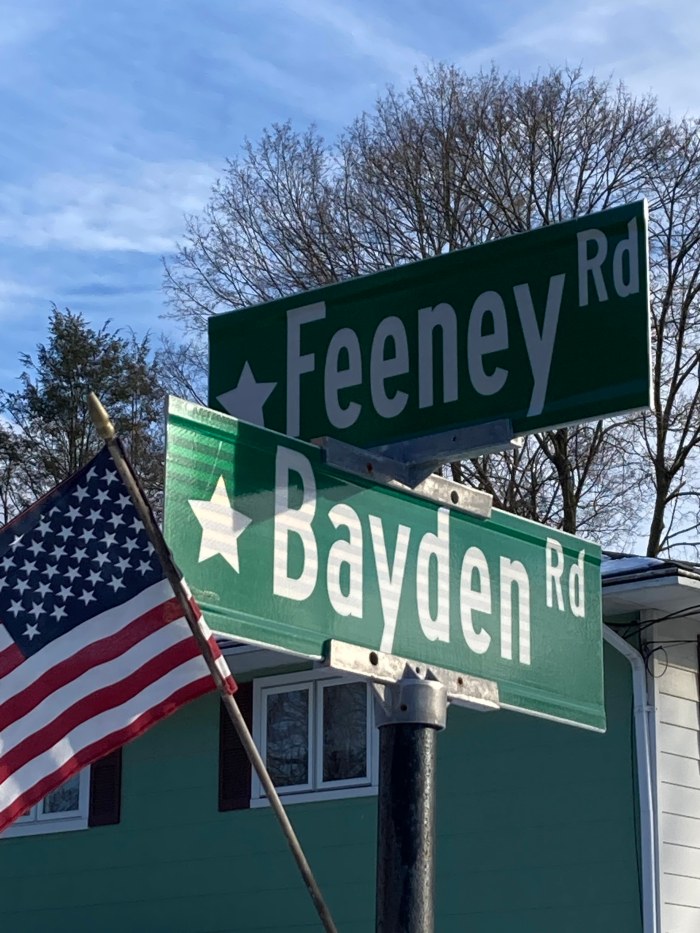
Did you know that Feeney Road in the Town of Ossining is named after Ensign Mary Feeney Gordenstein, a US Navy nurse who died in Pearl Harbor, Hawaii on April 14, 1943?

Mary Feeney was born in Ossining on September 11, 1916, to John and Ida Mae (Farren) Feeney.  Her father was a desk clerk for the Ossining Police.

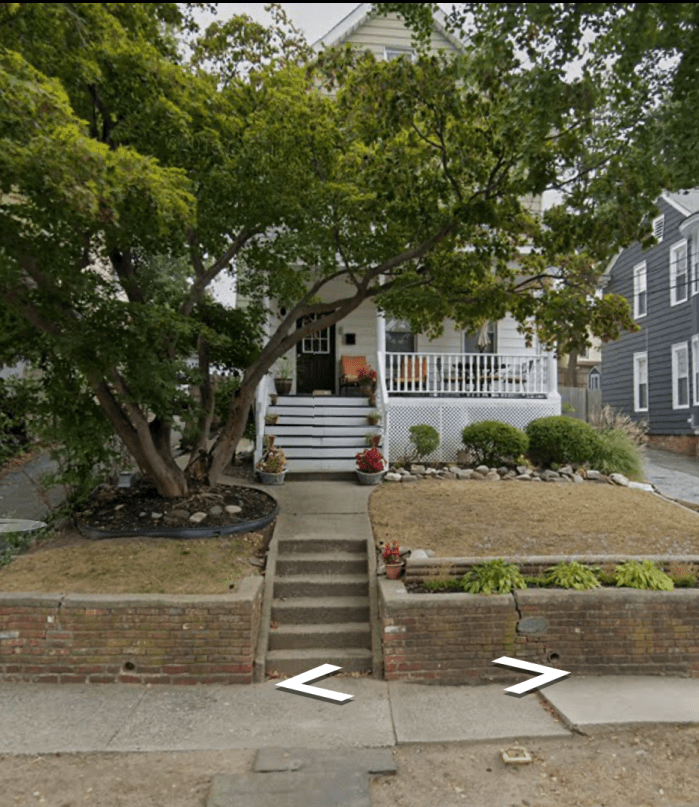
They first rented a house at 72 South Highland Avenue and then moved to 31 Hamilton Avenue.

Both houses still stand today:

72 Highland Avenue. Photo source: Google Streetview
31 Hamilton Avenue. Photo source: Google Streetview

Mary went to Ossining High School, graduating in 1933. She then went on to study at the Cochran School of Nursing at St. John’s Riverside Hospital, Yonkers, graduating in 1937.  

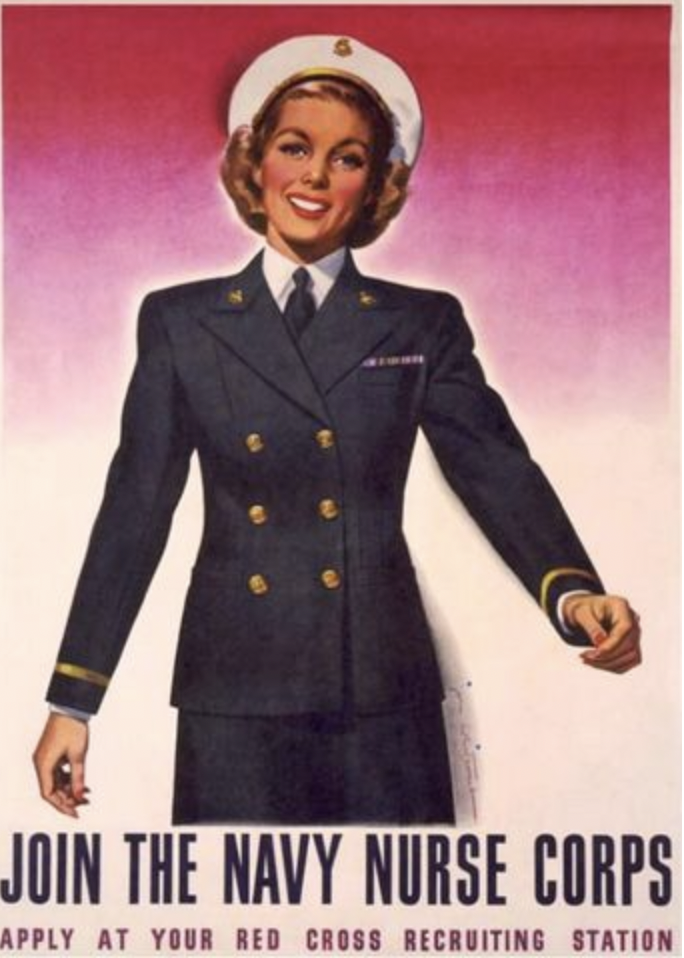
The census for 1940 has her working in “private practice.”  In August 1941, she entered the US Navy Nurse Corps as an Ensign and spent at least four months in training before being shipped out. (For more on the US Navy Nurse Corps see here and here.)

Navy Nurse Recruiting Poster.  
Courtesy of the National Archives

When Ensign Feeney joined up, there were only about 800 Navy nurses on active duty.  By the end of World War II, over 11,000 nurses, both active and reserve, were serving in the Navy.  

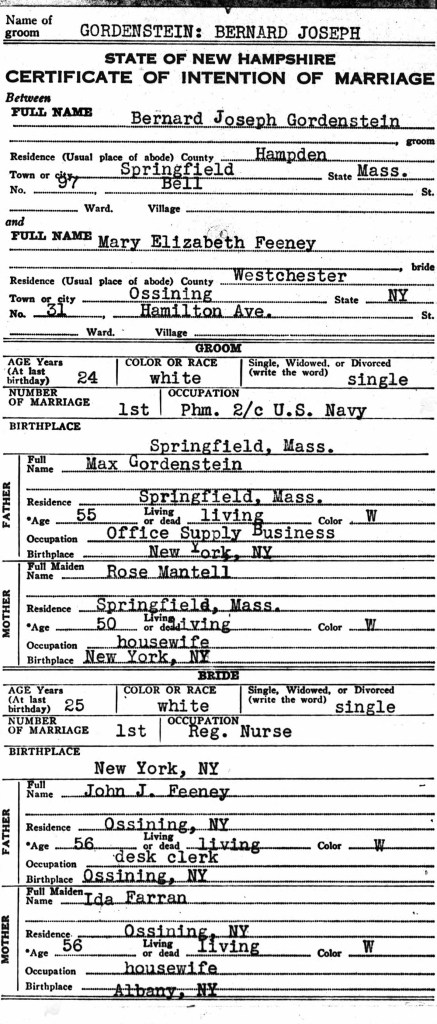
Ensign Feeney’s initial posting is still unclear, but in May of 1942 she married Bernard Joseph Gordenstein in Hillsborough, New Hampshire.  He was also in the Navy, serving as a pharmacist. (This bit of information came as something of a surprise to the members of the Feeney family consulted for this exhibit.  This might explain why the road is named Feeney and not Gordenstein.)

At some point, after the December 7, 1941 Pearl Harbor attacks, Ensign Mary Feeney was posted to Hawaii and served at the Pearl Harbor Naval Hospital.  This was where injured warriors, primarily those from the Pacific Theatre of Operations, were stabilized before they were sent back to the US.

Here’s a 1942 photo from the U.S. Navy Bureau of Medicine and Surgery — while I can’t prove it, I have a feeling that the third nurse from the left, in the back row, might be our Mary Feeney.

Administrative group including Navy nurses and Red Cross workers at the Pearl Harbor Naval Hospital, 1942.
Courtesy U.S. Navy Bureau of Medicine and Surgery

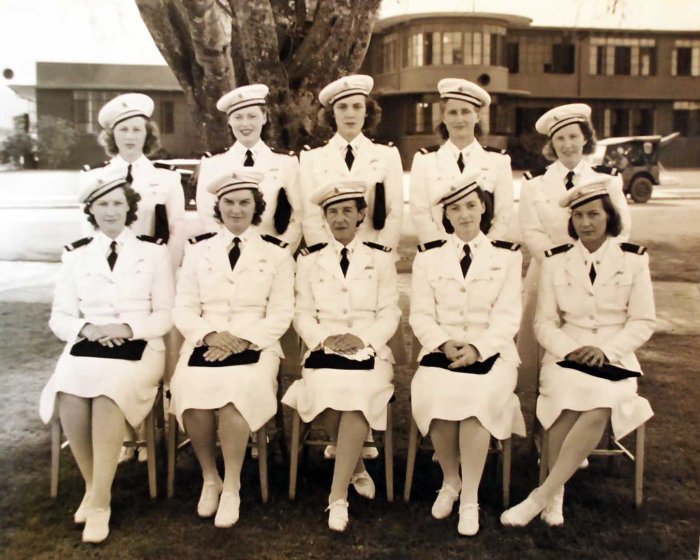
And in the photo below, the nurse seated in the front row all the way on the left actually does look very much like Ensign Feeney. (What do you think?) If it is, it would have been taken just four months before her death.

U.S. Navy Nurses pose for a group portrait at Pearl Harbor, Territory of Hawaii, December 16, 1942.  Photo source: National Museum of the U.S. Navy

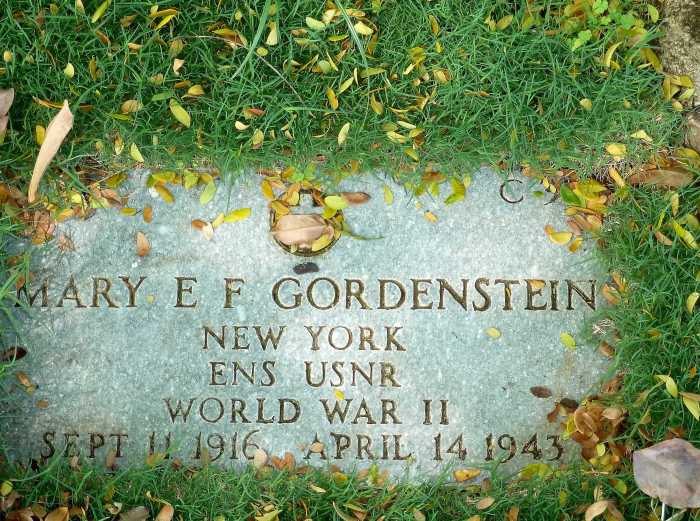
Sadly, Ensign Mary Feeney’s career in the US Navy was brief – she died of pneumonia on April 14, 1943 while stationed at the Pearl Harbor Naval Hospital.   

She was posthumously awarded the Bronze Star for “Heroic or Meritorious Achievement or Service.”

She is buried in the Punchbowl National Memorial Cemetery of the Pacific on Oahu.

And in 1963, the Town of Ossining would name a street in the newly completed Lakeville Estates subdivision after her.

Veterans’ Day 2024 — Honoring Ossining’s Veterans

I thought I’d compile the posts I’ve written over the years honoring Ossining’s War Veterans. Please note that this is an extremely small selection of the approximately 193 men and women who died in the service of our country, and doesn’t even touch on all those who have served. I also realize, in putting this together, I have so far only written about World War I and II.

But Ossining has had a part in nearly every US conflict, from the Revolutionary War, the War of 1812, the Mexican-American War, the Civil War, the Spanish-American War, WWI & II, the Korean War, the Vietnam War, the Beirut Police Action, the Gulf War, the Iraq War, the Afghanistan War and numerous other police actions and conflicts.

George de Barbiery WWI

Private Benjamin Feeney WWI

Private Elting Roosa WWI

Corporal Nathan Bayden WWII

Ensign Mary Feeney WWII

Private Homer Barnes WWII

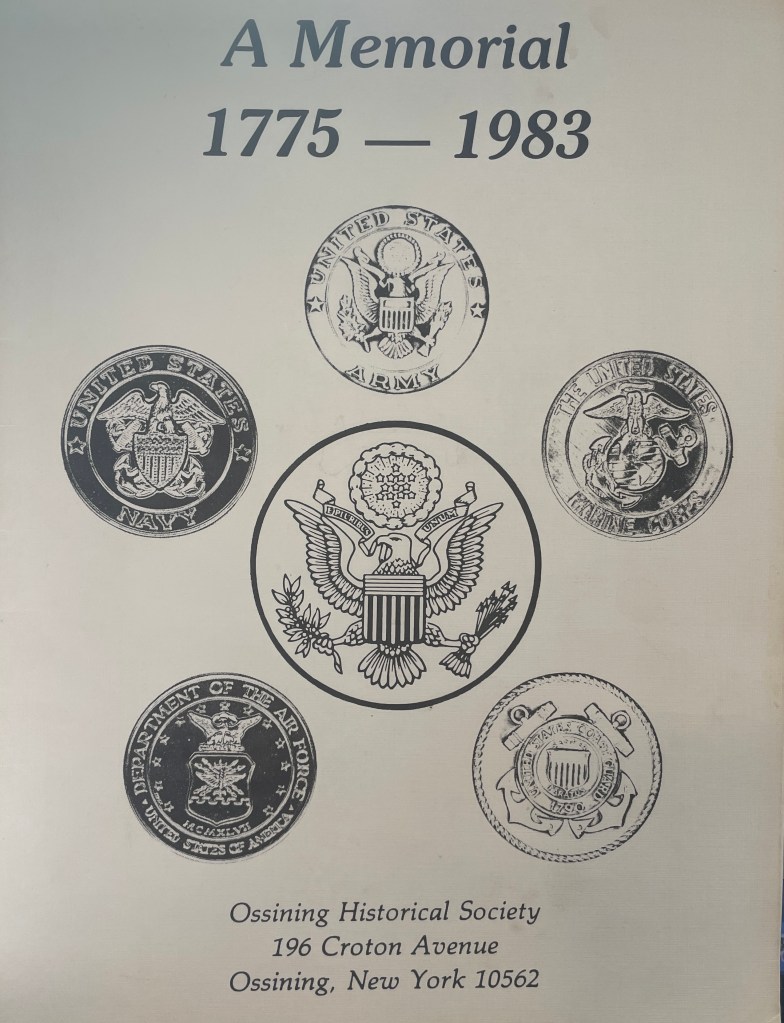
For a more complete list, please refer to this book, published in 1983 by the Ossining Historical Society. (Yes, it does need an update!) I believe a copy can be found in the Ossining Public Library for perusal. One can purchase this from the Ossining Historical Society which, as of this writing on 11/11/2024, is generally open the first Saturday of every month from 10am – 2pm.

We thank each and every person for their service to our country.

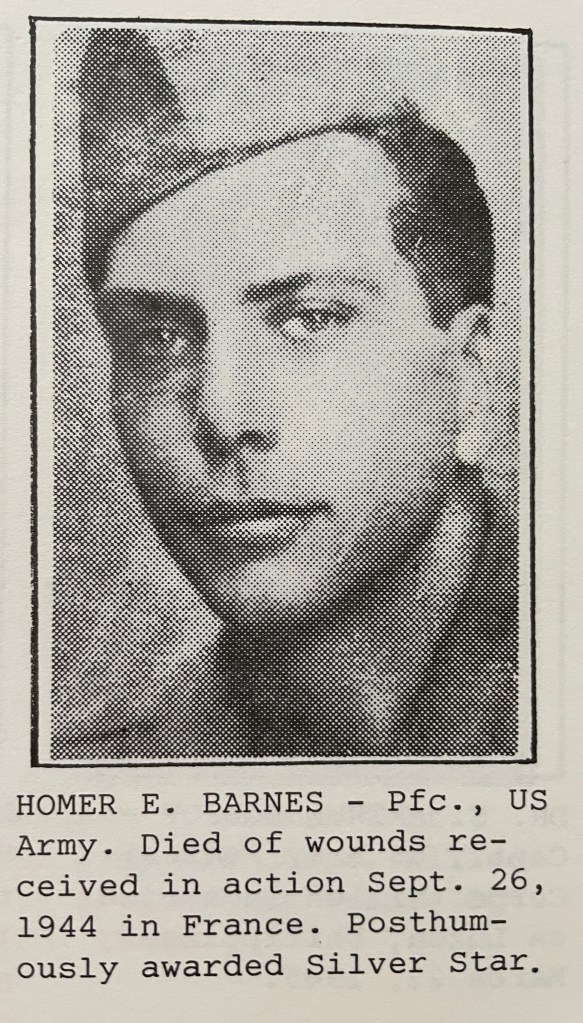
Ossining War Casualty — Homer Barnes

Ossining War Casualty — Homer Barnes
Courtesy of the Ossining Historical Society

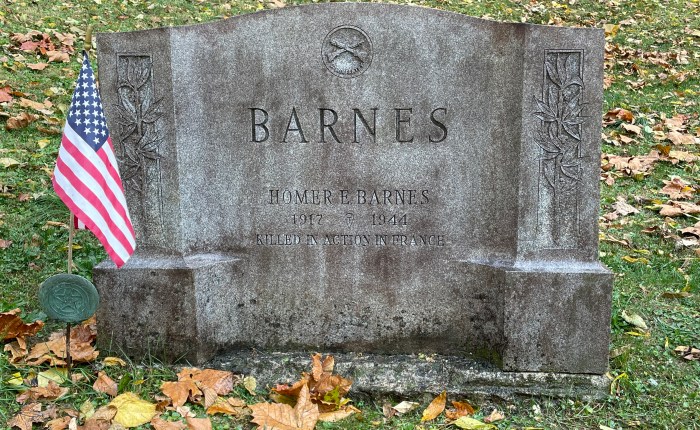
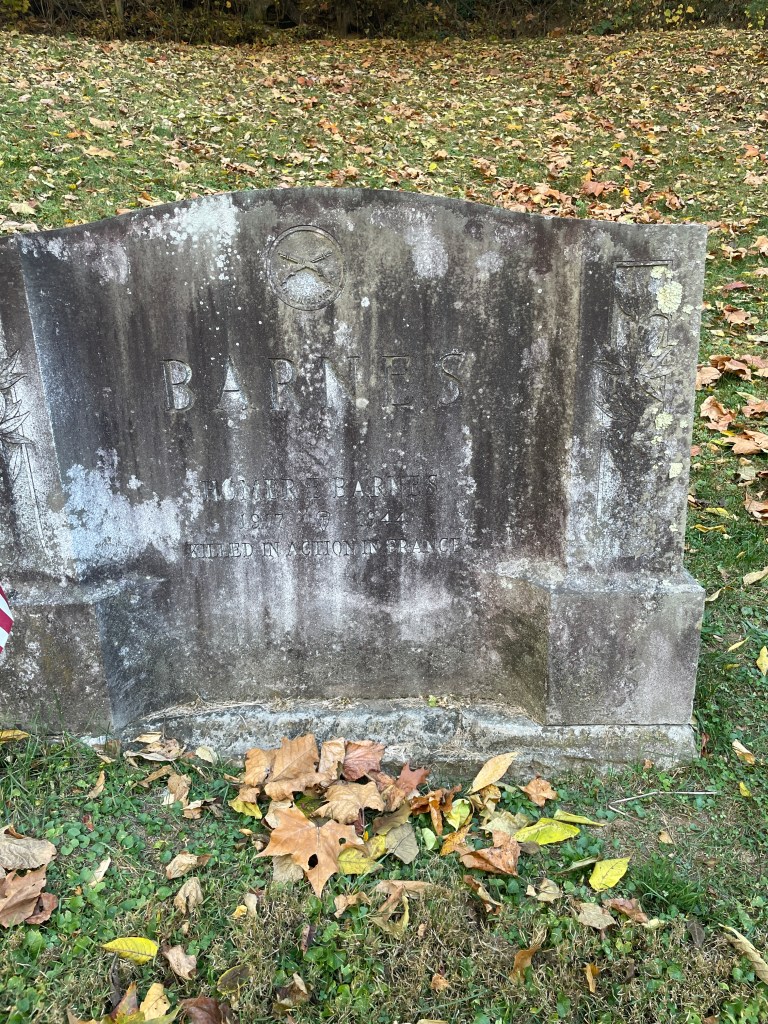
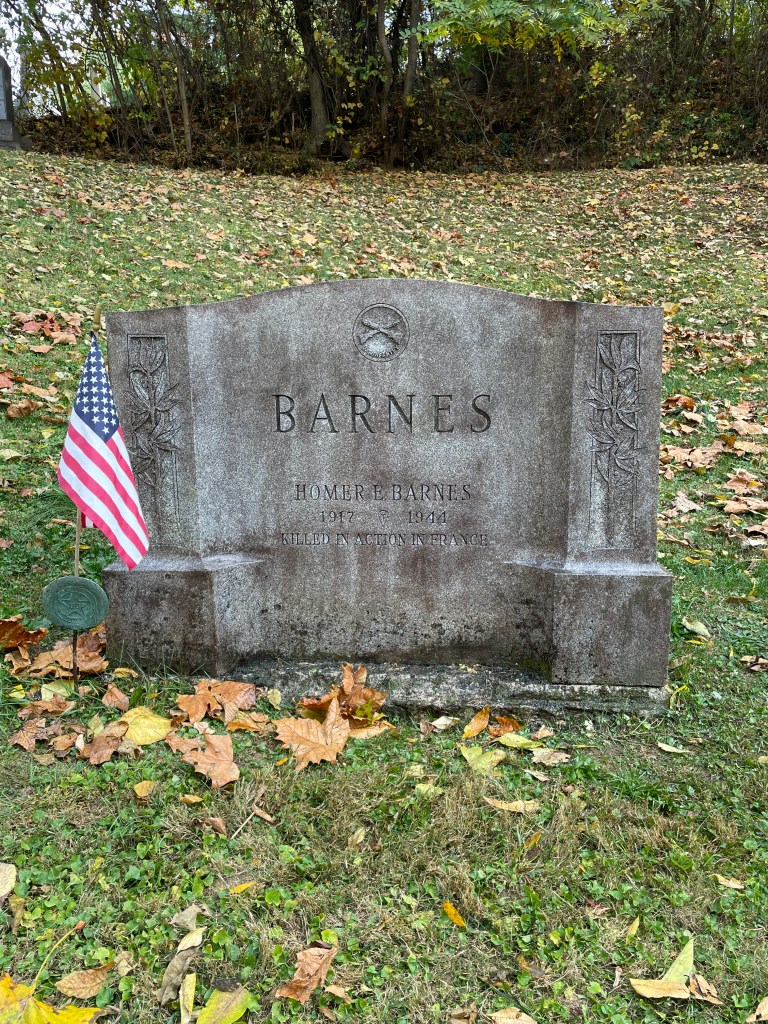
Thanks to the ongoing efforts of the Ossining Historic Cemeteries Conservancy, I recently had the privilege of cleaning this grave, that of Private Homer Barnes, who died in France on September 26, 1944:

I must confess that I chose this grave specifically because it had a Veteran’s flag stuck into the earth in front of it and because the date of death clearly indicated that he had died in WWII.  I felt that there was a story to uncover here, and I was not wrong.

Homer Barnes was born in Hamilton, Ontario in 1917 – at the time his father, Dr. Edmund Barnes, was serving as a Major in the Army Medical Corps stationed at Fort Dix during WWI.  Homer’s mother had gone home to live with her family while she awaited the birth of her son.

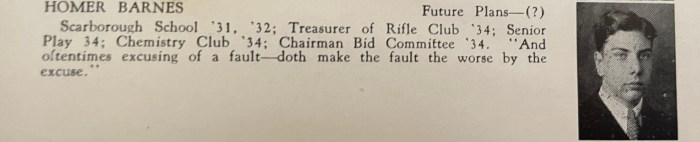
The Barnes family would move to Ossining after the War, and Homer would attend the Scarborough School and then graduate from OHS in 1934.  

Courtesy of the 1934 Ossining High School Yearbook

According to his October 23, 1944 obituary published in the Citizen Register, he then attended Pennington Seminary, New York University, and the New York Technical School.  The 1940 census has him working as a “chauffeur, self-employed.”

Homer Barnes registered for the draft on October 16, 1940, and was inducted into the service on December 16, 1942[1] at Camp Upton.

He would serve in the 36th Infantry Division, 143rd Infantry Regiment, Company A, 1st Battalion.  (I learned all this from the 36th Division Archive, which also notes that his address was 120 North Highland Avenue, Ossining.  Today this is the site of Mavis Discount Tire.)

Private First Class Barnes married Ruth Treanor on April 10, 1943 while he was on furlough from Camp Phillips, Kansas to attend his mother’s funeral in Ossining. Ruth would apparently accompany him back to Camp Phillips and stay there until he went overseas on November 1, 1943.  PFC Barnes would see some extraordinarily heavy action, first in Italy, then in France.

Now, I’ve never learned much about the Italian campaign of WWII.  Just quickly researching PFC Barnes’ Army service has already taught me more than I ever knew about this part of the war, thanks to the detailed after action reports kept (and digitized) by the 36th Infantry Division archive.  Here’s a link to the entire thing, if you’re interested.

I’m not yet exactly sure when PFC Barnes entered the field of battle, but the 143rd Infantry Regiment was engaged in some pretty hot fighting in Operation Avalanche, and the Battles of Monte Cassino, and San Pietro during the last few months of 1943.

By February 1944, PFC Barnes had been awarded a Purple Heart for wounds received while crossing the Rapido River near San Angelo, Italy that January.  The after-action report for the 36th Infantry offers some excruciating details about this Rapido River offensive:

Enemy artillery and mortar fire began falling as the first troops reached the river and when Company “A” [PFC Barnes’ company] sent the first wave across, it met with heavy machine gun fire. . . Reports from men who returned the next day indicate that the German machine gun positions were wired in and the bands of fire were interlocking.  Many men were wounded in the lower extremities or the buttocks by low grazing fire as they moved or crawled forward.” (52)

 PFC Barnes would have shrapnel lodge in his thigh and end up hospitalized for a month after this.

He returned to the front and continued advancing towards Rome with his regiment.  The after-action report almost waxes poetic here:

Never in the entire Italian campaign was there so brilliant a division operation as that employed by the 36th Infantry Division in flanking the enemy bastion at Velletri…. never before in history had the “Eternal City” been captured from the south and as was evidenced by the swiftness with which the enemy was forced to reel back, he was surprised and outwitted by this brilliant maneuver.” (77)

That said, there was deadly fighting throughout, with the German defense “skillfully located and carefully prepared, with first class infantry and strong supporting fire of artillery.” (77)

However, by June 5, 1944 (yes, the day before the Normandy Invasion D-Day!)

“The 143rd Infantry Regiment moved through the city in all available transportation, past the Colosseum, the Ancient Forum, Vatican City and splendid Saint Peter’s Cathedral, through the Arch of Triumph of the Caesars amid cheering throngs of Romans throwing garlands of flowers –  greeted as true liberators in a grandiose but sincere reception. No infantryman will forget this experience and he may well be proud to remember it.  Following this triumphal turn through Rome, all troops of the 143rd Regiment terminated their gruelling advance, and took a well-deserved rest, bivouacking on the outskirts of the city.” (78)

I sincerely hope that PFC Barnes got to experience this – it must have been rewarding and remarkable.  Because after a short break, his regiment would continue to pursue the Germans north.  As Captain Douglas Boyd, the Adjutant of the 143rd Infantry Regiment and author of this part of the after-action report writes: “There is no praise too great for the officers and men of the regiment who uncomplainingly, with true soldierly spirit and without regard to self, fought their way those 240 miles in hot pursuit of the enemy.” (90)

After this, PFC Barnes and the 143rd engaged in a Normandy-like invasion of  beachheads in Southern France, landing between Cannes (to the north) and Saint-Tropez to the south.  PFC Barnes would spend the last month of his life engaged in daily life and death battles, pushing up into the French Alps and encountering stiff resistance from German troops the whole way.  

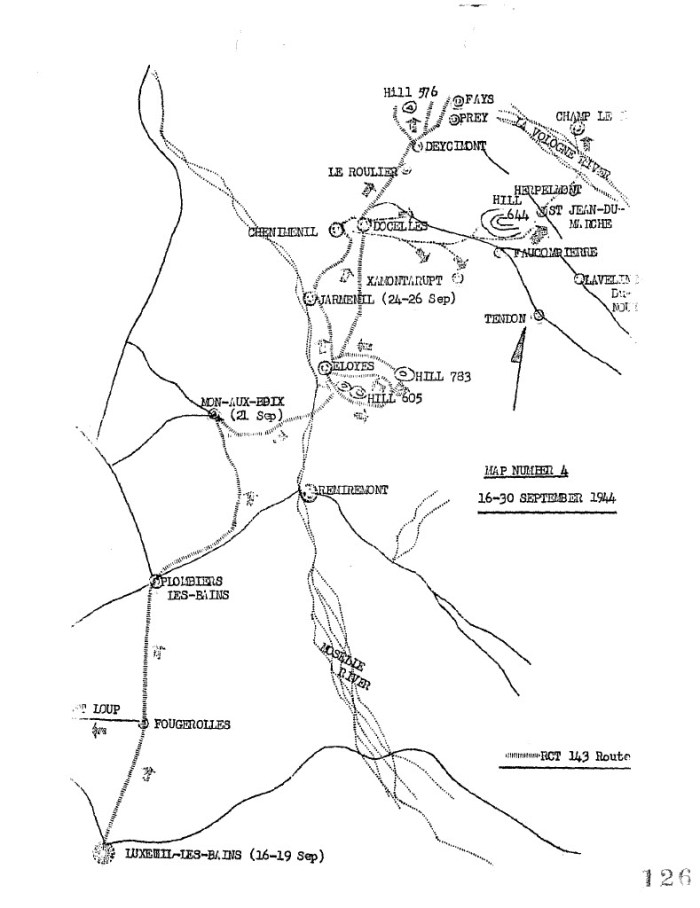
While I can’t be 100% certain, it seems that the last fight PFC Barnes engaged in took place around the Moselle River near a town called Remiremont.  

Courtesy of the 36th Division Archive, 143rd Infantry After-Action Reports

The after-action report describes the attack as follows:

“The 143rd began to cross the Moselle River in a column of battalions, the troops waiting and hand carrying their weapons . . . The 1st Battalion – [PFC Barnes’] moved towards its objective, Hill 605 southeast of Eloyes, while under enemy artillery, mortar and machine gun fire. The enemy, approximating battalion strength, engaged the first battalion units in a fierce fire fight. During the night of 21 September 1944, a company of Germans infiltrated Company A’s [PFC Barnes’] positions, and at the dawn of 22nd  September, bitter hand to hand fighting ranged until the Germans were cleared.” (133)

PFC Barnes died on 26 September 1944 from wounds received on 22 September, so I’m going to make the assumption that he was wounded in this “bitter hand to hand fighting.”

He would be posthumously awarded the Silver Star for gallantry and this decoration would be presented to his two-year-old son, William E. Barnes.


[1] October 23, 1944 obitiuary published in the Citizen Register