(Updated June 5, 2024)
I ran my first half-marathon eleven years ago, a race sponsored by the now-defunct MORE Magazine involving two soul-killing loops around Central Park. I ran it with my friend Lynette, and, as I recall, we did almost all of our training on a 4.5 mile loop around a section of the Croton reservoir off Route 129. We’d say “Hunterbrook tomorrow at 8am?” and would meet, rain or shine, in the tiny parking area at the top of Hunterbrook Road. We’d keep the reservoir on our left until we hit 129 again, then cross the bridge to complete the circle back to our cars. Fairly flat and generally shaded, it was a perfect introduction to training. When we needed to up our distance, we just did a second and (only once!) a third loop.
This, too, was the beginning of my habit of running by something unusual, wondering what it was in the moment, and then forgetting about it until the next time.
Here’s an inside view of that first unusual thing:
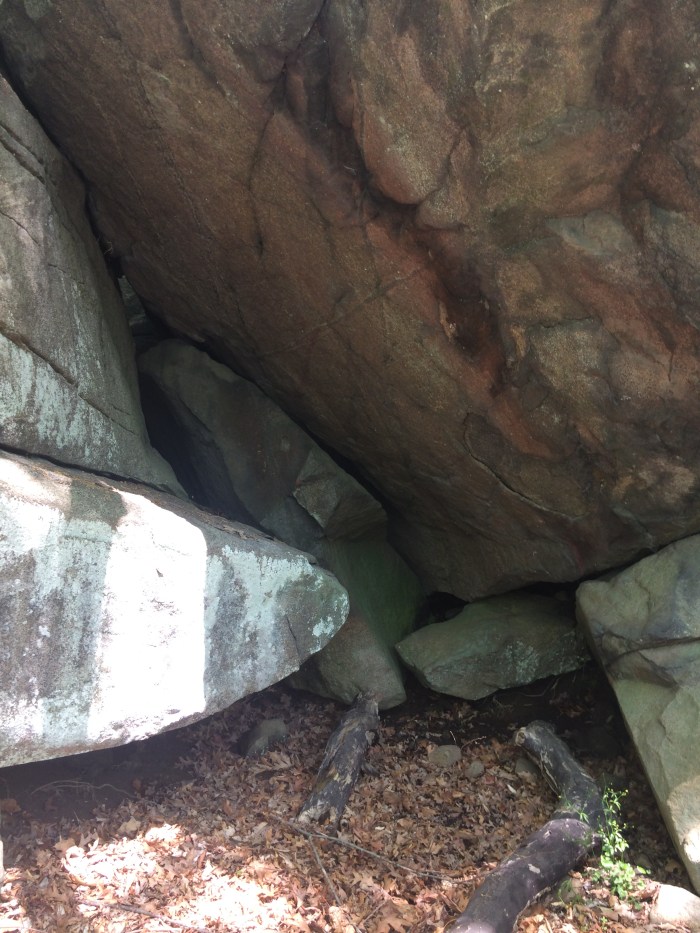
It always looked like the mouth of a cave to me, but of course I never stopped running to investigate it. (Find the exact location of this odd group of boulders here
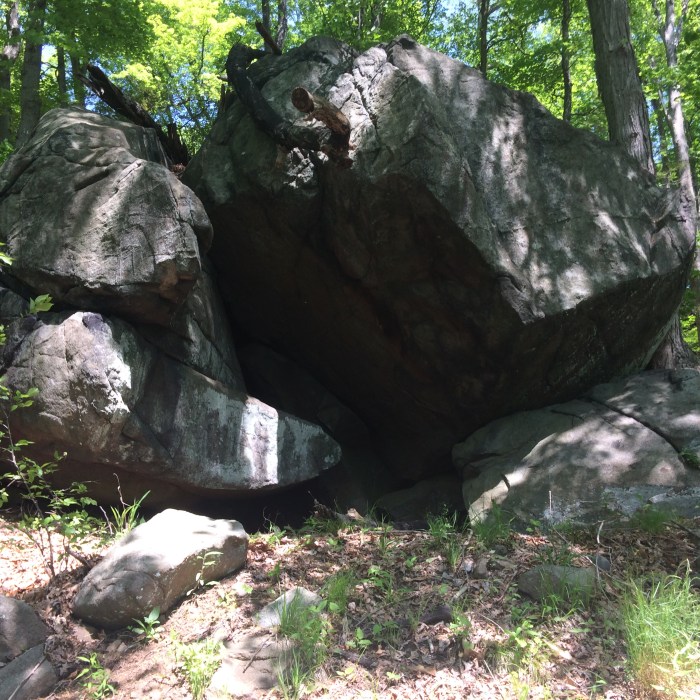
In the intervening years, I’ve mostly stopped running there. So it was only recently, just by chance, that the answer to this mystery found me, in the form of a flyer for a talk being given by the Yorktown Historical Society on the “Hunterbrook Rock Shelter.” The flyer featured a photo of those very boulders I’d wondered about years ago and I immediately, unaccountably, recognized them.
Described as “a prehistoric site in our backyard which illuminates the science of archaeology and the deep past in the Lower Hudson Valley. In 1976, Roberta Wingerson of MALFA (Museum and Laboratory For Archaeology) excavated a small cave of glacially tumbled boulders in Yorktown, not far from the Croton Dam. Her discoveries shed light on stone tool types as an indicator of culture and age, the local landscape of thousands years ago and the importance of small scale explorations by trained avocational archaeologists.”
A prehistoric site? In Westchester? The land of SUVs and Round-up and private SAT tutors? How very interesting.
(Yes, I was really that ignorant — I knew nothing of the 12,000 plus years of human habitation in the northeast. A product of American education, I’d never been taught or even asked to think about the history of the Wampanoag who “greeted” the Pilgrims in 1620 and “celebrated the first Thanksgiving” with them.)
Unfortunately, I couldn’t make it to the talk, but I rode my bike out there the very next day to finally investigate the boulders. I poked around inside, even though there’s really not much room inside there to poke. I took a stick and moved some leaves aside in front of the boulders hoping to find an arrowhead or something. I sat on one of the rocks and thought about eating a Paleo bar.
At home, I did some light Googling and almost immediately came upon Roberta Wingerson’s 1976 article on the dig. (Scroll ahead to page 19.)
And oh, I really hate to admit this, but the article bored me to tears.
Roberta Wingerson’s careful, methodical article keenly highlighted this blind spot of mine. She meticulously and thoroughly described the site (except that the map coordinates are wrong, so don’t try to use them!) and the precise method of excavation. She exhaustively discusses the stratigraphy and the soil zones and the “scattergram of artifacts.” She hypothesizes about the direction of the Ice Age-era glacier that left these boulders. She tells of the faint remains of campfires found about two feet down – “charcoal smears and lithic debris scattered onto the hard-packed surface into which were dug five hearths.”
Aha, people! I found myself trying to get excited about these hearths — “Feature No.1: a hearth, basin-shaped, 16 – 22 in. by 4 in. deep, almost completely ringed with stones, with burned earth on the bottom.” Well now, that is a little interesting. People made that hearth, then they burned wood in there. To cook. Or to keep themselves warm. I tried to imagine what the landscape might have looked like before the reservoir was constructed and the area in front of this cave was flooded. I tried to imagine what kinds of animals might be prowling in the woods. I wondered what these shadowy people cooked on these hearths, and what kind of implements did they use?
Ms. Wingerson includes several pages of photographs showing all the different types of arrowheads found in and around the shelter. Arrowheads that have been systematically identified, classified and named, indicating a sophisticated field of study I know nothing about. There’s a Madison-like point, a Lackawaxen expanded stem point, Beekman triangles, a dwindle-stemmed point – well, you get the idea. (See page 21 of her article if you’re really keen on arrowheads.)
The fact of the matter is that I simply don’t know enough about this time- that is, 12,000 BP – 1,000AD – to even begin to understand and think about it. In my limited study of this era, it seems that all we know about these Archaic peoples is gleaned from their leavings – fragments of pottery, or rocks chipped into points, or even the occasional human remains.
Wingerson’s article, though comprehensive, gives us no concrete information about the actual PEOPLE who left all those arrowheads and hearths. All she can do is theorize that they were nomadic, that they were likely “post-Paleo hunters following game herds migrating through the valley,” who grubbed for wild turnip and dandelions, maybe ate some oysters and mussels while sheltering under the boulders, and moved on.
However, they remain just shadows – the only tangible evidence we have of them is what they left behind. There’s just nothing there there. These spectral nomadic peoples – what did they look like? What did they wear? How did they eat their nuts and berries and oysters? Did they just huddle miserably around their smoky fires, hungry and cold, dying young of starvation or untreatable diseases, or were they a cohesive, proud, strong people who told intricate stories and sang songs? How were they related to the Lenape and the Wappingers and the Algonquins who greeted Henry Hudson in 1609? So many, too many, unknowns about these ciphers who wandered through today’s towns and villages and camped and hunted on what are now backyards and parks and highways and malls.
This site was, shockingly, my first encounter with First People. Since then, I’ve falled down many an Internet hole and learned about other pre-historic digs that took place in the area. Digs that show fairly conclusively that our very own section of Westchester has been inhabited for at least the last 10,000 years. (Check out this link that mentions the Piping Rock dig from the 1970s – it’s now the site of Eagle Bay condominiums in Ossining!)
Here’s a blog post I wrote about an intact Ossining Rock Shelter.
Here’s another post about a possible oyster shell midden in the Sing Sing Kill.
And here’s one more about Teatown that goes all the way back to before ANY people were here.
We “modern” humans have done so much to shape and craft this world in which we live. Coming up against actual evidence of ancient peoples who lived before me, perhaps literally right where I live, really changed my perspective. Sometimes, I’ll squint my eyes to try and imagine what all this looked like before the houses and the roads and the electric lines and reservoirs. I try to hear the birds chirping and the leaves rustling without that constant background hum of airplanes and lawn mowers and cars. I think about living with so few things that I could strap them on my back and walk for miles. Eating only the food I could find or catch. Looking to streams and lakes and rivers for my drinking water. Being grateful to find shelter under rocks and ledges,
Several years ago, I met a Dakota Santee Sioux artist who told me that he got antsy when he spent too much time indoors. The straight lines and flat, hard surfaces gave him a headache, he said. “In nature, you see, there are no straight lines.”
Go outside and look around — he’s right. Nothing is exactly straight or plumb. But I know that I feel more comfortable within the lines, both physically and historically. I want facts and documents and pictures to clarify and outline the past. I want to know that this happened then and it happened exactly here and this person was involved.
But really, there are no straight lines in history except for the ones we put there.
 Ossining History on the Run
You are an idiot for real
What a fucking condescending dumbass, please stay away from my ancestors artifacts with that atittude about archaeology
LikeLike
Hey, thanks for taking the time to read the blog post and respond. Honestly, this was one of my first posts and I was at the very beginning of my journey to understand the long, complex and entrenched history of first peoples here in Westchester. And yes, I was pretty much of an idiot when I wrote this. Re-reading it, I can see how very condescending and dismissive it sounds, but I was actually trying to highlight MY ignorance, not minimize the history of your ancestors. Would be interested in continuing the conversation offline and learning more, if you’d be interested.
LikeLike