
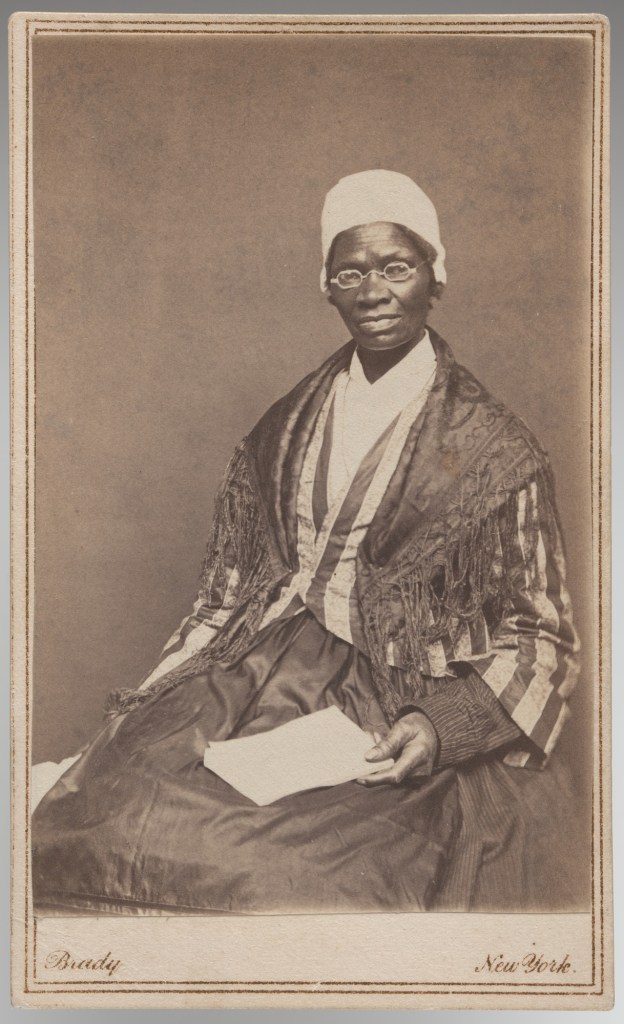
Photographer: Mathew Brady
Credit: National Portrait Gallery, Smithsonian Institution
Sojourner Truth
(aka Isabella Baumfree Van Wagenen)
c.1797 – 1883
Abolitionist
Activist
Speaker
***Local Connection: Zion Hill, Sparta***
(today the site of the Beechwood Condominium Complex off Route 9)
Sojourner Truth was born Isabella Baumfree in about 1797, to James and Elizabeth Baumfree. One of about ten children, the family was enslaved by a Col. Hardenburgh who owned a large farm in Ulster County, New York.
First, we’re able to know so much about her because in 1850 she dictated her memoirs to friend Olive Gilbert and they were published. This Book of Life would be added to and republished in 1878:
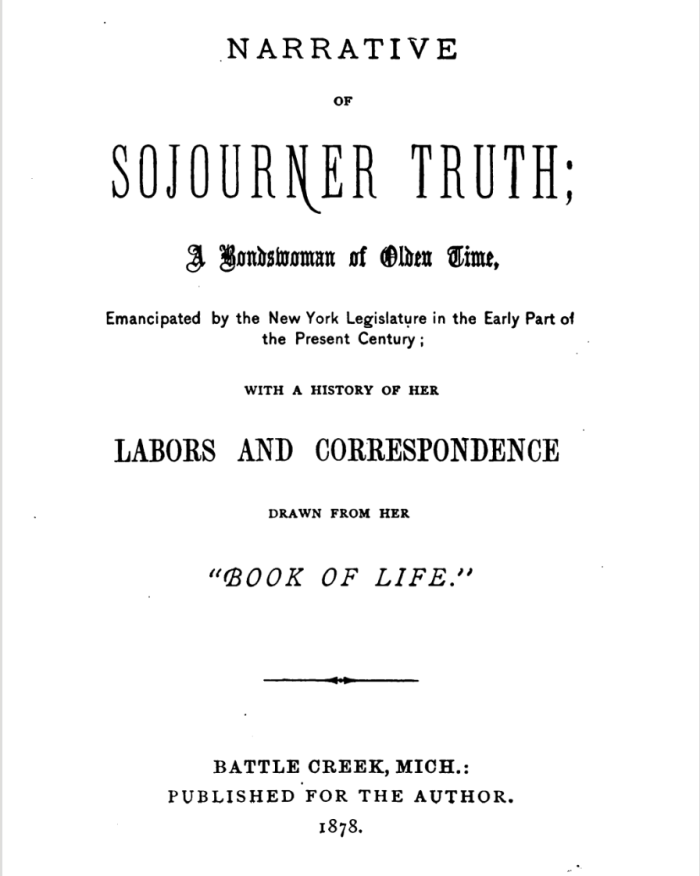
You can read it in its entirety here if you’re interested.
At the age of 9 (or so), Isabella was sold away from her family “for the sum of one hundred dollars, to one John Nealy, of Ulster County, New York; and she has an impression that in this sale she was connected with a lot of sheep.”
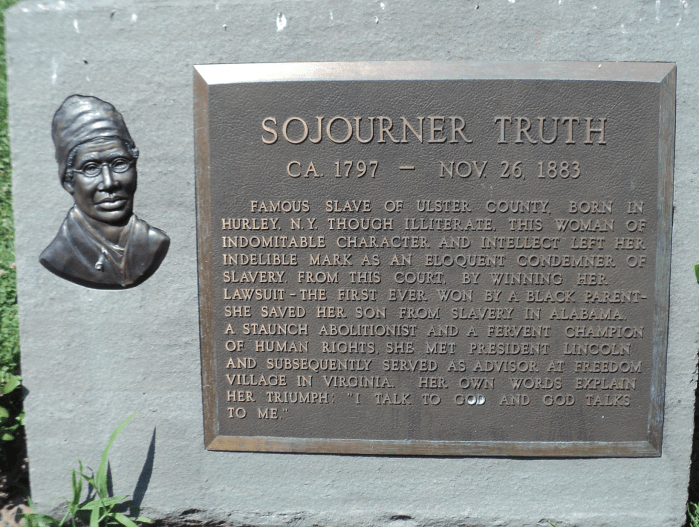
Her first language was Dutch, and she was said to speak with a Dutch accent when speaking English (which then brings into question the stylized “dees, dems and doze” accent she is often quoted as having in her famous “Ain’t I a Woman” speech. But more on that anon.)
Because at this point (she was NINE!) Isabella could only speak Dutch and the Nealys could only speak English, she was frequently whipped for her misunderstanding and confusion. Within a few years, she was again sold, this time to a tavern owner named Martinus Schryver who lived nearby in Port Ewen. She would later describe this as “a wild, out-of-door kind of life. She was expected to carry fish, to hoe corn, to bring roots and herbs from the wood for beers, go to the Strand for a gallon of molasses or liquor as the case might require . . . morally, she retrograded, as their example taught her to curse; and it was here that she took her first oath.”[3]
Within two years, Schryver sold her to a John Dumont in New Paltz, New York.
So, before she was 15, she had been taken from her family and sold as chattel to three other men.
Around the age of 18, she was “married to a fellow-slave, named Thomas, who had previously had two wives, one of whom, if not both, had been torn from him and sold far away.”[4] She would have about five children with Thomas.
Now, beginning in 1799, New York State began slowly abolishing slavery – so slowly, that it would take until 1827 for it to be completely outlawed. As described in her Narrative:
“After emancipation had been decreed by the State, some years before the time fixed for its consummation, Isabella’s master told her if she would do well, and be faithful, he would give her ‘ free papers,’ one year before she was legally free by statute. In the year 1826, she had a badly diseased hand, which greatly diminished her usefulness; but on the arrival of July 4, 1827, the time specified for her receiving her free papers, she claimed the fulfilment of her master’s promise; but he refused granting it, on account (as he alleged) of the loss he had sustained by her hand.”[5]
Furious, Isabella would sit down and spin about 100 pounds of wool before taking her infant daughter and walking away from the Dumonts early one morning (walked away, not run away. The distinction was important to Isabella.) She would eventually find herself in the home of the Van Wageners, an abolitionist, Quaker couple. When John Dumont tracked her to the Van Wageners, they offered $25 for Isabella and her infant. Dumont acquiesced, and Isabella lived with the Van Wageners (and took their name) until she was legally freed by the State of New York a year later.
Once free, Isabella Van Wagener wanted to find her young son, Peter who, at the age of five, had been sold away from Isabella by John Dumont. Now, human enslavement in New York State operated in a bit of a gray area. Post-1799, several laws were passed that would free all enslaved minors once they reached the age of 21, and specifically outlawed selling enslaved minors out of state. However, these laws were enforced only occasionally. But Isabella Baumfree was not to be trifled with and she marched down to the courthouse to file a lawsuit. Long story short, she got her son back from Alabama where he’d been sold – a remarkable feat for a woman of that era.
Courtesy of the New York State Archives
It’s at this point in her life that Isabella Baumfree Van Wagener’s Ossining connection arises. It’s a very complicated story and even the Narrative doesn’t get into the particulars, but let’s just say that in 1833 she was hired to be a housekeeper for what can really be only called a cult, led by one Prophet Matthias. They all ended up in a house in Sing Sing/Scarborough called Zion Hill (still standing today as part of the Beechwood condominium complex,) living with Benjamin and Ann Folger.
We can be quite certain that she really did live here, because Benjamin Folger implicated her in the murder of one Elijah Pierson, a follower of Matthias and resident of Zion Hill, who mysteriously died after eating blackberries. But though accused of murder, Isabella went to court, sued Benjamin Folger for libel and, amazingly, won. See (former Ossining Village Historian) Miguel Hernandez’s article here for a deeper dive.
Isabella would continue working as a servant for about ten more years, before she heard the Lord call on her to preach. She changed her name to Sojourner Truth on Pentecost Sunday, 1843 and began preaching against slavery. By all accounts she was a very charismatic speaker and an inspiring singer. She would go on to dictate her memoirs, and with the proceeds, buy a house in Massachusetts.
In 1851, Sojourner Truth gave her famous “Ain’t I a Woman” speech at the Ohio Women’s Rights Convention.
Today it’s believed that this is probably not at all an accurate representation of the speech Truth gave. A transcription was published at the time and is very unlike the version that has become associated with Truth. In fact, it wasn’t until 1863, at the height of the Civil War, that the version linked to above became the accepted version. (For more on this, check out the Sojourner Truth Project here.) But let’s just say the popular speech sounds pretty racially stereotyped linguistically and not at all like it came from someone who spoke with a Dutch accent.
Regardless, I think we can agree that Truth’s speech enlightened many who heard it, as did her life story.
Truth was a savvy marketer. She would sell Cartes de Visites (postcards) like the one below to support herself and fund her lecture tours. Often carrying the caption “I sell the shadow to support the substance,” these cards symbolized Truth’s struggle between self-promotion and her desire to be seen as a sophisticated and respectable free woman. Distributed at anti-slavery conventions and through mail orders, these postcards became wildly popular, enabling Truth to fully pay off her first home within three years and then purchase a second home.
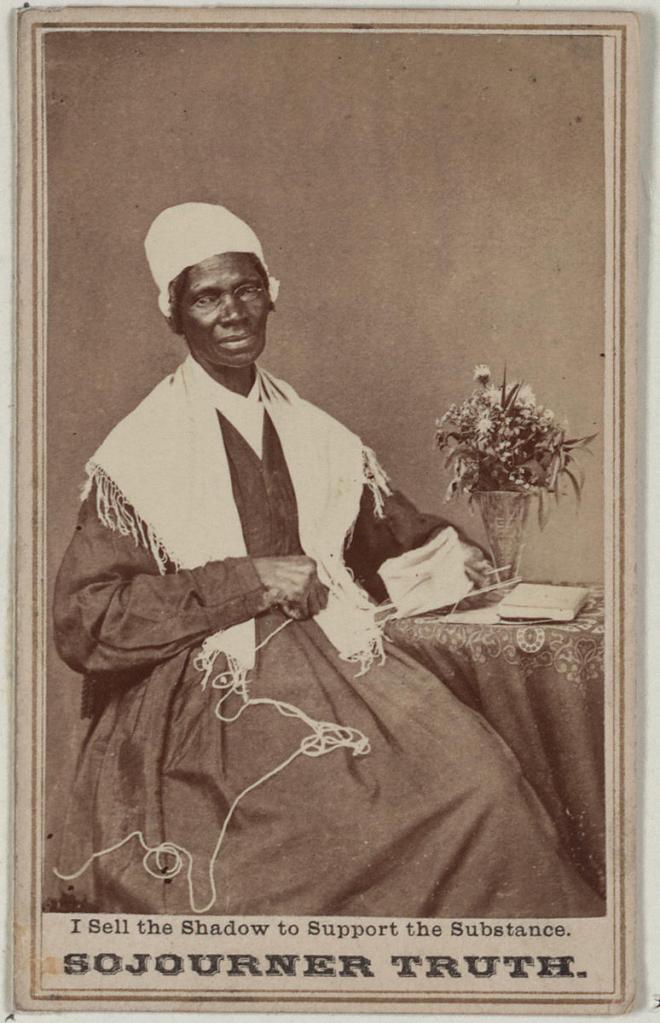
Courtesy of the Library of Congress
Truth would move to Michigan, join a Seventh Day Adventist sect there, all the while preaching about equality.
She would die in Battle Creek, MI in 1883, in the home she owned, bought with money she had earned from her writing and speeches, surrounded by her children.
A remarkable woman and a remarkable life.
[1] https://web.archive.org/web/20160331114300/http://www.thenation.com/article/hidden-history-slavery-new-york/
[2] P. 36, https://babel.hathitrust.org/cgi/pt?id=mdp.39015071140167&view=1up&seq=36
[3] P, 29, https://babel.hathitrust.org/cgi/pt?id=mdp.39015071140167&view=1up&seq=39
[4] P. 46, https://babel.hathitrust.org/cgi/pt?id=mdp.39015071140167&view=1up&seq=46
[5] P. 49, https://babel.hathitrust.org/cgi/pt?id=mdp.39015071140167&view=1up&seq=49
 Ossining History on the Run
I live this. Can I share on FB?
LikeLike
Sure, thanks!
LikeLike
yes!
LikeLike
Actually the story of Mad Mathias, Sojourner Truth and the (sex) cult of Mount Zion that went on at Beechwood Manor is considerably more twisted than that. Folger’s original house where it all happened is still there – it’s the core of the 27,000sf mansion that is now divided into 3 condos. Isabella Van Wagenen’s case is well documented in the White Plains court records The original story Miguel referenced from is here: http://www.murderbygaslight.com/2010/07/prophet-matthias.html
If you really want to get into the whole story and its sordid details, this book gets into all of it, including particulars from Isabella’s case. https://www.amazon.com/Kingdom-Matthias-Salvation-19th-Century-America/dp/0199892490/ref=sr_1_1?hvadid=409970908271&hvdev=c&hvlocphy=9004223&hvnetw=g&hvqmt=e&hvrand=2075537857334008309&hvtargid=kwd-596490935&hydadcr=22538_11318434&keywords=kingdom+of+matthias&qid=1679514170&sr=8-1
LikeLike